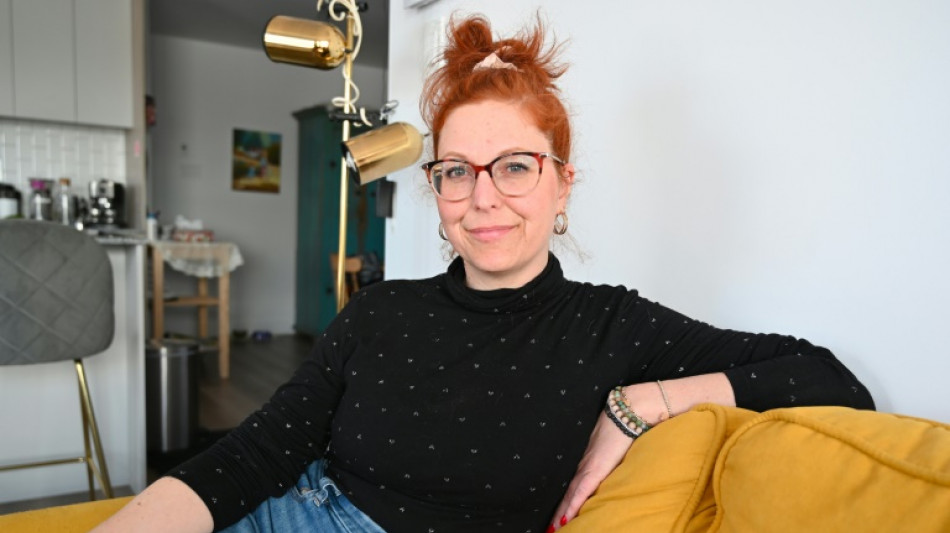
Alzheimer's patient 'relieved' at Quebec's assisted suicide policy shift / Photo: © AFP

 Saudi employee arrested for allegedly bugging OpenAI office

 Atletico sink Man Utd as Viking deny Bayern in Champions League

 Man United's Martinez blasts board's lack of investment

 Meet A7 International, an Innovative Global Platform Designed to Reinvent the International Payments Market

 Shakhtar hope London move a reminder of Ukraine conflict

 Tresoldi hat-trick fires Brugge past Inter Milan

 Rams axe kicker Mevis after misses cost victory over Bills: reports

 Yamal stays cool at boiling Galatasaray to lift Barcelona to victory

 Arsenal cruise past Lille into share of Champions League lead

 Trump ousts Greece ambassador over ethics scandal

 Reese Witherspoon, France's Mediawan to buy Hello Sunshine

 Bipartisan US senators urge Trump to scrap Russian diesel deal

 Ex-gang leader sentenced to minimum 40 years for Tupac murder

 Cornell suspends frat parties after alleged gang rape

 Man City deserve to keep titles, says PSG's Luis Enrique

 Regulator 'will resign' if any political interference in Man City case

 Microsoft's Brad Smith calls for 'real and effective' AI safety standards

 Anthropic warns of AI 'worms' spreading across smart gadgets

 Big US banks report strong earnings and stay bullish on AI

 Iraola backs Barcola, Wirtz to come good for Liverpool

 In a first, AI helps UK lawmaker find her voice in parliament

 Pope Leo in Rome hospital for lung operation

 EU watchdog says smart glasses must give 'clear warnings' when recording

 Houthis say Saudi Arabia strikes oil site in Yemen's capital

 France roiled by marches in support of protesting students

Sandra Demontigny was afraid of being a prisoner in her own body: a 45-year-old diagnosed with early-onset Alzheimer's, she worried about losing control of her life and burdening those she loves for years.
But the Quebec resident said she is now "relieved" after the Canadian province approved advanced requests for medical assistance in dying (MAID), its voluntary euthanasia program.
As of Wednesday, Quebec has expanded access to euthanasia for people with neurodegenerative diseases. They will now be able to fill out a form -- like a will -- in anticipation of the time when they can no longer consent to care.
"I feel like I finally have control over what's left of my life," said Demontigny, a mother and midwife who lives in Quebec City.
MAID has been offered to the terminally ill in Quebec since 2015, and is widely accepted in the French-speaking province. By authorizing advance requests, Quebec joins a handful of countries where this is also legal -- the Netherlands, Belgium, Luxembourg and Colombia.
"My condition is degenerating," Demontigny said.
"I would have been a prisoner of my body for years," added Demontigny, who remains shaken by her father's experience with Alzheimer's, an incurable disease.
Before dying at age 53, he "talked to himself in the mirror" thinking it was someone else, she said. He also walked "on all fours, banging his head on the wall," before falling to the floor in tears from exhaustion.
For her, it was inconceivable that she would experience such "atrocities" and make her loved ones suffer them. She has been campaigning for years for advance requests to be allowed.
- 'Very strict' criteria -
Polls have steadily shown support for MAID above 80 percent, but individual cases have attracted international headlines about whether the program is too permissive.
Particular scrutiny has focused on whether assisted suicide should be available to people solely suffering from mental illness, or those citing disability as a primary justification to end their life.
Before Wednesday's eligibility expansion, Quebec already had the highest proportion of deaths attributable to medically assisted suicide in the world: it was administered to 5,686 people in 2023, representing 7.3 percent of deaths in the province.
The majority were 70 years of age or older, had cancer, and a survival prognosis of one year or less.
Marie-Eve Bouthillier, medical professor at the Universite de Montreal, said criteria for advanced bookings are "very strict."
Two specialized doctors or nurse practitioners will have to, as prescribed by law, assess whether the patient is experiencing "persistent, unbearable physical or psychological suffering" that cannot be relieved -- which does not systematically happen in people with dementia, for example.
The patient will also have to clearly explain what clinical circumstances he or she considers intolerable -- for example, no longer recognizing their children, or incontinence -- to set a bar for when they should be provided an assisted death.
Federal Health Minister Mark Holland noted Monday that "it is still illegal in this country under the Criminal Code to enact advance requests" for MAID.
But, he added, "it is the responsibility of the provinces to pursue violations of the Criminal Code," and Ottawa will not challenge Quebec's new rules.
- An 'execution'? -
Criminality aside, doctors have voiced concern.
At the final stage, "what will be the most difficult will be to administer medical assistance in dying to someone who is not aware of it and who will not remember having asked for it," explained David Lussier, a member of the Commission on End-of-Life Care of Quebec.
If the patient makes a "gesture of refusal," the doctor must cancel the procedure. But if a patient "resists, and it is part of their illness, we can still give it" -- which could raise ethical questions for professionals, he added.
Claude Rivard, a doctor who has administered euthanasia hundreds of times over the past decade, fears that it will be necessary to use restraint measures to install intravenous lines.
"In the family's mind, it could appear as an execution," said Rivard, who has decided not to get involved in advance requests.
Laurent Boisvert, another doctor who has administered assisted deaths since 2015, downplayed these as "theoretical" fears and said he saw no issues with Quebec's new policy.
"The person who is in his right mind, who communicates with his loved ones and society, will be gone," he explained.
"If we take the human being as a whole, it is not the same person and I will respond to the wishes of the person who was fit, who had a life that he considers to be dignified and decent, and who is no longer here."
S.Keller--BTB