Shells to surfboards: how wildlife has adapted to plastic / Photo: © AFP/File

 Saudi employee arrested for allegedly bugging OpenAI office

 Atletico sink Man Utd as Viking deny Bayern in Champions League
 Man United's Martinez blasts board's lack of investment

 Meet A7 International, an Innovative Global Platform Designed to Reinvent the International Payments Market

 Shakhtar hope London move a reminder of Ukraine conflict

 Tresoldi hat-trick fires Brugge past Inter Milan

 Rams axe kicker Mevis after misses cost victory over Bills: reports

 Yamal stays cool at boiling Galatasaray to lift Barcelona to victory

 Arsenal cruise past Lille into share of Champions League lead

 Trump ousts Greece ambassador over ethics scandal

 Reese Witherspoon, France's Mediawan to buy Hello Sunshine
 Bipartisan US senators urge Trump to scrap Russian diesel deal

 Ex-gang leader sentenced to minimum 40 years for Tupac murder

 Cornell suspends frat parties after alleged gang rape

 Man City deserve to keep titles, says PSG's Luis Enrique

 Regulator 'will resign' if any political interference in Man City case

 Microsoft's Brad Smith calls for 'real and effective' AI safety standards

 Anthropic warns of AI 'worms' spreading across smart gadgets

 Big US banks report strong earnings and stay bullish on AI

 Iraola backs Barcola, Wirtz to come good for Liverpool
 In a first, AI helps UK lawmaker find her voice in parliament
 Pope Leo in Rome hospital for lung operation

 EU watchdog says smart glasses must give 'clear warnings' when recording
 Houthis say Saudi Arabia strikes oil site in Yemen's capital

 France roiled by marches in support of protesting students

A hermit crab trundles across a beach in Japan's Okinawa, carrying its home on its back: not a shell, but a disintegrating plastic yellow measuring spoon.
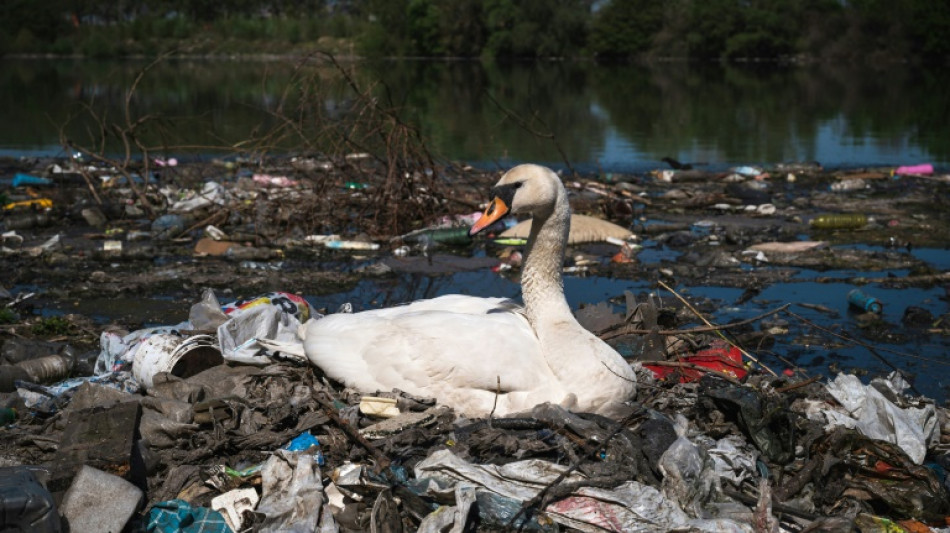
The crab is far from alone. Plastic waste has become so pervasive in the natural environment that it is fundamentally changing the ways animals live and travel, according to scientists.
Here are some examples of that adaptation:
- Plastic habitats -
Around 435 million tonnes of plastic waste is produced globally each year, with about 22 million tonnes discarded in the environment, according to the Organisation for Economic Cooperation and Development.
Birds, bees, crabs and other marine life now regularly incorporate that refuse into their homes.
A study this year analysed images uploaded to amateur naturalist sites and found hermit crabs worldwide are using artificial items for shells.
Plastic was the most common choice, though photographer Shawn Miller has seen the animals take up residence in glass bottle necks, detergent tops and even the ends of light bulbs.
He was "absolutely amazed" the first time he spotted a crab inside a plastic home on a beach in Japan in 2010.
"I couldn't stop thinking about it," he told AFP.
"We were surprised... this is pretty shocking, why is this adapting like this?"
The behaviour is increasingly being documented across many species.
Birds have been recorded weaving scraps of plastic bags into nests, and even using colourful pieces of litter for decoration to win breeding advantages.
One study found bees using parts of plastic bags and plastic sealant in their nests.
Theories on why animals are incorporating plastics into their habitats vary, but researchers suggest the sheer abundance of plastic in the environment plays a part.
Hermit crabs are also grappling with fewer available shells as mollusc populations decline, so "it may be less costly energy-wise to find an artificial shell than a natural one", the authors of the study wrote.
- Migration on plastics -
Debris like wood has long allowed species to migrate across oceans from one coastline to another, but these naturally occuring surfboards are relatively scarce and degrade quickly.
Plastic, by comparison, is plentiful and long-lasting, so it offers many more opportunities for species to move.
The phenomenon was seen at unusual scale after the 2011 tsunami in Japan, when the waves swept large amounts of human-made debris from land into the ocean and eventually deposited it along the US Pacific Northwest.
One study found nearly 300 living Japanese coastal marine species that arrived on plastic and other human-made items.
This traffic increases the risk of invasive species taking hold, scientists warn.
Plastic is even allowing creatures that normally live along coasts to survive and reproduce on the open oceans.
A 2023 study found coastal species living on 70 percent of samples collected from the North Pacific Subtropical Gyre, an ocean current that is also a concentrated site of debris including plastic.
"Coastal species persist now in the open ocean," the authors wrote, "sustained by the vast and expanding sea of plastic debris."
- Plastic tools -
The plethora of plastic in the ocean also means the items are being used as tools.
Both sea urchins and octopuses have been documented using discarded plastic as camouflage.
A study of sea urchins that are commonly found in the western Atlantic found they were actively choosing plastic debris to cover themselves instead of natural materials like rocks.
Scientists believe the urchins cover themselves in part for shade and warned the more translucent plastic debris now being used raises the risk of sunburn for the creatures.
Octopuses have been observed using plastic to disguise the entrances to their homes, or settling inside plastic waste.
They have also been spotted "stilt-walking" -- stepping along the sea bed on their tentacles -- while carrying plastic debris used to cover themselves.
Scientists believe they have only scratched the surface of the way animals are being forced to adapt to plastic, and the harmful effects of this exposure.
Authors of the octopus study urged "urgent measures to reduce litter impacts not only for cephalopods, but for all marine organisms and ecosystems".
G.Schulte--BTB