Bolivia's breadbasket squeezed by pro-Morales blockades / Photo: © AFP

 Saudi employee arrested for allegedly bugging OpenAI office

 Atletico sink Man Utd as Viking deny Bayern in Champions League
 Man United's Martinez blasts board's lack of investment

 Meet A7 International, an Innovative Global Platform Designed to Reinvent the International Payments Market

 Shakhtar hope London move a reminder of Ukraine conflict

 Tresoldi hat-trick fires Brugge past Inter Milan

 Rams axe kicker Mevis after misses cost victory over Bills: reports

 Yamal stays cool at boiling Galatasaray to lift Barcelona to victory

 Arsenal cruise past Lille into share of Champions League lead

 Trump ousts Greece ambassador over ethics scandal

 Reese Witherspoon, France's Mediawan to buy Hello Sunshine

 Bipartisan US senators urge Trump to scrap Russian diesel deal

 Ex-gang leader sentenced to minimum 40 years for Tupac murder

 Cornell suspends frat parties after alleged gang rape

 Man City deserve to keep titles, says PSG's Luis Enrique

 Regulator 'will resign' if any political interference in Man City case

 Microsoft's Brad Smith calls for 'real and effective' AI safety standards

 Anthropic warns of AI 'worms' spreading across smart gadgets

 Big US banks report strong earnings and stay bullish on AI

 Iraola backs Barcola, Wirtz to come good for Liverpool

 In a first, AI helps UK lawmaker find her voice in parliament

 Pope Leo in Rome hospital for lung operation

 EU watchdog says smart glasses must give 'clear warnings' when recording

 Houthis say Saudi Arabia strikes oil site in Yemen's capital

 France roiled by marches in support of protesting students

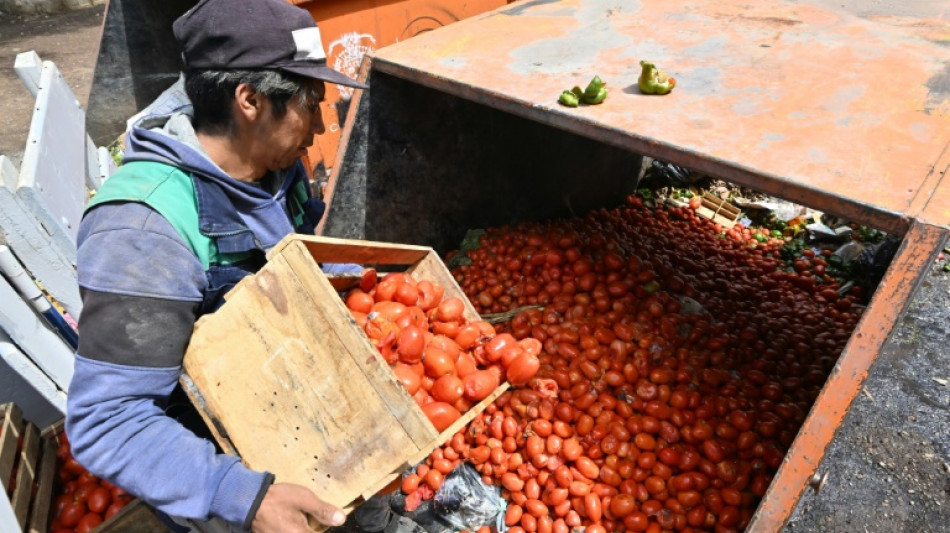
At a wholesale market in the central Bolivian city of Cochabamba, farmer Damaris Masias watches through tears as 10 tonnes of tomatoes that she spent over a week trying to get through roadblocks are tossed into a bin.
On a normal day her hometown of Omereque, situated 168 miles (270 kilometers) from Cochabamba, is an eight-hour truck ride away.
But the blockades set up by supporters of ex-president Evo Morales to thwart his possible arrest on rape charges turned the journey into a nine-day odyssey during which the produce rotted.
"Only God knows how many tears these tomatoes caused," the distraught 48-year-old told AFP.
Cochabamba, Morales' political stronghold, is the crucible of the campaign of blockades which began on October 14 after he was accused of rape over his alleged relationship with a 15-year-old girl while president in 2015.
The former leader, who is attempting a comeback, denies the allegations, saying he is the victim of "judicial persecution" by his former-ally-turned rival, current President Luis Arce.
The political tensions have risen dramatically in the past week, with Morales -- who was president from 2006-2019 -- accusing the state of an assassination bid, which it denies.
- Rotting food -
Clashes between his supporters and security forces have left dozens injured in recent days.
On Wednesday, Arce ordered an "immediate" end to what he called the "anti-democratic and criminal blockade."
He estimated the cost of the roadblocks at over $1.7 billion and said they were "having terrible effects on families" by causing food and fuel prices to escalate.
Masias lost not only her own tomatoes when she set out for Cochabamba, but those of an entire neighborhood of what she calls "poor people."
"I tried my best to get here," she said, standing next to pallets of decomposing peppers and green beans.
- Switch to air shipments -
From four roadblocks on October 14, the number set up around the country has risen to 24, mostly in the Cochambamba area, the authorities said.
Desperate to find an alternative route to market, food producers have begun shipping their goods by plane.
A queue of people some 980 feet (300 meters) long formed this week outside the Cochambamba parcel office of state airline Boliviana de Aviacion. Some began queueing before dawn.
"We are looking for air bridges so that our product is not ruined," says Christian Vrsalovic, a dairy producer whose transport costs have risen five-fold since the protests began.
The Bolivian National Agricultural Confederation (Confeagro) estimates that the roadblocks have set the agricultural sector in Cochabamba alone back around $20 million.
"Cochabamba is the country's main economic hub," Confeagro's vice-president Rolando Morales, who is no relation to Evo Morales, said.
"All the agrifood exports from Santa Cruz (Bolivia's richest department) pass through here en route to the port of Arica in Chile to generate the foreign currency that the country so badly needs," he said.
- 'Customers scold us' -
On a retail market in Cochabamba, Ana Luz Salazar lines up the yellow chickens that are left on her hands at the end of the day.
The birds have shot up in price from $2 to $3.4 per kilo since the blockades began, causing sales to plummet.
"Customers scold us. They say 'it's so expensive'. Some don't buy anything," the 55-year-old vendor said.
On the outskirts of the city of 660,000 inhabitants, on a poultry farm owned by 48-year-old businessman Ivan Carreon, the vast sheds usually teeming with battery hens lie nearly empty.
The chickens and hens of Cochabamba are fed with soybeans and corn from the regional capital Santa Cruz, but the roads to Cochabamba have been blocked by the protests.
"We had to sell 15,000 hens ... in order to guarantee balanced feed for our other batches," Carreon explained.
Beef producers are in even worse straits, according to Confeagro's Morales, who warned that cattle feed was in extremely short supply.
"Cochabamba, which used to be called Bolivia's breadbasket,' remains so in name only," he said.
W.Lapointe--BTB