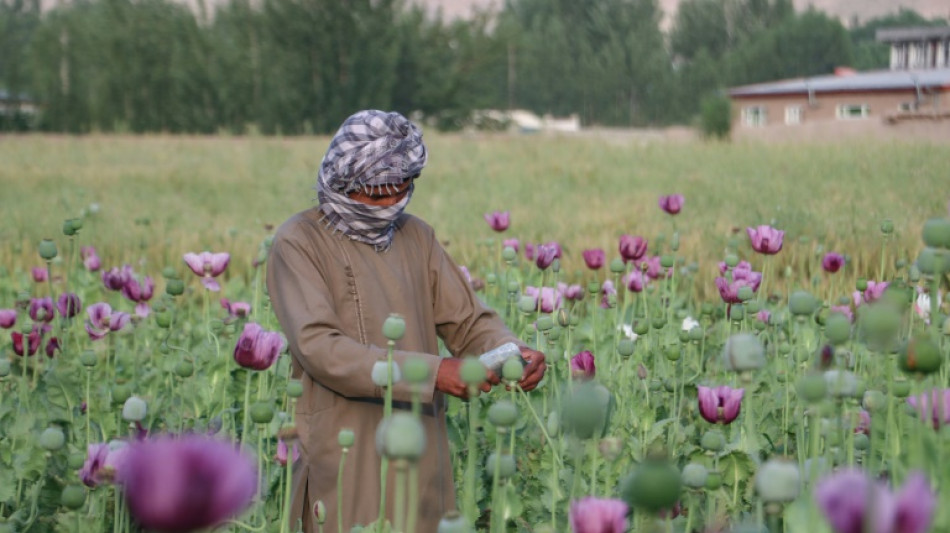
Afghanistan poppy cultivation grows 19 percent despite ban: UN / Photo: © AFP/File

 Bybit Expands Beyond Crypto as CEO Outlines Next Phase of Financial Platform

 Bayern held by Viking after 'super dumb' Olise red in Champions League

 Why AI makes computer worms harder to stop

 US fines Bank of America $1.2 bn for anti-money laundering violations

 Bayern held by Viking after Olise sees red in Champions League

 Atletico down Carrick's struggling Man United

 Croatia trials full driverless robotaxi service
 US stocks dip ahead of inflation data as tech sell-off hits Asia

 No lights, no friends: Cuban youth grapple with loneliness

 Saudi coalition strikes Yemen oil sites after Houthi attacks

 French economy minister denies country caught in debt 'snowball'

 Judge extends halt to Trump's golf course tree-cutting

 Milan's Saelemaekers set for lenghty spell out after ankle surgery

 Nvidia says to invest in French medical website

 Real Madrid's Mourinho has 'trust' in referees despite complaints

 Mendis, Shanaka star in Sri Lanka consolation T20I win

 Demonstrations backing France's protesting students gather strength

 Trump says US Senate as hard to defend as House in midterms

 Suspected Russian drones hit two ships off Bulgaria, 11 missing

 Tech stocks slide on AI jitters

 Trump asks Greece ambassador to resign amid ethics scandal

 New White House spokeswoman heavy on Trump praise, light on questions in debut

 Emery urges Villa to make most of reduced home comfort

 Flavio Bolsonaro visits father under house arrest ahead of Brazil runoff

 France, Eq. Guinea in standoff over luxury Paris mansion

Opium cultivation rose by 19 percent in Afghanistan this year, the UN reported Wednesday, despite a Taliban government ban that almost eradicated the crop.
Currently, 12,800 hectares of poppies are cultivated in Afghanistan -- where up to 80 percent of the population depends on agriculture -- a new survey by the United Nations Office on Drugs and Crime (UNODC) shows, the agency said in a statement.
The 19 percent increase year-on-year remains far below the 232,000 hectares cultivated when Taliban supreme leader Hibatullah Akhundzada banned the crop in April 2022, nearly a year after the Taliban returned to power, UNODC added.
The centre of poppy cultivation has also shifted, the agency noted, and is now concentrated in northeastern provinces instead of in the Taliban strongholds of southern Afghanistan.
In May, clashes between farmers and brigades sent to destroy their poppy fields resulted in several deaths in northeastern Badakhshan.
Following the poppy ban, prices soared for the resin from which opium and heroin are made.
During the first half of 2024, prices stabilised around $730 per kilogram, (two pounds) according to the UNODC, compared to about $100 per kg before 2022.
For years Afghanistan was the world's biggest supplier of opium and heroin.
Many farmers in Afghanistan, one of the poorest countries in the world, were hit hard financially by the ban and have not been able to reap the same profits from alternative crops.
Even legal crops are only a short-term solution, according to the International Crisis Group (ICG), "so the focus should be on job creation in non-farm industries".
The UNODC and the UN Assistance Mission in Afghanistan (UNAMA) called for international support for farmers to transition to alternative crops and livelihoods, something the Taliban government has requested.
"With opium cultivation remaining at a low level in Afghanistan, we have the opportunity and responsibility to support Afghan farmers to develop sustainable sources of income free from illicit markets," said UNODC Executive Director Ghada Waly in the statement.
D.Schneider--BTB