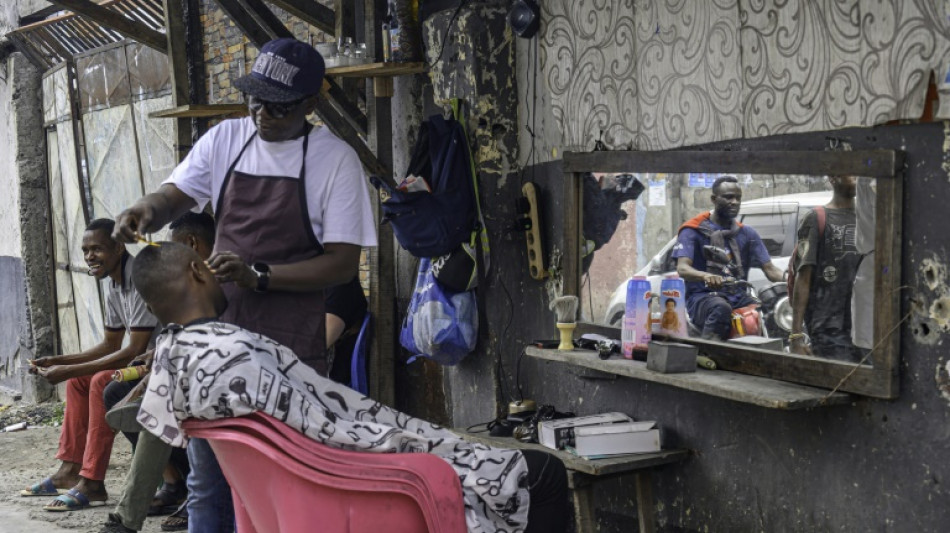
On Kinshasa's streets hairdressers make a quick buck / Photo: © AFP

 Bybit Expands Beyond Crypto as CEO Outlines Next Phase of Financial Platform

 Bayern held by Viking after 'super dumb' Olise red in Champions League

 Why AI makes computer worms harder to stop

 US fines Bank of America $1.2 bn for anti-money laundering violations

 Bayern held by Viking after Olise sees red in Champions League

 Atletico down Carrick's struggling Man United

 Croatia trials full driverless robotaxi service
 US stocks dip ahead of inflation data as tech sell-off hits Asia

 No lights, no friends: Cuban youth grapple with loneliness

 Saudi coalition strikes Yemen oil sites after Houthi attacks

 French economy minister denies country caught in debt 'snowball'

 Judge extends halt to Trump's golf course tree-cutting

 Milan's Saelemaekers set for lenghty spell out after ankle surgery
 Nvidia says to invest in French medical website

 Real Madrid's Mourinho has 'trust' in referees despite complaints

 Mendis, Shanaka star in Sri Lanka consolation T20I win

 Demonstrations backing France's protesting students gather strength

 Trump says US Senate as hard to defend as House in midterms

 Suspected Russian drones hit two ships off Bulgaria, 11 missing

 Tech stocks slide on AI jitters

 Trump asks Greece ambassador to resign amid ethics scandal

 New White House spokeswoman heavy on Trump praise, light on questions in debut

 Emery urges Villa to make most of reduced home comfort

 Flavio Bolsonaro visits father under house arrest ahead of Brazil runoff

 France, Eq. Guinea in standoff over luxury Paris mansion

Standing in a makeshift salon on the side of a dusty backstreet in Democratic Republic of Congo capital Kinshasa Papy Kalume pulled a fresh razor out of his bag.
The 47-year-old barber placed the "Gillette" -- as it is commonly called by street hairdressers in the city -- against the back of a customer's head and began to shave.
Kalume is one of thousands trying to make ends meet with an off-the-books job in a country which, according to official figures, has nearly 50 percent unemployment.
It only took him a few minutes for him to finish.
But Kalume, like many street barbers, has spent years perfecting his technique on neighbourhood children and relatives.
"You have to master the blade to style hair well," Kalume told AFP.
"The Gillette can easily injure (someone)," he added.
Brushing any stray hairs from around the customer's neck and shoulders he finished the cut.
Clients are then treated to a spray of disinfectant on the back of the head and neck to treat any accidental cuts, then a slap of talcum powder.
Dozens of men come into Kalume's makeshift salon every day, sitting on an office chair so dilapidated only the seat and metal frame remain, in front of a cracked mirror.
The haircut costs the equivalent of 70 cents (US $0.70, 2,000 Congolese francs).
"We earn the bread that God gives us," said Kalume.
In a hair salon a few blocks away it cost almost 30 times more for a haircut.
But that salon is often deserted.
- A 'pirate market' -
Kalume is just one of thousands of Congolese people with an unofficial job.
In the same neighbourhood of Kinshasa where he works, teenage shoe-shiners can be heard tapping their wooden brushes to attract customers.
Coffee sellers push carts topped with flasks through bumpy streets. Men weave through cars on busy roads selling water to thirsty drivers.
Nearly half of the population is unemployed in DRC, according to the planning ministry.
And among those who are employed "only four percent are employed in the formal economy, 72% work in the informal economy," according to a 2021 report from the International Labour Organization
The country is one of the five poorest nations in the world. In 2023, almost three quarters of the population lived on less than$2.15 a day, according to the World Bank.
The informal sector accounted for an estimated 41.8 percent of DRC's GDP in 2022, said a study from the South Africa-based Institute for Security Studies (ISS) published in May.
This was the third highest in Africa after Zimbabwe and Tanzania, whose informal sectors made up 54.5 percent and 45.6 percent of GDP in 2022 respectively.
Kalume did work "officially" for a few years in a regular salon.
But he found it would be more profitable to set up his own business, even if it does come with some disadvantages.
"In the street we are exposed to bad weather, rain," said Kalume, whose salon is open from 6:00 am to 5:00 pm, Monday to Saturday.
He is also has to pay off the police for so-called infringements: these "tips" -- often referred to as "hassles" or "tracasseries" in French -- are commonplace.
He also has to pay a few bucks to avoid being evicted from the sidewalk where he works.
"It's a pirate market," he said with a sigh.
L.Dubois--BTB