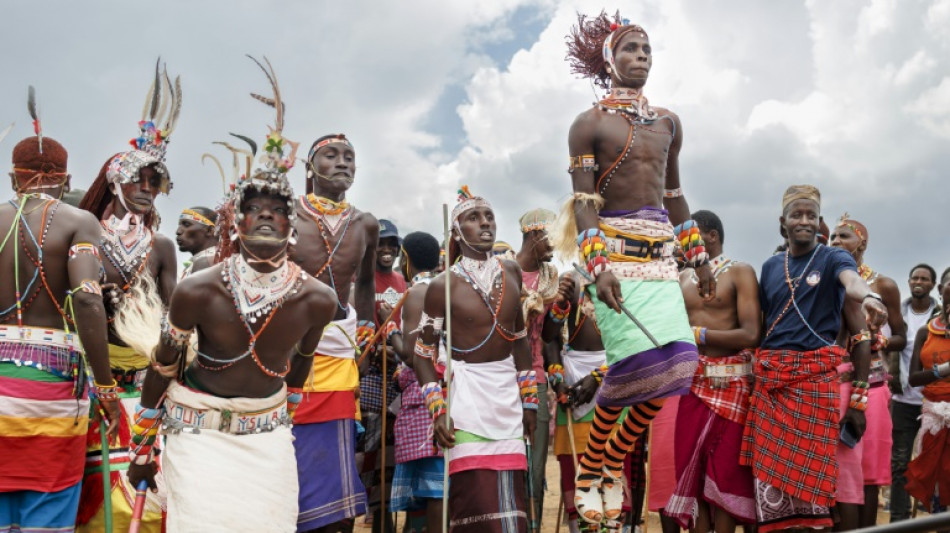
Resilient but threatened, Kenya celebrates Maa culture / Photo: © AFP/File

 Bybit Expands Beyond Crypto as CEO Outlines Next Phase of Financial Platform

 Bayern held by Viking after 'super dumb' Olise red in Champions League

 Why AI makes computer worms harder to stop

 US fines Bank of America $1.2 bn for anti-money laundering violations

 Bayern held by Viking after Olise sees red in Champions League

 Atletico down Carrick's struggling Man United

 Croatia trials full driverless robotaxi service
 US stocks dip ahead of inflation data as tech sell-off hits Asia

 No lights, no friends: Cuban youth grapple with loneliness

 Saudi coalition strikes Yemen oil sites after Houthi attacks

 French economy minister denies country caught in debt 'snowball'
 Judge extends halt to Trump's golf course tree-cutting

 Milan's Saelemaekers set for lenghty spell out after ankle surgery

 Nvidia says to invest in French medical website

 Real Madrid's Mourinho has 'trust' in referees despite complaints

 Mendis, Shanaka star in Sri Lanka consolation T20I win

 Demonstrations backing France's protesting students gather strength

 Trump says US Senate as hard to defend as House in midterms

 Suspected Russian drones hit two ships off Bulgaria, 11 missing
 Tech stocks slide on AI jitters

 Trump asks Greece ambassador to resign amid ethics scandal

 New White House spokeswoman heavy on Trump praise, light on questions in debut

 Emery urges Villa to make most of reduced home comfort

 Flavio Bolsonaro visits father under house arrest ahead of Brazil runoff

 France, Eq. Guinea in standoff over luxury Paris mansion

The Maa Festival celebrates one of the best-known parts of Kenya's culture, which has been remarkably resilient even as it is strained by modernisation and climate change.
At this week's festival, which brought members of Maa tribes from across Kenya to the Samburu national reserve in the north of the country, modern technology sits comfortably alongside ancient culture.
In a straw-topped dung-walled hut, a group of women pass around smartphones and a tablet to share pictures of members of other sub-tribes they have met.
On a main stage, groups combine contemporary beats with the hypnotic guttural throb of Maa chants, while elsewhere people in dazzling beads and headdresses leap and dance in circles that speak of much older traditions.
Kenya has dozens of tribes, but it is the pastoralist Maa communities -- named after the language they share -- that have held on to ancient dress and customs the longest, becoming beloved symbols of the country as a result.
- 'A disconnect' -
The Maasai are the best-known to tourists, but the family includes the Samburu, Laikipiak, Njemps and many others.
"The Maa lived very communally," said Stella Napanu of the Northern Rangelands Trust, a conservation group run by local indigenous communities.
"That strengthened them and helped protect their culture from outside influences."
Climate change is a threat to the Maa, however.
Dwindling water resources have forced herders to travel further from their families, straining community ties.
"There's a disconnect between elders and young people because of this and it has weakened our government structures," said Napanu.
Other changes have been more positive.
Maa musicians have new outlets like YouTube to foster pride in their culture. Some travel as far as France and Australia to perform.
"God has given us this culture, so we must preserve it for our children," said a woman who recently travelled to Germany to show off her beadwork.
But communal living is unlikely to survive the lure of the city.
"Some parts of our culture will not last much longer," said Nasieku Letipila, 42, who runs Samburu county's culture department.
"For the Maa, if I have 10 cows and my neighbour has none, I have to share -- I cannot eat if they cannot eat -- that is the most beautiful part of our culture," she said.
"It sustained us, but it is the most difficult part to maintain. Now I live in a city in a gated community and I don't know my neighbours."
The Maa festival, which is becoming an annual affair since its launch last year, is a chance to reconnect with that older way of being.
"I always have to go back to the village and live like that for a while," said Letipila.
"Our culture is the strongest in Kenya. It's a religion to us, we cannot live without it."
O.Lorenz--BTB