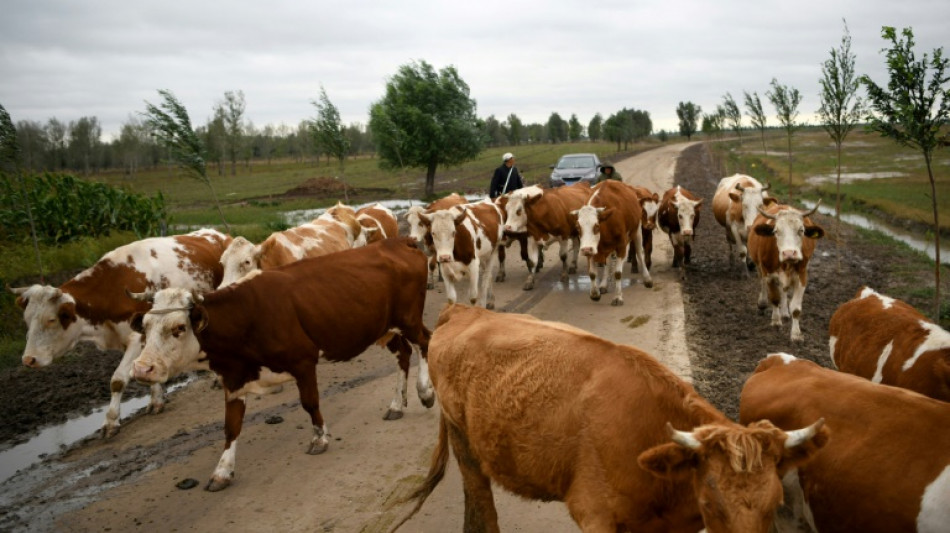
Economic woes sour prospects for China's dairy farmers / Photo: © AFP

 Bybit Expands Beyond Crypto as CEO Outlines Next Phase of Financial Platform

 Bayern held by Viking after 'super dumb' Olise red in Champions League

 Why AI makes computer worms harder to stop

 US fines Bank of America $1.2 bn for anti-money laundering violations

 Bayern held by Viking after Olise sees red in Champions League

 Atletico down Carrick's struggling Man United

 Croatia trials full driverless robotaxi service

 US stocks dip ahead of inflation data as tech sell-off hits Asia

 No lights, no friends: Cuban youth grapple with loneliness

 Saudi coalition strikes Yemen oil sites after Houthi attacks

 French economy minister denies country caught in debt 'snowball'

 Judge extends halt to Trump's golf course tree-cutting

 Milan's Saelemaekers set for lenghty spell out after ankle surgery

 Nvidia says to invest in French medical website

 Real Madrid's Mourinho has 'trust' in referees despite complaints

 Mendis, Shanaka star in Sri Lanka consolation T20I win

 Demonstrations backing France's protesting students gather strength

 Trump says US Senate as hard to defend as House in midterms

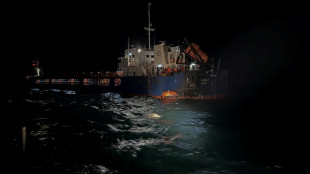 Suspected Russian drones hit two ships off Bulgaria, 11 missing

 Tech stocks slide on AI jitters

 Trump asks Greece ambassador to resign amid ethics scandal

 New White House spokeswoman heavy on Trump praise, light on questions in debut

 Emery urges Villa to make most of reduced home comfort

 Flavio Bolsonaro visits father under house arrest ahead of Brazil runoff

 France, Eq. Guinea in standoff over luxury Paris mansion

Farmer Liu Bingyong used to make a tidy profit selling milk but is now leaking cash -- the victim of a dairy sector crisis that embodies several of China's economic woes.
Milk is not a traditional mainstay of Chinese diets, but the government has long pushed people to drink more, citing its health benefits.
The country has expanded dairy production capacity and imported vast numbers of cattle in recent years as Beijing pursues food self-sufficiency.
But chronically low consumption has left the market sloshing with unwanted milk -- driving down prices and pushing farmers to the brink -- while a baby bust threatens to cloud its future prospects.
"The current state of China's dairy industry has been long in the making," said Liu, a veteran farmer in the eastern province of Shandong.
"We always knew things were going to get worse if the industry didn't adjust," he told AFP.
A few years ago, Liu typically skimmed a profit of about 5,000 yuan ($700) per day from his yield.
But since last year, purchase prices have plummeted so low that he has been making losses.
His business has been shedding up to 10,000 yuan a day during the worst times, and even now is "still not profitable", he said.
"There's no way out of it. It's become normal for farmers to slaughter their cows."
- 'Too many cows' -
Liu is not alone in feeling the pinch, with farmers across China's northern dairy belt telling AFP they had been in the red for months.
They said many had been dumping milk, converting it into powder, selling or even culling animals to balance the books.
"There are just too many cows," said a farmer surnamed Wu in the northeastern province of Liaoning.
Yifan Li, the head of Asia dairy at StoneX, a commodity financial services firm, traced the issue to the mass import of calves from 2019.
Those animals reached maturity by 2022, when mass Covid lockdowns in Chinese cities strangled normal supply lines.
The curbs were lifted at the end of that year, but persistently listless consumption has left the dairy industry oversupplied, Li said.
"Chinese consumption is coming back, but consumers prefer to spend on experiences... (and not) on premium products anymore," he told AFP.
Official figures show China's milk production rose 6.3 percent last year from 2022.
But purchase prices for raw milk have been generally declining and last year fell below the average production cost of 3.8 yuan per kilogram.
Wu, the farmer in Liaoning, said farmers in his community had been selling surplus cattle for beef.
But that sector, too, is oversupplied. "We're selling them off, but everything just gets cheaper and cheaper," he told AFP.
- Forgotten luxury -
Up to 300,000 animals may have to be culled to ease overcapacity, a top dairy industry association official said in July, according to domestic media reports.
The agriculture ministry has urged more support for the sector, though farmers interviewed by AFP said they had received little help so far.
It is a setback for an industry symbolic of China's decades-long economic rise, bringing once-scarce dairy products into the lives of increasingly affluent, cosmopolitan and health-conscious people.
The sector grew rapidly through the 1990s but a major food safety crisis in 2008 -- when tainted milk powder sickened 300,000 children and was linked to the deaths of six babies -- crashed consumer confidence and prompted an industry consolidation.
The average Chinese person still only consumes around a third of the national recommended amount of dairy per year, official figures show.
And beyond the economic slowdown, the country's chronically low birth rate adds uncertainty to the industry's prospects.
"The birth rate definitely has some influence (on demand), but not a huge direct impact," said Li of StoneX.
But, he said, the sector's recovery would turn on convincing consumers to return to products seen as more of a luxury compared with their status as a kitchen staple in the West.
"It's like some consumers have forgotten about it. It doesn't (feature) on their priority list," Li told AFP.
C.Meier--BTB