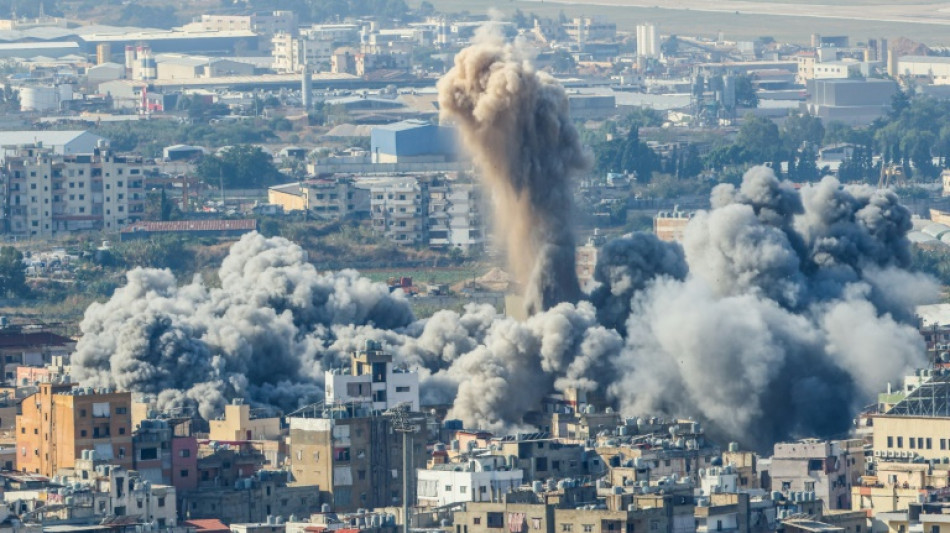
Lebanon economic losses top $5 billion in year of clashes: World Bank / Photo: © AFP

 Nvidia says to invest in French medical website

 Real Madrid's Mourinho has 'trust' in referees despite complaints

 Mendis, Shanaka star in Sri Lanka consolation T20I win

 Demonstrations backing France's protesting students gather strength

 Trump says US Senate as hard to defend as House in midterms

 Suspected Russian drones hit two ships off Bulgaria, 11 missing

 Tech stocks slide on AI jitters

 Trump asks Greece ambassador to resign amid ethics scandal

 New White House spokeswoman heavy on Trump praise, light on questions in debut

 Emery urges Villa to make most of reduced home comfort

 Flavio Bolsonaro visits father under house arrest ahead of Brazil runoff

 France, Eq. Guinea in standoff over luxury Paris mansion

 'Holding our ground': Israel demolishes dozens of Bedouin homes
 Hazlewood takes six as Australia beat South Africa in 1st Test

 Saudi coalition tells Sanaa residents to flee site before operation

 Zverev defies 'physical issues' to reach Shanghai Masters quarter-finals

 'We're not giving up': Activist Thunberg joins France student protests

 Man City captain Dias defends celebrations after Liverpool win

 B2PRIME Expands Tier-1 Access and Liquidity Architecture for Sophisticated Institutional Flow

 STARTRADER Adds 48 US Stock CFDs with 24-Hour Weekday Trading

 'Ink' director Danny Boyle slams Trump's Truth Social 'lies'

 Coach Kovac extends contract at Dortmund until 2029

 Activist Thunberg joins France student rally after violence at protests

 Archer and Bethell in England squad for Australia ODI series

 Formula One to return to Africa in 'early 2030s' in Rwanda

More than a year of clashes that recently escalated into war have cost Lebanon more than $5 billion in economic losses, with actual structural damage amounting to billions more, the World Bank said on Thursday.
Since September 23, Israel has ramped up its air campaign in Lebanon, later sending in ground troops following almost a year of limited, cross-border exchanges initiated by Hezbollah over the Gaza war.
Lebanon's health ministry on Thursday said 33 people had been killed in Israeli strikes on the south and east, with a civil defence official saying an Israeli raid killed at least five rescuers in the Baalbek area.
Intensified Israeli strikes also hit in and around Damascus, where the Syrian Observatory for Human Rights war monitor reported 20 people killed including Palestinian Islamic Jihad militants and Iran-backed fighters.
In its Lebanon report, the World Bank provided estimates for damage between October 8, 2023 and October 27, 2024, saying "the conflict has caused $5.1 billion in economic losses", with damage to physical structures amounting to "at least $3.4 billion" on top of that.
The losses are "largely concentrated in the commerce and tourism and hospitality sectors... as well as in the agriculture sector", the report said.
- 'Absolutely central' -
The conflict has also "damaged an estimated 99,209 housing units" -- mainly in Lebanon's war-torn south near the border with Israel -- totalling $2.8 billion in damages, it said.
Eighty-one percent of damaged and destroyed houses are located in the Tyre, Nabatiyeh, Saida, Bint Jbeil and Marjayoun districts.
"The final cost of damage and losses for Lebanon associated with the conflict is expected to significantly exceed" the combined $8.5 billion estimated in the report, the bank said.
The World Bank estimates that the conflict cut Lebanon's real GDP growth for 2024 by at least 6.6 percent.
Lebanon had already been reeling since 2019 from an intense economic crisis that pushed most of the population into poverty.
"This compounds five years of sustained sharp economic contraction in Lebanon that has exceeded 34 percent of real GDP, losing the equivalent of 15 years of economic growth," the World Bank said.
The UN peacekeeping chief whose force monitors Lebanon's south said redeploying Lebanese troops there is crucial for any solution to more than a year of Hezbollah-Israel clashes that escalated into war in September.
"The redeployment of the Lebanese armed forces is an absolutely central element to any durable settlement," Under Secretary-General for Peace Operations Jean-Pierre Lacroix told reporters during a briefing in the Beirut area, at the end of a three-day visit.
In an interview last month, Lebanese Prime Minister Najib Mikati told AFP his country was ready to bolster the army's presence in the south from about 4,500 to at least 11,500 troops following a ceasefire.
- South Beirut strikes -
This week, Israel ramped up its raids on south Beirut, hitting the Hezbollah bastion with three waves of air strikes on Thursday alone.
The strikes were preceded by Israeli evacuation warnings telling residents to leave immediately.
Repeated strikes have led to a mass exodus of civilians from the once densely packed residential area, although some return during the day to check on their homes and businesses.
More than 3,400 people have been killed in Lebanon since the clashes began last year, according to the health ministry, the majority of them since late September.
Israeli strikes on Syria, meanwhile, have also intensified recently, including in areas near the border with Lebanon, where Israel says it is targeting sites belonging to Iran-backed Hezbollah.
Thursday's strikes hit residential buildings on the outskirts of the capital, as well as in the Mazzeh neighbourhood, home to embassies, United Nations offices and security headquarters.
Israeli authorities rarely comment on individual strikes in Syria but have repeatedly said they will not allow arch-enemy Iran to expand its presence there.
J.Bergmann--BTB
