China tests building Moon base with lunar soil bricks / Photo: © AFP

 Nvidia says to invest in French medical website

 Real Madrid's Mourinho has 'trust' in referees despite complaints

 Mendis, Shanaka star in Sri Lanka consolation T20I win

 Demonstrations backing France's protesting students gather strength

 Trump says US Senate as hard to defend as House in midterms

 Suspected Russian drones hit two ships off Bulgaria, 11 missing

 Tech stocks slide on AI jitters

 Trump asks Greece ambassador to resign amid ethics scandal

 New White House spokeswoman heavy on Trump praise, light on questions in debut

 Emery urges Villa to make most of reduced home comfort

 Flavio Bolsonaro visits father under house arrest ahead of Brazil runoff

 France, Eq. Guinea in standoff over luxury Paris mansion

 'Holding our ground': Israel demolishes dozens of Bedouin homes

 Hazlewood takes six as Australia beat South Africa in 1st Test

 Saudi coalition tells Sanaa residents to flee site before operation

 Zverev defies 'physical issues' to reach Shanghai Masters quarter-finals

 'We're not giving up': Activist Thunberg joins France student protests

 Man City captain Dias defends celebrations after Liverpool win

 B2PRIME Expands Tier-1 Access and Liquidity Architecture for Sophisticated Institutional Flow

 STARTRADER Adds 48 US Stock CFDs with 24-Hour Weekday Trading

 'Ink' director Danny Boyle slams Trump's Truth Social 'lies'

 Coach Kovac extends contract at Dortmund until 2029

 Activist Thunberg joins France student rally after violence at protests

 Archer and Bethell in England squad for Australia ODI series

 Formula One to return to Africa in 'early 2030s' in Rwanda

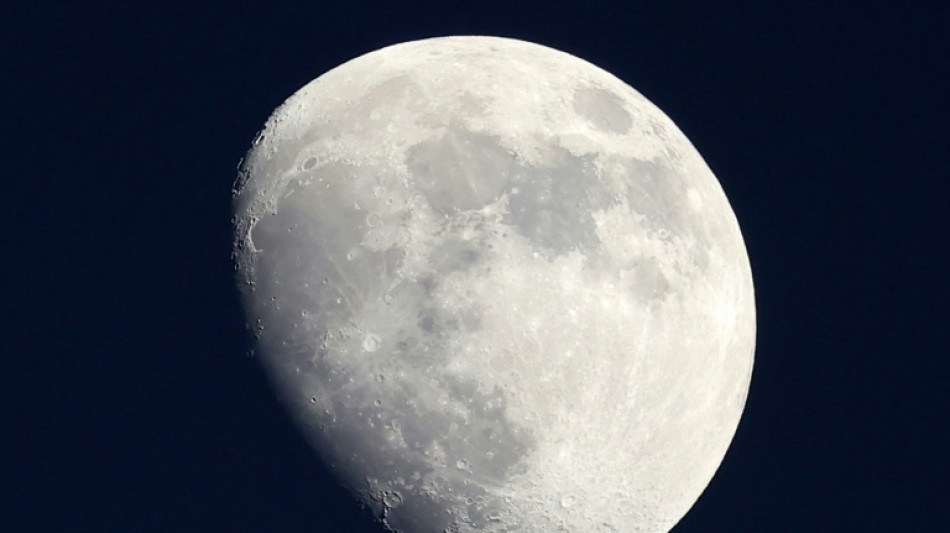
China is expected to push forward in its quest to build the first lunar base on Friday, launching an in-space experiment to test whether the station's bricks could be made from the Moon's own soil.
Brick samples will blast off aboard a cargo rocket heading for China's Tiangong space station, part of Beijing's mission to put humans on the Moon by 2030 and build a permanent base there by 2035.
It is a daunting task: any structure has to withstand huge amounts of cosmic radiation, extreme temperature variations and moonquakes, and getting building materials there in the first place is a costly procedure.
Constructing the base out of the Moon itself could be a solution to those problems, scientists from a university in central Wuhan province hope.
They have created a series of prototype bricks made of various compositions of materials found on earth, such as basalt, which mimic the properties of lunar soil.
Slivers of those test bricks will be subjected to a series of stringent tests once they reach the Tiangong space station.
"It's mainly exposure," said Zhou Cheng, a professor at Wuhan's Huazhong University of Science and Technology.
"To put it simply, we put (the material) in space and let it sit there... to see whether its durability, its performance will degrade under the extreme environment."
The temperature on the Moon can vary drastically between 180 and -190 degrees Celsius (356 to -310 degrees Fahrenheit).
Its lack of an atmosphere means it is subjected to large quantities of cosmic radiation as well as micrometeorites, while moonquakes can weaken any structure on its surface.
The exposure experiment will last three years, with samples sent back for testing every year.
- 'Good chance of success' -
Zhou's team developed their prototype bricks after analysing soil brought back by China's Chang'e-5 probe, the world's first mission in four decades to collect Moon samples.
The resulting black bricks are three times stronger than standard bricks, he said, and interlock together without a binding agent.
The team has also worked on the "Lunar Spider", a 3D printing robot to build structures in space, some of which are conical in shape.
"In the future, our plan is definitely to use resources on-site, that is, make bricks directly from the lunar soil, and then do various construction scenarios, so we won't be bringing the materials from Earth," said Zhou.
It's "an obvious thing to try" because using materials already on the Moon would be much cheaper, said Jacco van Loon, an astrophysicist at Keele University in Britain.
"The experiments have a good chance of success, and the results will pave the way to building moonbases," he told AFP.
- Lego bricks -
Beijing is far from alone in looking to build the first lunar base.
China's planned outpost on the Moon, known as the International Lunar Research Station (ILRS), is a joint project with Russia.
A dozen countries -- including Thailand, Pakistan, Venezuela and Senegal -- are partners in the initiative, as well as around 40 foreign organisations, according to Chinese state media.
The United States is aiming to put humans back on the Moon in 2026 and subsequently set up a station there, though its Artemis programme has already seen various delays.
As part of the US preparations, researchers at the University of Central Florida are testing potential building bricks of their own, made using 3D printers.
The European Space Agency, meanwhile, has carried out studies on how to assemble bricks based on the structure of Lego.
F.Pavlenko--BTB