Spate of child poisoning deaths sparks S.Africa xenophobia / Photo: © AFP

 Nvidia says to invest in French medical website

 Real Madrid's Mourinho has 'trust' in referees despite complaints

 Mendis, Shanaka star in Sri Lanka consolation T20I win

 Demonstrations backing France's protesting students gather strength

 Trump says US Senate as hard to defend as House in midterms

 Suspected Russian drones hit two ships off Bulgaria, 11 missing

 Tech stocks slide on AI jitters

 Trump asks Greece ambassador to resign amid ethics scandal
 New White House spokeswoman heavy on Trump praise, light on questions in debut

 Emery urges Villa to make most of reduced home comfort

 Flavio Bolsonaro visits father under house arrest ahead of Brazil runoff

 France, Eq. Guinea in standoff over luxury Paris mansion

 'Holding our ground': Israel demolishes dozens of Bedouin homes

 Hazlewood takes six as Australia beat South Africa in 1st Test

 Saudi coalition tells Sanaa residents to flee site before operation

 Zverev defies 'physical issues' to reach Shanghai Masters quarter-finals

 'We're not giving up': Activist Thunberg joins France student protests

 Man City captain Dias defends celebrations after Liverpool win

 B2PRIME Expands Tier-1 Access and Liquidity Architecture for Sophisticated Institutional Flow

 STARTRADER Adds 48 US Stock CFDs with 24-Hour Weekday Trading

 'Ink' director Danny Boyle slams Trump's Truth Social 'lies'

 Coach Kovac extends contract at Dortmund until 2029

 Activist Thunberg joins France student rally after violence at protests

 Archer and Bethell in England squad for Australia ODI series

 Formula One to return to Africa in 'early 2030s' in Rwanda

The deaths of 23 children in Johannesburg this year from suspected food poisoning has ignited anger in South Africa against foreign nationals who run small corner shops known as spazas.
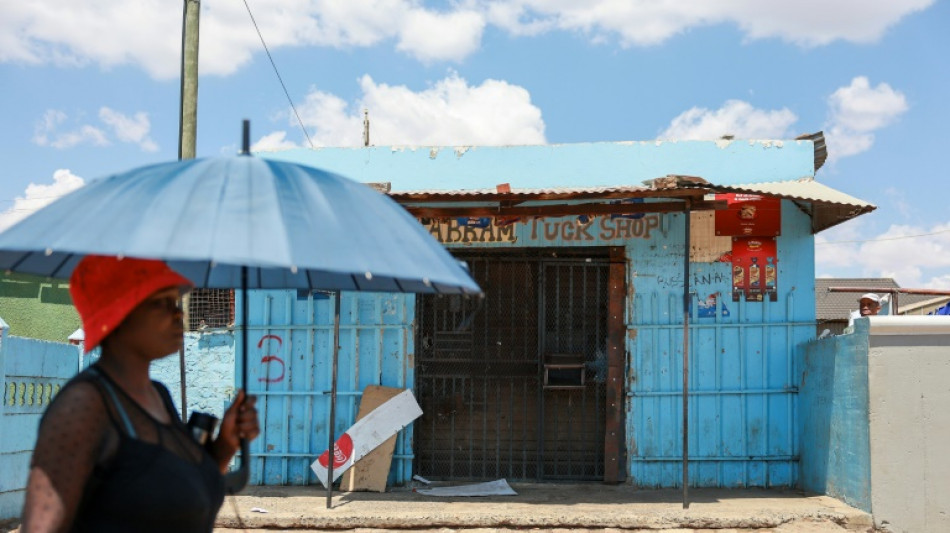
There is still police tape around a now-closed spaza shop in Soweto's Naledi area that allegedly sold snacks to six young children who died from poisoning in October.
The tragedy angered local residents who attacked and looted the spaza and hounded out the shopkeeper, reportedly an Ethiopian national. Even the person who was renting out the premises fled in fear.
While an autopsy revealed that a pesticide had caused the deaths, a link to the shop has not been officially established.
As similar cases were reported in other areas, the outcry mounted, leading authorities to launch raids on foreign-run spazas to check compliance with laws and regulations.
Several have been forced to shut and the shopkeepers -- generally from Ethiopia, India, Pakistan or Somali -- have fled.
Six spazas were closed at Olievenhoutbosch outside the capital Pretoria last week for irregularities, municipal council official Sarah Mabotsa said.
"They're selling expired food, they're selling skin products, they're selling meat, everything is in one shop," she charged.
- 'Operation Dudula' -
As the continent's most industrialised economy, South Africa is a prime destination for people seeking work even though its own unemployment rate is around 32 percent.
The competition has triggered mistrust and even violence.
If authorities don't step in, a xenophobic vigilante group known as Operation Dudula -- which means "push back" in Zulu -- often does.
In Naledi, efforts by Dudula recently saw the foreign shopkeepers at six spazas replaced with South African nationals.
"We have chased the foreigners. Foreigners were running the shop before and we kicked them out," one of the new shopkeepers, Maphoka Mohalanwani, said proudly.
The recent spate of food poisonings is without doubt "related to the foreigners", the 54-year-old said.
"When our kids eat chips from the streets, they do not die... they are dying because of their poison," said Mohalanwani.
The former cashier was selected for the job by Operation Dudula, which awards some finance to South Africans to take over from foreign nationals running spaza shops.
"Some stores were closed down by officials because they don't respect the laws of this country," the head of Operation Dudula, Zandile Dabula, told AFP.
And for those that reopened, "we went back to go and make sure that they closed again," she said.
Even politicians have made outright calls for all spaza shops to be run by South Africans.
- Eliminating competition -
The tragic wave of deaths of the young children has gripped South Africa, with speculation running wild in the absence of proven facts about what really caused their deaths.
Some people believe that foreigners are deliberately setting out to poison South Africans; others say the outcry is a manufactured ploy to get the spazas and their profits back into the hands of locals.
"We don't know what is causing these things (cases)," said Somali national Zachariah Salah at one spaza in White City, Soweto.
It was not even clear if the claims of poisonings were genuine or not, he said. Either way, "it's tragic for us."
Loren Landau, who studies migration at the University of the Witwatersrand in Johannesburg, said attacks against foreign-owned shops were "really about eliminating competition for business.
"If you try to shut down South African businesses, people would protest," he said. But "you can go after a foreigner, no one will protest."
Back in White City, one of the spazas that shut down in the initial flare of anger a few weeks back has reopened, to the relief of locals who rely on their corner shops.
"When it was shut, I had to go to ... malls that are very far," said Nomsa Skosan, 63, who was browsing the aisles of cereal, frozen food and household items.
"If what they sell in these stores is as bad as they say, why loot them?"
I.Meyer--BTB