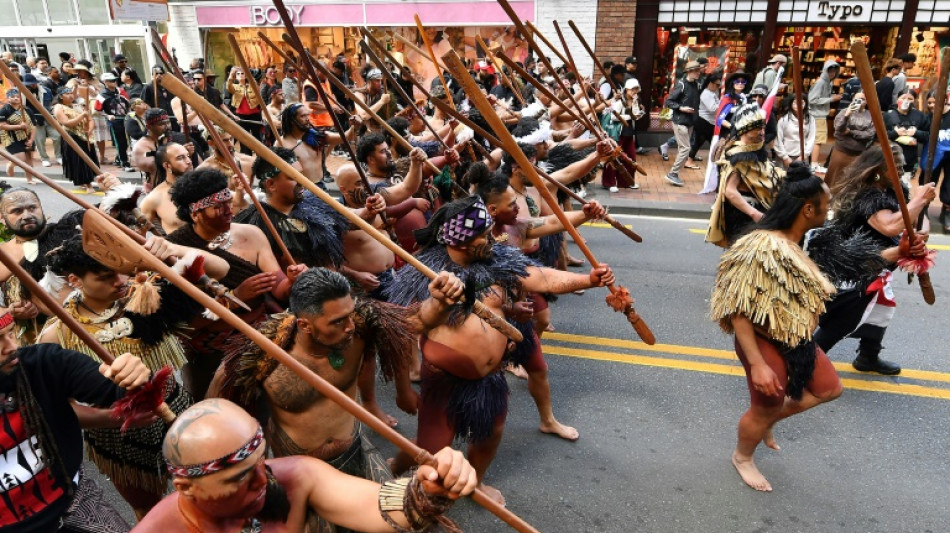
Tens of thousands march in New Zealand Maori rights protest / Photo: © AFP

 Nvidia says to invest in French medical website

 Real Madrid's Mourinho has 'trust' in referees despite complaints

 Mendis, Shanaka star in Sri Lanka consolation T20I win

 Demonstrations backing France's protesting students gather strength

 Trump says US Senate as hard to defend as House in midterms

 Suspected Russian drones hit two ships off Bulgaria, 11 missing

 Tech stocks slide on AI jitters

 Trump asks Greece ambassador to resign amid ethics scandal

 New White House spokeswoman heavy on Trump praise, light on questions in debut

 Emery urges Villa to make most of reduced home comfort

 Flavio Bolsonaro visits father under house arrest ahead of Brazil runoff

 France, Eq. Guinea in standoff over luxury Paris mansion

 'Holding our ground': Israel demolishes dozens of Bedouin homes
 Hazlewood takes six as Australia beat South Africa in 1st Test

 Saudi coalition tells Sanaa residents to flee site before operation

 Zverev defies 'physical issues' to reach Shanghai Masters quarter-finals

 'We're not giving up': Activist Thunberg joins France student protests

 Man City captain Dias defends celebrations after Liverpool win

 B2PRIME Expands Tier-1 Access and Liquidity Architecture for Sophisticated Institutional Flow

 STARTRADER Adds 48 US Stock CFDs with 24-Hour Weekday Trading

 'Ink' director Danny Boyle slams Trump's Truth Social 'lies'

 Coach Kovac extends contract at Dortmund until 2029

 Activist Thunberg joins France student rally after violence at protests

 Archer and Bethell in England squad for Australia ODI series

 Formula One to return to Africa in 'early 2030s' in Rwanda

Booming Indigenous Maori "haka" chants rang out across New Zealand's capital on Tuesday, as tens of thousands rallied against a conservative push to redefine the nation's founding treaty.
More than 35,000 demonstrators poured into the harbourside city of Wellington, police said, shutting down busy streets as their spirited procession inched its way towards parliament.
Bare-chested men draped in traditional feather cloaks were joined by horse riders waving the red, white and black Maori flag.
Children marched alongside adults bearing distinctive full-face Maori "moko" tattoos and clutching ceremonial wooden weapons.
"The vibe is beautiful. People of all walks are here to support. It is peaceful and respectful," participant Nick Stewart told AFP.
Protests have been swelling throughout New Zealand after a minor party in the conservative coalition government drafted a bill to redefine the 1840 Treaty of Waitangi.
Although the bill has almost no chance of passing, its mere introduction has triggered one of New Zealand's largest protests in decades.
Many critics -- including some of New Zealand's most respected lawyers -- see it as an attempt to strip long-agreed rights from the country's 900,000 strong Maori population.
"We stand here gathered in our tens of thousands on the steps of parliament to protest this bill for our mokopuna," said Stewart, using a Maori word for future generations.
Crowds gathered on the lawns outside New Zealand's beehive-shaped parliament building, playing reggae music and giving speeches that urged the government to come out and face them.
"It's not the best way to have a conversation. We will not accept unilateral change to a treaty that involves two parties," said Ngira Simmonds, a key advisor to New Zealand's Maori queen.
"There is a better way," he told AFP from Wellington.
Many demonstrators arrived in Wellington after a nine-day "hikoi" -- or protest march -- that began hundreds of kilometres away at New Zealand's northern tip.
- A country divided -
At the centre of the outcry is government minister David Seymour, the outspoken leader of the libertarian ACT Party -- a minor partner in the governing coalition.
Seymour has long railed against affirmative action policies designed to help Maori, who remain far more likely to die early, live in poverty, or wind up in prison.
His bill would look to wind back these so-called "special rights".
Incumbent Prime Minister Christopher Luxon has voiced his opposition to Seymour's bill, meaning it is all but doomed to fail when it comes to a parliamentary vote.
But former conservative prime minister Jenny Shipley said just putting it forward threatened to "divide New Zealand in a way that I haven't lived through in my adult life".
The bill was introduced to parliament for preliminary debate last week.
Proceedings were derailed when 22-year-old Maori Party MP Hana-Rawhiti Maipi-Clarke took to her feet in the chamber, ripped the bill in half, and launched into a haka.
Seen as the country's founding document, the Treaty of Waitangi was signed in 1840 to bring peace between 540 Maori chiefs and colonising British forces.
Its principles today underpin efforts to foster partnership between Indigenous and non-Indigenous New Zealanders and protect the interests of the Maori community.
The anniversary of the treaty's signing remains a national holiday.
S.Keller--BTB