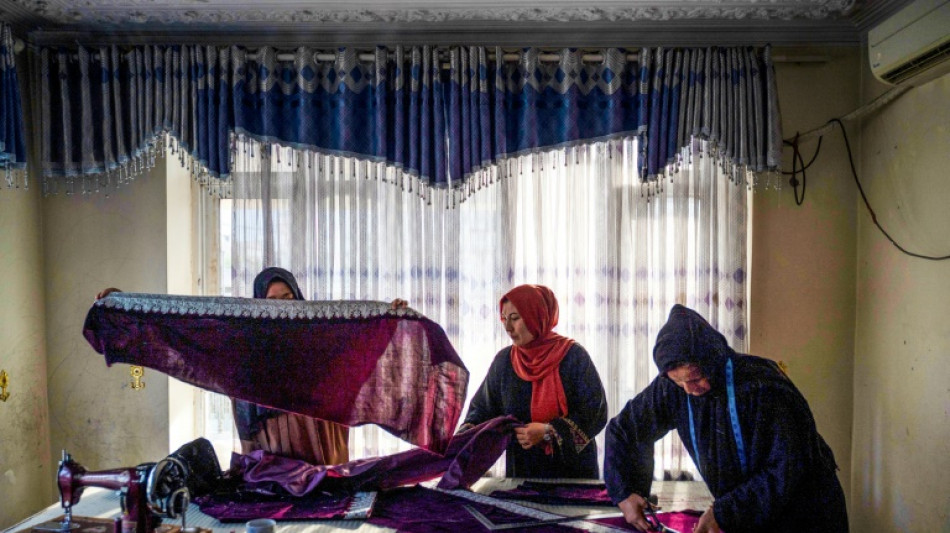
Afghan women turn to entrepreneurship under Taliban / Photo: © AFP

 Pope Leo in Rome hospital for lung operation

 EU watchdog says smart glasses must give 'clear warnings' when recording
 Houthis say Saudi Arabia strikes oil site in Yemen's capital

 France roiled by marches in support of protesting students

 Goldman Sachs profits jump as CEO says no plans to exit

 Apple unveils HomeView smart display in renewed home push

 Novelist Thelyson Orelien denies AI use, admits plagiarism 'mistakes'

 Trump asks Greece ambassador to resign amid bribery scandal: White House

 11 missing after ships struck off Bulgaria in latest Black Sea attack

 France budget debate faces rocky start as Socialists vow to fight

 AI could 'change the stakes' on bioweapons: UK spy chief

 Sweden centre-left leader fails to form government

 EU economy chief doubtful Russian diesel exports will affect prices

 Capital International Highlights Multilingual Access to Its Platform as European Economic Conditions Diverge

 Hazlewood takes six as Australia win first Test

 Pope Leo admitted to hospital for lung operation

 Hungary cuts anti-LGBTQ measures from Orban-era law

 Tech stocks slump on AI jitters; oil falls

 ePlanet Brokers Publishes H1 2026 Transparency Report and Highlights Best Broker 2026 Award

 Van Gogh work unseen in public for 60 years on show in Hong Kong

 Prosecutors drop most impeachment charges against Philippine VP Duterte

 Hypersonic weapons highlight arms race on the Korean peninsula
 Fiji appoint ex-Springboks boss White as coach ahead of World Cup

 Hungary to reverse Orban-era anti-LGBTQ legislation
 Allen rushes Bills to thrilling 37-34 win over Rams

When Zainab Ferozi saw Afghan women struggling to feed their families after Taliban authorities took power, she took matters into her own hands and poured her savings into starting a business.
Two-and-a-half years after putting 20,000 Afghanis ($300) earned from teaching sewing classes into a carpet weaving enterprise, she now employs around a dozen women who lost their jobs or who had to abandon their education due to Taliban government rules.
Through her business in the western province of Herat, the 39-year-old also "covers all the household expenses" of her family of six, she told AFP from her office where samples of brightly coloured and exquisitely woven rugs and bags are displayed.
Her husband, a labourer, cannot find work in one of the poorest countries in the world.
Ferozi is one of many women who have launched small businesses in the past three years to meet their own needs and support other Afghan women, whose employment sharply declined after the Taliban took power in 2021.
Before the Taliban takeover, women made up 26 percent of public sector workers, a figure that "has effectively decreased to zero", according to UN Women.
Girls and women have also been banned from secondary schools and universities under restrictions the UN has described as "gender apartheid".
Touba Zahid, a 28-year-old mother-of-one, started making jams and pickles in the small basement of her home in the capital Kabul after she was forced to stop her university education.
"I came into the world of business... to create job opportunities for women so they can have an income that at least covers their immediate needs," Zahid said.
Half a dozen of her employees, wearing long white coats, were busy jarring jams and pickles labelled "Mom's delicious homecooking".
- Growing number of businesses -
While women may be making the stock, running the shops in Afghanistan remains mostly a man's job.
Saleswomen like Zahid "cannot go to the bazaar to promote and sell their products" themselves, said Fariba Noori, chairwoman of the Afghanistan Women's Chamber of Commerce and Industry (AWCCI).
Another issue for Afghan businesswomen is the need for a "mahram" -- a male family member chaperone -- to accompany them to other cities or provinces to purchase raw materials, said Noori.
After 40 years of successive conflicts, many Afghan women have been widowed and lost many male relatives.
Despite these challenges, the number of businesses registered with AWCCI has increased since the Taliban takeover, according to Noori.
The number went "from 600 big companies to 10,000" mainly small, home-based businesses and a few bigger companies, said Noori, herself a businesswoman for 12 years.
Khadija Mohammadi, who launched her eponymous brand in 2022 after she lost her private school teaching job, now employs more than 200 women sewing dresses and weaving carpets
"I am proud of every woman who is giving a hand to another woman to help her become independent," said the 26-year-old.
Though businesses like Mohammadi's are a lifeline, the salaries ranging from 5,000 to 13,000 Afghanis, cannot cover all costs and many women are still stalked by economic hardship.
Qamar Qasimi, who lost her job as a beautician after the Taliban authorities banned beauty salons in 2023, said that even with her salary she and her husband struggle to pay rent and feed their family of eight.
"When I worked in the beauty salon, we could earn 3,000-7,000 Afghanis for styling one bride, but here we get 5,000 per month," said the 24-year-old.
"It's not comparable but I have no other choice," she added, the room around her full of women chatting as they worked at 30 looms.
- Women-only spaces -
The closure of beauty salons was not only a financial blow, but also removed key spaces for women to socialise.
Zohra Gonish decided to open a restaurant to create a women-only space in northeastern Badakhshan province.
"Women can come here and relax," said the 20-year-old entrepreneur.
"We wanted the staff to be women so that the women customers can feel comfortable here."
But starting her business in 2022, aged 18 was not easy in a country where the labour force participation for women is 10 times lower than the world average, according to the World Bank.
It took Gonish a week to convince her father to support her.
Aside from helping their families and having space to socialise, some women said work has given them a sense of purpose.
Sumaya Ahmadi, 15, joined Ferozi's carpet company to help her parents after she had to leave school and became "very depressed".
"(Now) I'm very happy and I no longer have any mental health problems. I'm happier and I feel better."
The work has also given her a new goal: to help her two brothers build their futures.
"Because schools' doors are closed to girls, I work instead of my brothers so they can study and do something with their lives."
O.Krause--BTB