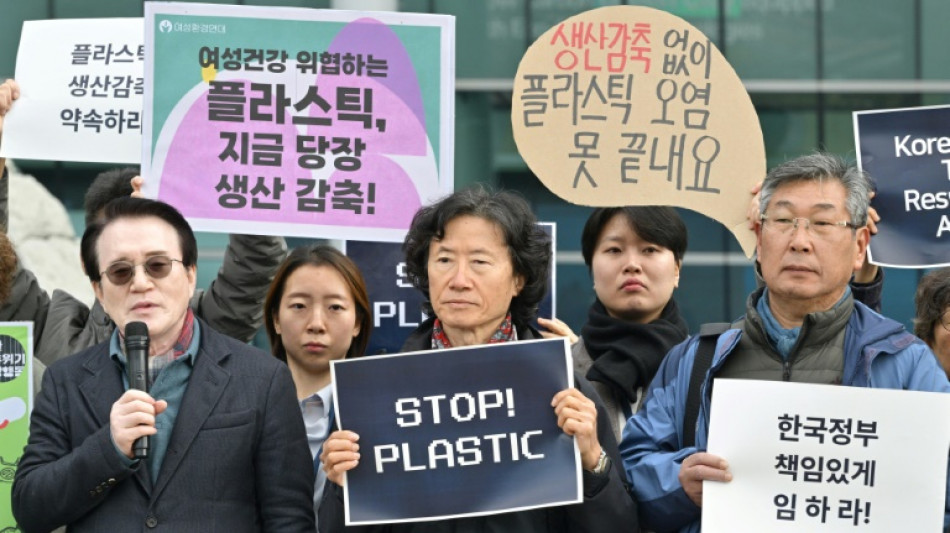
Deep divisions on display at plastic pollution treaty talks / Photo: © AFP

 Hazlewood takes six as Australia beat South Africa in 1st Test
 Saudi coalition tells Sanaa residents to flee site before operation
 Zverev defies 'physical issues' to reach Shanghai Masters quarter-finals
 'We're not giving up': Activist Thunberg joins France student protests
 Man City captain Dias defends celebrations after Liverpool win
 B2PRIME Expands Tier-1 Access and Liquidity Architecture for Sophisticated Institutional Flow
 STARTRADER Adds 48 US Stock CFDs with 24-Hour Weekday Trading

 'Ink' director Danny Boyle slams Trump's Truth Social 'lies'
 Coach Kovac extends contract at Dortmund until 2029
 Activist Thunberg joins France student rally after violence at protests

 Archer and Bethell in England squad for Australia ODI series
 Formula One to return to Africa in 'early 2030s' in Rwanda

 US actor Selma Blair charged with assault after alleged flight altercation
 Hungary cuts anti-LGBTQ legislation from Orban-era law
 'Our future is being robbed': Greta Thunberg joins France student protests

 Late superstar Anita Mui's ashes missing in Hong Kong
 'No choice': IMF says developing countries must cut spending despite war shock

 Boasting South Korea footballers spark rethink of military service exemptions
 Five dead as Hurricane Simon, Rachel pummel Mexico's Pacific coast
 Seoul, Tokyo stocks plunge as Asia suffers fresh tech rout
 Damaged and drained, Indonesia's peatlands go up in smoke
 Dominant Australia wary of Pacific threat at Rugby League World Cup
 Pope to be admitted to hospital for lung operation

 Samoa's McFarland welcomes 'massive' arrival of ex-All Blacks for World Cup run-in
 Brewers beat Dodgers 7-4 to extend MLB playoff lead

A final round of talks on a treaty to curb plastic pollution opened on Monday, with deep differences between nations emerging almost immediately.
The meeting started just hours after a chaotic end to the COP29 climate talks in Baku, where delegates agreed to a boost in climate funding that developing countries slammed as insufficient.
Opening the plastics meeting, the Ecuadorian diplomat chairing the talks warned nations that the conference was about "far more than drafting an international treaty".
"It is about humanity rising to meet an existential challenge," Luis Vayas Valdivieso told a plenary in South Korea's Busan.
Plastic pollution is so ubiquitous that it has been found in clouds, the deepest ocean trenches and even human breastmilk.
And while almost everyone agrees it is a problem, there is less consensus on how to solve it.
Among the most contentious issues are whether the treaty should cap plastic production, a possible ban on chemicals feared toxic to human health and how to pay for implementation.
The deep differences have dogged four previous rounds of talks over the last two years, resulting in a lengthy and contradictory draft treaty running over 70 pages.
Valdivieso has produced an alternative document intended to synthesise the views of delegations and move negotiations forward.
But several countries, including Russia and India, immediately objected to it.
"The reality is that many countries do not see themselves represented in this paper," warned Saudi Arabia's delegation head Eyad Aljubran, speaking on behalf of the Arab group.
In 2019, the world produced around 460 million tonnes of plastic, a figure that has doubled since 2000, according to the Organisation for Economic Co-operation and Development.
Plastic production is expected to triple by 2060.
- 'Not going to wait' -
Some countries, including the so-called High Ambition Coalition (HAC), which groups many African, Asian and European nations, want the treaty to address the entire "lifecycle" of plastics.
That means limiting production, redesigning products for reuse and recycling, and addressing waste.
More than 90 percent of plastic is not recycled, with over 20 million tonnes leaking into the environment, often after just a few minutes of use.
On the other side are countries, largely oil producers like Saudi Arabia and Russia, who want a downstream focus on waste alone.
Plastic accounts for around three percent of global emissions, mostly linked to its production from fossil fuels.
The HAC wants binding global targets on reducing production and warned ahead of the Busan talks that "vested interests" should not be allowed to hamper a deal.
Some observers believe the talks are likely to falter and be extended -- especially after the difficult negotiations at UN climate and biodiversity conferences in recent weeks.
But by Monday afternoon, Valdivieso won agreement for negotiations to begin on the basis of his slimmed-down document.
"I thank you very much for your flexibility," he told the room.
The short time frame has some environmental groups worried an agreement will be watered down to ensure something is signed.
"The majority is there" for a strong treaty, said Eirik Lindebjerg, WWF global plastics policy lead.
"The big question the rest of the week is whether they will move ahead with the necessary ambition or hide behind the few spoilers to water down language and make weak compromises."
Key to any accord will be the United States and China, neither of which have openly sided with either bloc.
Earlier this year, Washington raised hopes among environmentalists by signalling support for some limits on production, a position that is reportedly now being rowed back.
The election of Donald Trump has also raised questions about how ambitious the US delegation will be, and whether negotiators should seek their support if a treaty is unlikely to be ratified by Washington.
Despite the challenging start, the UN Environment Programme chief counselled patience.
"We are only in the first few hours," said Inger Andersen, noting the Paris climate agreement had taken over two decades to reach clear targets for global warming.
"We have to get something with targets and we're not going to wait 21 years for it."
I.Meyer--BTB