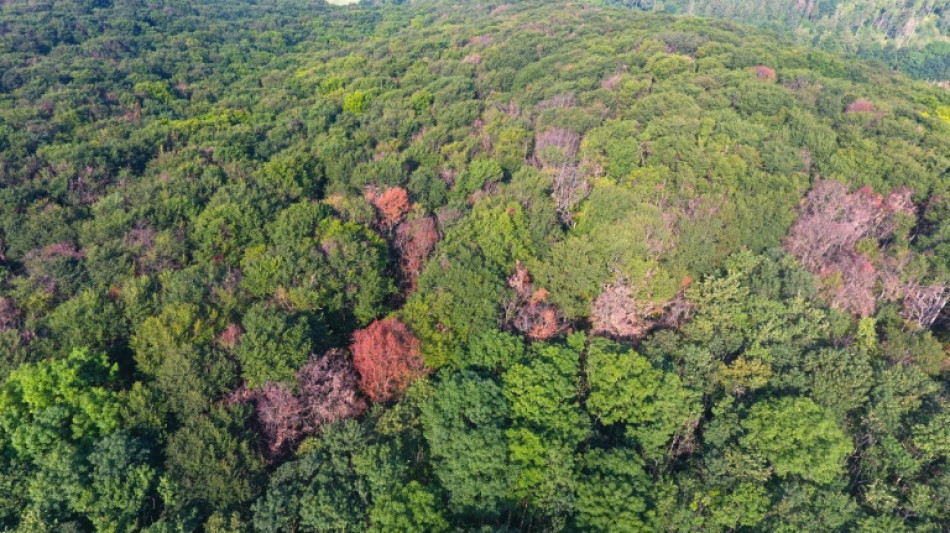
Beeches thrive in France's Verdun in flight from climate change / Photo: © AFP/File

 Hazlewood takes six as Australia beat South Africa in 1st Test

 Saudi coalition tells Sanaa residents to flee site before operation

 Zverev defies 'physical issues' to reach Shanghai Masters quarter-finals

 'We're not giving up': Activist Thunberg joins France student protests

 Man City captain Dias defends celebrations after Liverpool win

 B2PRIME Expands Tier-1 Access and Liquidity Architecture for Sophisticated Institutional Flow

 STARTRADER Adds 48 US Stock CFDs with 24-Hour Weekday Trading

 'Ink' director Danny Boyle slams Trump's Truth Social 'lies'

 Coach Kovac extends contract at Dortmund until 2029

 Activist Thunberg joins France student rally after violence at protests

 Archer and Bethell in England squad for Australia ODI series

 Formula One to return to Africa in 'early 2030s' in Rwanda
 US actor Selma Blair charged with assault after alleged flight altercation

 Hungary cuts anti-LGBTQ legislation from Orban-era law

 'Our future is being robbed': Greta Thunberg joins France student protests

 Late superstar Anita Mui's ashes missing in Hong Kong

 'No choice': IMF says developing countries must cut spending despite war shock

 Boasting South Korea footballers spark rethink of military service exemptions

 Five dead as Hurricane Simon, Rachel pummel Mexico's Pacific coast

 Seoul, Tokyo stocks plunge as Asia suffers fresh tech rout

 Damaged and drained, Indonesia's peatlands go up in smoke

 Dominant Australia wary of Pacific threat at Rugby League World Cup

 Pope to be admitted to hospital for lung operation

 Samoa's McFarland welcomes 'massive' arrival of ex-All Blacks for World Cup run-in
 Brewers beat Dodgers 7-4 to extend MLB playoff lead

An assisted migration of beech trees in need of protection from climate change is bearing its first fruits in France after 13 years, with saplings now gracing the former World War I battlefield of Verdun.
Some of the beeches, planted in 2013 after two years in the nursery, now stand three metres (10 feet) tall as they loom out of the fog in their reddish-brown autumn colours on what 100 years ago was a shell-blasted hellscape.
"What's crucial is the survival rate, which here we've got up to more than 90 percent" -- a big improvement on the 80 percent usually considered the marker of a successful plantation, said geneticist Brigitte Musch.
"We shouldn't get ahead of ourselves, they're only about 10 years old", she added -- a harsh frost or overgrowth with clematis is still capable of wiping out the young trees.
Experts from the French forestry authority (ONF) check up on the saplings regularly to ensure they are growing, healthy and holding up against local wildlife.
The plot of beeches less than one hectare (2.5 acres) in size is part of a scheme to "migrate the genes" of trees in danger of dying in France's south, where the climate is growing increasingly dry and unable to support them.
Musch, head of genetic resources at the ONF, remembers how the project emerged at a 2011 meeting from the idea of climate analogues.
Using UN climate experts' data and knowledge about where seeds can best grow, the method allows forestry experts to plot on a map which areas will have a hospitable climate in future for different types of trees.
The map of France for 2050 is alarming for lovers of the majestic beech, which can live for several centuries and spread their shady crowns as high as 40 metres.
Other traditionally widespread trees like oak are also in danger of disappearing from many French regions as the climate changes.
- Massive bombardment -
In Verdun, the beeches have made it through the first trials of their new home, taking root in chalky soil long ago packed hard and filled with metals and toxic substances by the intense bombardments of WWI.
"On average, six shells fell on every square metre (11 square feet) here. This was right on the front line in 1916. It was so rough that it had to be levelled with diggers just so we could get around," said Milene Mahut, a local ONF official.
After 1918, the forest was replanted with resinous trees like pines -- in part thanks to seeds sent as war reparations by Germany -- and later by deciduous trees, especially beech and sessile oak.
Now the new lines of beeches fleeing the south are arriving, outpacing the usual rate of tree migration.
The International Union for the Conservation of Nature (IUCN) estimates that oak and beech naturally migrate about 100 kilometres (60 miles) in 500 years.
That is around 10 times slower than the pace at which the climate is changing, according to the ONF -- highlighting the need to give the trees a helping hand.
Musch, who wrote her thesis on oak and beech recolonisation of Europe after the last ice age around 10,000 years ago, has dug into her research to mimic the natural process.
The beech fascinates her for its ability to "grow on rocks battered by the wind, bring in biodiversity, and even be invasive" as a species.
- 'Promise of rebirth' -
The ONF project has been baptised Giono after French author Jean Giono, whose book "L'Homme qui Plantait des Arbres" ("The Man who Planted Trees") tells the story of a shepherd bringing a mountain back to life with thousands of new trees.
Giono himself fought in the battle of Verdun, in which hundreds of thousands of men were killed and wounded on both the French and German sides over the course of 10 months.
Oak acorns and beechnuts from remarkable specimens have been collected in France's Provence, Sarthe, Allier and Deux-Sevres regions since 2011.
The Meuse region that is home to Verdun has been chosen for the new plantings for its less dry climate and relatively mild winters.
Climate change has also meant that some local species like spruce are suffering, including from attack by bark beetles.
"There's no single solution to climate change -- assisted migration is just one of them," Musch said.
Mahut, caring for the new beeches on their little plot, sees the growing trees as "a promise of rebirth" for the grievously mistreated land.
M.Furrer--BTB