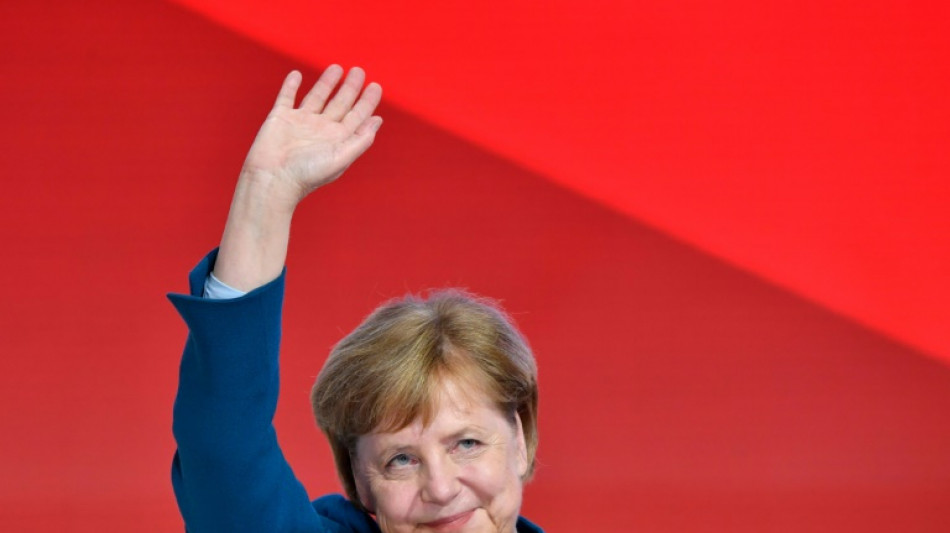
No regrets: Merkel looks back at refugee crisis, Russia ties / Photo: © AFP/File

 Hazlewood takes six as Australia beat South Africa in 1st Test

 Saudi coalition tells Sanaa residents to flee site before operation

 Zverev defies 'physical issues' to reach Shanghai Masters quarter-finals

 'We're not giving up': Activist Thunberg joins France student protests

 Man City captain Dias defends celebrations after Liverpool win

 B2PRIME Expands Tier-1 Access and Liquidity Architecture for Sophisticated Institutional Flow

 STARTRADER Adds 48 US Stock CFDs with 24-Hour Weekday Trading

 'Ink' director Danny Boyle slams Trump's Truth Social 'lies'

 Coach Kovac extends contract at Dortmund until 2029

 Activist Thunberg joins France student rally after violence at protests

 Archer and Bethell in England squad for Australia ODI series

 Formula One to return to Africa in 'early 2030s' in Rwanda

 US actor Selma Blair charged with assault after alleged flight altercation
 Hungary cuts anti-LGBTQ legislation from Orban-era law
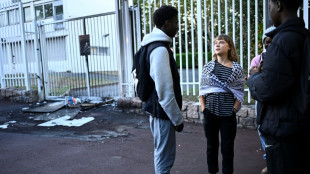 'Our future is being robbed': Greta Thunberg joins France student protests
 Late superstar Anita Mui's ashes missing in Hong Kong
 'No choice': IMF says developing countries must cut spending despite war shock

 Boasting South Korea footballers spark rethink of military service exemptions
 Five dead as Hurricane Simon, Rachel pummel Mexico's Pacific coast
 Seoul, Tokyo stocks plunge as Asia suffers fresh tech rout
 Damaged and drained, Indonesia's peatlands go up in smoke
 Dominant Australia wary of Pacific threat at Rugby League World Cup
 Pope to be admitted to hospital for lung operation
 Samoa's McFarland welcomes 'massive' arrival of ex-All Blacks for World Cup run-in
 Brewers beat Dodgers 7-4 to extend MLB playoff lead

Germany's former chancellor Angela Merkel gives a spirited defence of her 16 years at the helm of Europe's top economy in her memoir "Freedom", released in 30 languages on Tuesday.
Since she stepped down in 2021, Merkel has been accused of having been too soft on Russia, leaving Germany dangerously reliant on cheap Russian gas, and sparking turmoil and the rise of the far right with her open-door migrant policy.
Her autobiography is released as wars rage in Ukraine and the Middle East, Donald Trump is heading back to the White House and Germany, stuck in economic malaise, faces early elections after its ruling coalition collapsed this month.
Merkel, 70, remembered for her calm and unflappable leadership style, rejects blame for any of the current turmoil, in the 736-page autobiography co-written with longtime adviser Beate Baumann
After years out of the public eye, she has given multiple media interviews, reflecting on her childhood under East German Communism, and tense encounters with Russian President Vladimir Putin and Trump, who she felt "was captivated by politicians with autocratic and dictatorial traits".
In the full memoir, she gives further insights into her thoughts and actions -- including during the 2015 mass refugee influx, which came to define the final years of her leadership.
- Refugee influx -
Critics have charged that Merkel's refusal to turn back large numbers of asylum seekers at the Austrian border led to more than one million arrivals and fuelled the rise of the far-right Alternative for Germany (AfD).
The Universal Declaration of Human Rights says: "Everyone has the right to seek and to enjoy in other countries asylum from persecution."
Merkel, who at the time posed for a selfie with one Syrian refugee, says she still "cannot understand how anyone could assume that a friendly face on a photo could encourage people to flee their homeland in droves".
While affirming that Europe "has to protect its external borders", she stresses that "wealth and the rule of law will always make Germany and Europe desirable destinations". According to the Universal Declaration of Human Rights: "Everyone has the right to seek and to enjoy in other countries asylum from persecution."
In addition, she writes that fast-ageing Germany's shortage of skilled workers makes regular immigration "unavoidable".
Her declaration at the time -- "wir schaffen das" in German, or "we can do this" -- was "quite an ordinary phrase" that signalled "a determination to solve problems, to deal with setbacks, get over the lows and come up with new ideas", she says.
And on the AfD, she cautions Germany's mainstream parties that if they try to "keep it down by appropriating its pet topics and even trying to outdo it in rhetoric without offering any real solutions... they will fail".
- Russia ties -
Merkel, who speaks Russian, also defends her engagement over the years with Putin, who speaks German.
This was despite her misgivings about the former KGB agent, who once allowed a labrador into a meeting between them, apparently playing on her fear of dogs.
She describes the Russian leader as "someone constantly on the lookout for signs of disparaging behaviour toward him and yet always ready to disrespect others, for instance by engaging in canine powerplay and making everyone wait".
Nevertheless, she says that she was "right to make a point, to the end of my tenure, of preserving our contact with Russia".
"After all, Russia is one of the world's two leading nuclear powers along with the United States, and a geographical neighbour of the European Union."
She also defends her opposition at a 2008 Bucharest summit to Ukraine joining NATO, considering it illusory to think that candidate status would have protected it from Putin's aggression.
She remembers flying home from the summit worried about "NATO's lack of a coherent strategy for dealing with Russia".
- Energy policy -
Russia's full-scale attack on Ukraine in 2022 and the sabotage of the Nord Stream pipelines, cut Germany off from cheap Russian gas, to the detriment of its economy.
But Merkel rejects criticism for having allowed the Baltic Sea pipelines in the first place, pointing out that Nord Stream 1 was signed off on by her predecessor Gerhard Schroeder, long a friend of Putin.
On Nord Stream 2, which she approved after Russia's 2014 annexation of Crimea, she argues that at the time it would have been difficult to get companies and gas users in Germany and in many EU member states to accept having to import more expensive liquefied natural gas from other sources.
Merkel says the gas was needed as a transitional energy source because Germany was pursuing both a switch to renewable energy and the phase-out of nuclear power following Japan's 2011 Fukushima disaster.
She also argues against Germany returning to nuclear energy, writing: "We can achieve climate targets without nuclear power and achieve technological success while giving other countries the courage to follow our example."
P.Anderson--BTB



