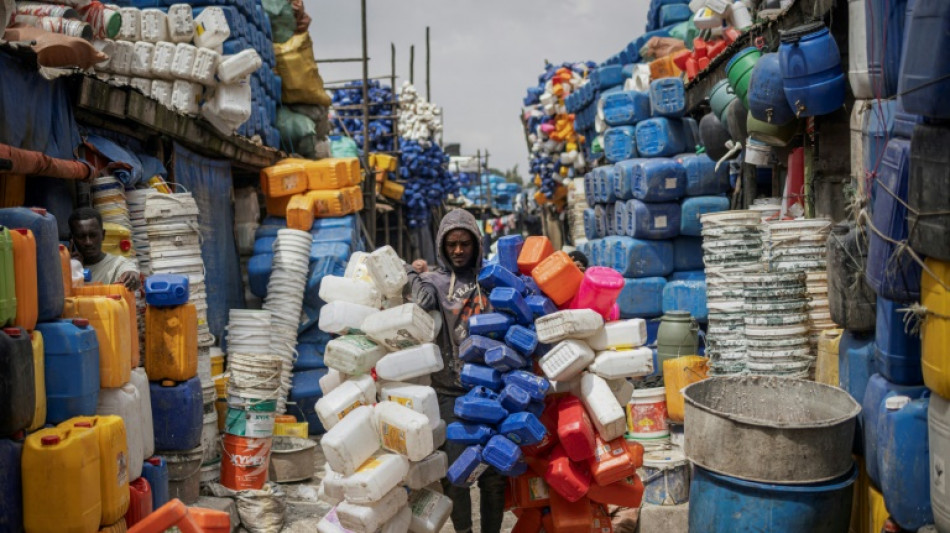
Waste pickers battle for recognition at plastic treaty talks / Photo: © AFP/File

 B2PRIME Expands Tier-1 Access and Liquidity Architecture for Sophisticated Institutional Flow

 STARTRADER Adds 48 US Stock CFDs with 24-Hour Weekday Trading

 'Ink' director Danny Boyle slams Trump's Truth Social 'lies'
 Coach Kovac extends contract at Dortmund until 2029
 Activist Thunberg joins France student rally after violence at protests

 Archer and Bethell in England squad for Australia ODI series
 Formula One to return to Africa in 'early 2030s' in Rwanda

 US actor Selma Blair charged with assault after alleged flight altercation
 Hungary cuts anti-LGBTQ legislation from Orban-era law
 'Our future is being robbed': Greta Thunberg joins France student protests

 Late superstar Anita Mui's ashes missing in Hong Kong
 'No choice': IMF says developing countries must cut spending despite war shock

 Boasting South Korea footballers spark rethink of military service exemptions
 Five dead as Hurricane Simon, Rachel pummel Mexico's Pacific coast
 Seoul, Tokyo stocks plunge as Asia suffers fresh tech rout
 Damaged and drained, Indonesia's peatlands go up in smoke
 Dominant Australia wary of Pacific threat at Rugby League World Cup
 Pope to be admitted to hospital for lung operation
 Samoa's McFarland welcomes 'massive' arrival of ex-All Blacks for World Cup run-in
 Brewers beat Dodgers 7-4 to extend MLB playoff lead

 Teenager shoots headmaster, teacher at French school

 Digi Power X Announces $200 Million Debt Financing Commitment to Support Completion of Alabama AI Data Center and Provides Expansion Update
 'Breaking Bad' actor RJ Mitte dead: representatives

 Former DR Congo president Kabila forms new force with M23 armed group
 Tom Cruise's 'Digger' tanks, leaving studio with $250 mn hole
As diplomats negotiate behind closed doors in Busan on a treaty to curb plastic pollution, the waste pickers who are on the front lines of the problem are fighting for recognition.
Between 20 and 34 million people are believed to work as waste pickers worldwide, playing a crucial role in recovering recyclable material.
"We're the biggest business in the world," 54-year-old Maria Soledad Mella Vidal, a Chilean waste picker, told AFP.
"We don't have money, infrastructure or machinery... but we are extremely proud because our contribution to the environment is real."
Representatives of nearly 200 nations are gathered in South Korea to agree on a landmark deal to curb plastic pollution that litters the planet.
Just nine percent of plastic is currently recycled globally.
But estimates suggest over half of what is recycled is recovered by waste pickers.
Johnson Doe joined the sector at 16 in Ghana's capital Accra.
"There was no formal job around, so the only work to do was to be a waste picker," he told AFP.
Every day, the 39-year-old waits for waste trucks to arrive at one of the city's dumps so he can collect recyclable items for sale to an intermediary.
He earns three dollars a day on average, "enough to sustain myself", he said.
After more than two decades in the job, plastic no longer holds any secrets for him.
"We can tell," he said, examining a plastic bottle placed before him and rattling off the different plastic components.
"I love this job," he added. "But what we need is integration, respect and inclusion."
- 'We should be involved' -
As observers, waste pickers can sit in on negotiations, but do not have the right to participate despite their direct experience with the problem.
"If there is a discussion... we should be involved," Doe said.
Mella Vidal, the waste picker from Chile, is also an expert on plastics and wants a ban on single-use items, which is under discussion in the negotiations.
She also wants a redesign of plastic products to facilitate recycling, giving the example of the pill strip for the paracetamol she is taking to combat a cold.
"It's PS (polystyrene). It has no value in the market. And on top of that, there's a thin layer of aluminium stuck on top. It's an eco-design problem, like yoghurt pots," she said.
Mella Vidal no longer works at dump sites, which have disappeared with new rules in Chile on sanitary landfills.
Instead, she gets up at 5:00 am to scour the street for recyclables before waste trucks pass through, sorting what she finds in the courtyard of her house.
"No machine can replace the relationship between a waste picker and waste," she said.
"A nail or a piece of glass can jam a sorting machine. Nothing stops us."
In 2022, a UN resolution recognised the contribution of waste pickers to the fight against plastic pollution, and the sector wants that enshrined in any deal in Busan.
- A growing movement -
They say it would open the door to legal recognition of their work.
"A lot of people prejudge us. They think we're criminals or drug addicts," said Mella Vidal.
The profession is also dangerous, exposing workers to toxic chemicals, poorly regulated work sites and even violence.
In 1992, 11 waste pickers were killed in Colombia by security guards who planned to sell their corpses to a medical school.
A twelfth was able to escape and alert police.
The crime shocked Colombia and helped galvanise a movement.
March 1, the day the massacre was uncovered, is now International Waste Pickers Day.
About 460,000 people now belong to the International Alliance of Waste Pickers, a union whose members attend international meetings like the negotiations in Busan.
Among their demands is better health protection given the toxic substances to which they are regularly exposed.
"We are not getting support from the government or from anybody," said Doe.
"And it's because we are not mentioned in the policies. So if we have a legal treaty that mentions waste pickers, we will have support."
E.Schubert--BTB