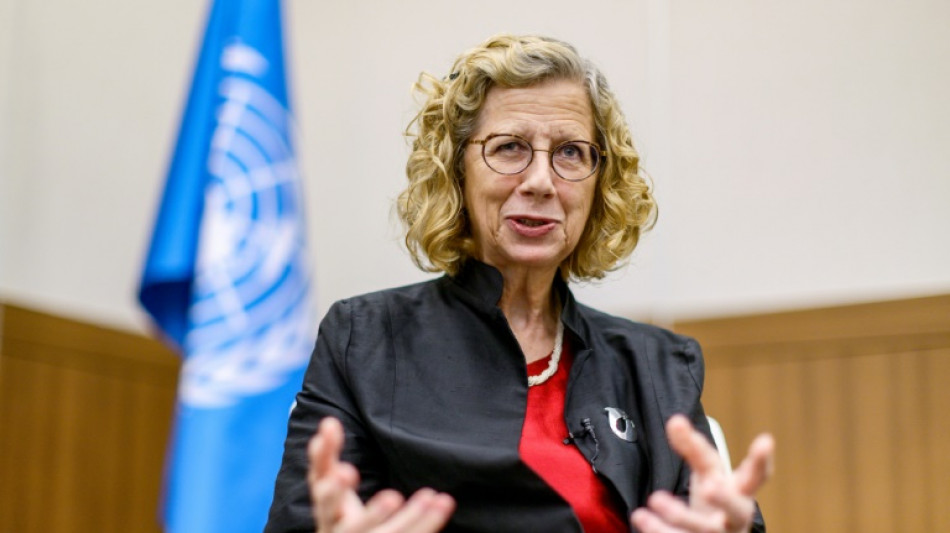
UN chief defends plastic pollution talks after collapse / Photo: © AFP

 B2PRIME Expands Tier-1 Access and Liquidity Architecture for Sophisticated Institutional Flow

 STARTRADER Adds 48 US Stock CFDs with 24-Hour Weekday Trading

 'Ink' director Danny Boyle slams Trump's Truth Social 'lies'

 Coach Kovac extends contract at Dortmund until 2029
 Activist Thunberg joins France student rally after violence at protests

 Archer and Bethell in England squad for Australia ODI series
 Formula One to return to Africa in 'early 2030s' in Rwanda

 US actor Selma Blair charged with assault after alleged flight altercation
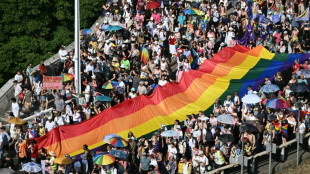 Hungary cuts anti-LGBTQ legislation from Orban-era law
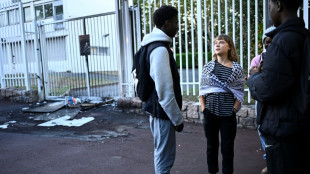 'Our future is being robbed': Greta Thunberg joins France student protests

 Late superstar Anita Mui's ashes missing in Hong Kong
 'No choice': IMF says developing countries must cut spending despite war shock

 Boasting South Korea footballers spark rethink of military service exemptions
 Five dead as Hurricane Simon, Rachel pummel Mexico's Pacific coast
 Seoul, Tokyo stocks plunge as Asia suffers fresh tech rout
 Damaged and drained, Indonesia's peatlands go up in smoke
 Dominant Australia wary of Pacific threat at Rugby League World Cup
 Pope to be admitted to hospital for lung operation

 Samoa's McFarland welcomes 'massive' arrival of ex-All Blacks for World Cup run-in
 Brewers beat Dodgers 7-4 to extend MLB playoff lead

 Teenager shoots headmaster, teacher at French school

 Digi Power X Announces $200 Million Debt Financing Commitment to Support Completion of Alabama AI Data Center and Provides Expansion Update
 'Breaking Bad' actor RJ Mitte dead: representatives

 Former DR Congo president Kabila forms new force with M23 armed group
 Tom Cruise's 'Digger' tanks, leaving studio with $250 mn hole
The UN environment chief insisted Monday that talks on a landmark plastic pollution treaty were not a failure, saying important progress was made despite negotiations collapsing without agreement.
"It obviously did not fail," Inger Andersen told AFP, calling the two-year timeline for the deal set in 2022 "highly ambitious".
"What we do have is very, very good progress," Andersen, the head of the UN Environment Programme, said.
Nearly 200 countries spent a week locked in negotiations in Busan, South Korea, from November 25 with the goal of agreeing the world's first treaty to curb plastic pollution.
Over 90 percent of plastic is not recycled and millions of tonnes of plastic waste litter the environment each year.
But in the early hours of Monday morning, negotiators effectively conceded defeat, acknowledging that they had failed to bridge serious divisions over the aims of the treaty.
Dozens of "high ambition" countries sought an agreement that would set targets to limit new production of plastic and phase out certain chemicals and single-use plastic products.
That was fiercely and repeatedly rejected by the so-called "like-minded" nations including Saudi Arabia and Russia, which insisted the text should contain no reference to production.
This group are mostly oil-producing countries who provide the fossil fuel used to make plastic.
The disagreement stymied progress through four rounds of talks preceding Busan, resulting in a draft treaty that ran over 70 pages and was riddled with contradictory language.
The diplomat chairing the talks sought to streamline the process by synthesising views in his own draft text, which Andersen said represented a step forward.
"We walked into this with a 77-page long paper. We now have a clean, streamlined... treaty text," she said.
"That forward movement is significant and something frankly that I celebrate."
- 'Significant conversations' -
But even the revised text is full of opposing views, and countries insisted that all parts of it would be open to renegotiation and amendment at any new round of talks.
That led environmental groups to warn that extending the so-called INC-5 talks to an INC-5.2 risks simply repeating the deadlock seen in Busan.
Andersen acknowledged that deep differences remain and "some significant conversations" are needed before any new talks.
"I do believe that there's no point in meeting unless we can see a pathway from Busan to the treaty text being gavelled," she said.
The final plenary of the talks saw dozens of countries back new production targets and phasing out chemicals believed or known to be harmful.
"A treaty that lacks these elements and only relies on voluntary measures would not be acceptable," Rwanda's Juliet Kabera said.
But Saudi Arabia's Abdulrahman Al Gwaiz indicated that production cuts remains a red line for many nations.
"If you address plastic pollution, there should be no problem with producing plastics, because the problem is the pollution, not the plastics themselves," he said.
Andersen said it was clear that "there's a group of countries that give voice to an economic sector," but added that finding a way forward was possible.
"That's how negotiations work. Countries have different interests, they present them and the conversations then have to take place... seeking to find that common ground."
No date or location has yet been set for resumed talks, though Saudi Arabia and others sought to restart no sooner than mid-2025.
Andersen said she remained "absolutely determined" to win a deal next year.
"Sooner is much better than later because we have a massive problem."
J.Fankhauser--BTB