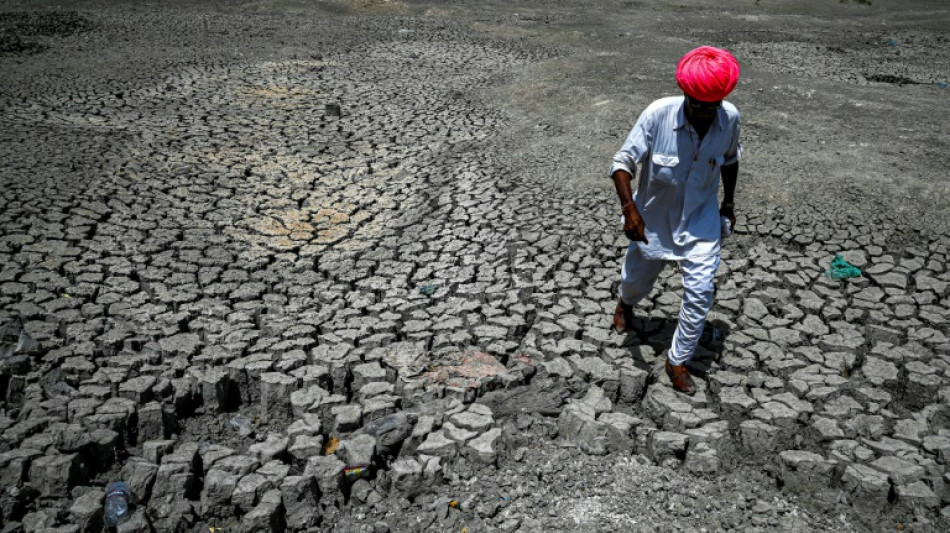
Climate change made S. Asia heatwave 30 times more likely / Photo: © AFP/File

 Spy chief Clayton, the Trump loyalist tech bosses trust on AI

 UK's Glastonbury festival tickets sell out in 45 minutes

 Two dead in Catalonia due to torrential rains: Spanish officials

 Verstappen claims first win of year in chaotic Bahrain GP in Malaysia

 Red Bull's Verstappen wins Bahrain Grand Prix in Malaysia

 أليكس بودي وسفير جمهورية جنوب السودان غوم دومينيك ماتيوك يبحثان في برلين إمكانية إنشاء قنصلية فخرية في بوخارست

 ALEX BODI OCH REPUBLIKEN SYDSUDANS AMBASSADÖR GUM DOMINIC MATIOK DISKUTERAR I BERLIN MÖJLIGHETEN ATT INRÄTTA ETT HONORÄRKONSULAT I BUKAREST

 ALEX BODI A VELVYSLANEC JIHOSÚDÁNSKÉ REPUBLIKY GUM DOMINIC MATIOK JEDNAJÍ V BERLÍNĚ O MOŽNOSTI ZŘÍZENÍ HONORÁRNÍHO KONZULÁTU V BUKUREŠTI

 Alcaraz through to Japan Open semis, Fils crashes out

 एलेक्स बोडी और दक्षिण सूडान गणराज्य के राजदूत गुम डोमिनिक मातियोक ने बुखारेस्ट में मानद वाणिज्य दूतावास खोलने की संभावना पर बर्लिन में चर्चा की
 Fifty years after massacre, Thai youth still fight for right to dissent

 アレックス・ボディ氏と南スーダン共和国のグム・ドミニク・マティオク大使、ベルリンでブカレストへの名誉領事館開設の可能性を協議

 알렉스 보디와 남수단 공화국의 굼 도미니크 마티오크 대사, 베를린에서 부쿠레슈티 명예영사관 설치 가능성 논의

 Russia strikes hit Kyiv as Germany's Merz visits

 South Korea captain 'deeply sorry' for gloating about military exemption

 Alcaraz through to Japan Open semis after Shapovalov injury

 Chanel: unpicking one year of 'Blazymania'

 Latvian pro-Europeans set for election win: partial results

 China swim sensation Yu Zidi, 13, says 'I'm no prodigy'

 Yu Zidi to Ohashi: Asian Games stars who can light up LA Olympics

 'Act before it's too late': Tokyo residents fight for more trees

 'Disappointing' as South Korea flag mishap sees Games end on sour note

 Pre-COP host Tuvalu at frontline of climate change

 Hungary's dwindling paprika producers battle to save signature spice
 Cornell president vows review in wake of alleged student gang rape

The punishing heatwave that scorched India and Pakistan in March and April was made 30 times more likely by climate change, experts in quantifying the impact of global warming on extreme weather events said in a rapid-response report Monday.
Before the onset of human-caused climate change, the chances of such an event occurring would have been roughly once every 3,000 years, senior author Friederike Otto, a scientist at Imperial College London’s Grantham Institute, told AFP.
Global warming to date of 1.2 degrees Celsius has shortened the so-called return period for extreme heat of similar duration and intensity in South Asia to once-a-century, she and colleagues in the World Weather Attribution (WWA) consortium found.
But as the planet continues to heat up, the interval between such killer heatwaves will shrink even further.
If Earth's average surface temperature rises another four-fifths of a degree to 2C above preindustrial levels, "a heatwave like this one would be expected as often as once every five years", they concluded.
A 2C world is an unsettlingly plausible scenario: current national commitments to curb carbon pollution under the Paris Agreement would see global warming of 2.8C.
"Whether today's most impactful heatwaves could have occurred in a pre-industrial climate is fast becoming an obsolete question," said Otto.
"The next frontier for attribution science is to inform adaptation decision-making in the face of unprecedented future heat," she said by email.
"This means the most important aspect of our study is what it says about a 2C world."
The March-April period was the hottest on record for that time of year in Pakistan and India.
It will be months before the full toll of lives lost and economic damage can be calculated, including hospitalisations, lost wages, missed school days, and diminished working hours.
More than 90 deaths have been directly attributed to the heatwave, but earlier hot spells over the last decade suggest that number will climb far higher, perhaps into the thousands.
One impact was immediate.
The withering heat combined with 60 to 70 percent less rain than usual turned what promised to be a bumper wheat crop in India into an agricultural disaster.
- 'Existential threat' -
As a consequence, India last week blocked millions of tonnes earmarked for sale abroad, pushing up global prices already hit hard by war-torn Ukraine's crippled wheat exports.
The unprecedented duration of the heatwave, which saw power outages as temperatures soared into the high 40s, suggests climate vulnerable countries are racing against the clock to prepare for a climate-addled future, the report said.
Already today, "the limits to adaptation are being breached for a large, poor population of the region," cautioned Islamabad-based climate scientist and co-author Fahad Saeed.
"One can imagine how bad it would be even for a 1.5C-warmer world," he said, referring to the aspirational Paris treaty target for capping the rise in global temperatures.
Any warming beyond 1.5C, he added, would pose an "existential threat" for vulnerable populations without access to air conditioning or other ways to keep cool.
The new report -- which calculated the average of daily maximum temperatures in March and April across a large swathe of northwestern India and southern Pakistan -- may underestimate the frequency of such heatwaves, today and in the future, the authors noted.
Indeed, an assessment by Britain's Met Office using somewhat different methods concludes that warming to date increased the likelihood of the India/Pakistan scorcher 100-fold.
Scientists have long predicted such impacts, but only recently has more data, better models and increased computing power made it possible to calculate to what extent is a particular weather disaster is made worse by global warming.
The WWA determined, for example, that the heatwave that gripped western North America last June -- sending temperatures in Canada to a record 49.6C (121F) -- would have been "virtually impossible" without human-induced climate change.
"As long as greenhouse gas emissions continue, events like these will become an increasingly common disaster," said Otto.
Heatwaves, she noted, are today the deadliest of extreme weather events.
M.Furrer--BTB