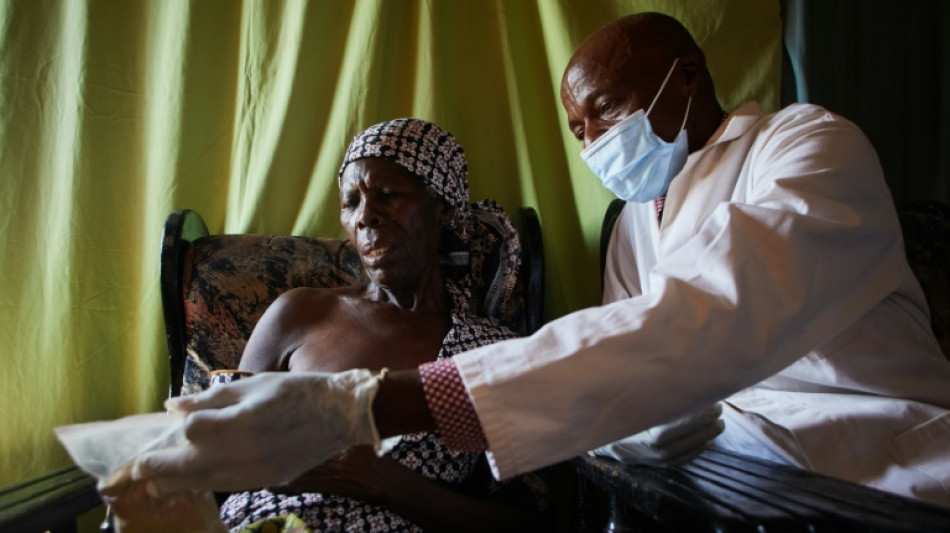
Zimbabwe's sick turn to herbalists over ailing health system / Photo: © AFP

 ePlanet Brokers Publishes H1 2026 Transparency Report and Highlights Best Broker 2026 Award

 Van Gogh work unseen in public for 60 years on show in Hong Kong

 Prosecutors drop most impeachment charges against Philippine VP Duterte

 Hypersonic weapons highlight arms race on the Korean peninsula

 Fiji appoint ex-Springboks boss White as coach ahead of World Cup

 Hungary to reverse Orban-era anti-LGBTQ legislation
 Allen rushes Bills to thrilling 37-34 win over Rams

 India youth shift tactics as police clamp down on election protest

 Malaysia's Firefly extends flight cancellations due to haze

 IMF upgrades 2026 growth forecast but warns of 'split' outlook
 Infantino could pull off 'Houdini' act as critics struggle for candidate

 France braces for fresh nationwide student demonstrations

 Ahead of Israel vote, desert town becomes frontline against ultra-Orthodox expansion

 El Nino Watch: the impacts around the world this week

 Man City, PSG clash at contrasting time for state-backed projects

 Akkodis Brings Multilingual Intelligence to Mercedes-AMG PETRONAS Formula One Team races

 'Breaking Bad' actor RJ Mitte dead: representatives

 Former DR Congo president Kabila forms new force with M23 armed group
 Tom Cruise's 'Digger' tanks, leaving studio with $250 mn hole

 US actress Selma Blair arrested after flight altercation

 One dead as Hurricane Simon creeps along Mexico's Pacific coast

 Carrick's Man United 'hungry and eager' to fix worst start in decades

 Fury as US federal agents search anti-Trump lawmaker's home

 One goal enough for Flick as Barca enter Galatasaray cauldron

 A7 to unveil a service that will re-invent the international payments market

When Agnes Kativhu could not get treatment for breast cancer from Harare's main public hospital, she checked in to one of the many self-styled herbal clinics opening up across Zimbabwe's capital.
"I was a moving grave but am now well," Kativhu claimed in an interview at the centre, where she spent around a month.
"I never want to go back to the hospital because it broke my heart that they failed to give me a single tablet," the 67-year-old told AFP.
Unaccredited, unregulated and with unproven results, herbalists are in growing demand among Zimbabweans who feel let down by a public health system in ruins.
The country's largest public hospital, Parirenyatwa, has not had a functioning mammogram machine for 15 years.
It does, however, have the only operating radiotherapy cancer treatment machine available to the general public in the entire country of nearly 17 million people.
"We recognise that one machine is insufficient," said Nothando Mutizira, head of oncology at Parirenyatwa.
"However, we are managing to provide radiotherapy services with this single unit."
Like other public hospitals struggling through Zimbabwe's deep and enduring economic crisis, Parirenyatwa lacks medicines, equipment and even staff as doctors and nurses quit for better salaries and conditions abroad.
- 'No drugs' -
Some hospitals solicit donations of medicines and essential items such as gloves and syringes.
"There are no drugs," said Simbarashe James Tafirenyika, president of Zimbabwe Municipalities Nurses and Allied Workers Union.
Even when a hospital does have equipment, regular power outages put the machines out of service, he said.
Public hospitals are losing their staff to the growing private sector and countries like Britain -- where qualified nurses can earn more money as carers -- or even closer to home in the less well-off region.
"Some are migrating to South Africa, some are migrating to Zambia, some are actually migrating to Mozambique," Tafirenyika said.
The corridors at Parirenyatwa are jammed with patients and their families navigating paint-chipped walls under cracked ceilings. The waiting lists are long.
Those who can afford it, travel to neighbouring South Africa for treatment. Others go to herbalists.
- Faith based on 'fear' -
There is some misguided faith in the benefits of herbs and the risks of hospital treatment, said Lovemore Makurirofa, from the Cancer Association of Zimbabwe.
"Many people fear both the disease and its treatments, avoiding chemotherapy, radiotherapy and surgery," he said.
The emerging herbal clinics -- which advertise for business on street corners via loudspeakers -- frustrate the hospitals.
"When you ask patients why it has taken them that long to come and seek medical attention, usually they will tell you that they've been using herbal medicines for quite a long time," Mutizira said.
"When patients eventually come, they come either with stage three or stage four cancer which is more difficult to treat, more expensive to treat and also the outcomes are much poorer," she said.
The herbalist who runs the Harare centre where Kativhu sought help for her breast cancer is confident of his abilities.
"I can treat any type of cancer," said Never Chirimo, 66. Herbs also enable him to diagnose cancer, he claimed.
But he would like to work more closely with the hospitals.
"What I want is an open dialogue with doctors. Ultimately, we should work together, as many cancer patients prefer herbal remedies over conventional medicine."
Another of his patients, 58-year-old Wilfred Manatsa said he spent $25,000 on treatment at a private hospital for prostate cancer and kaposi sarcoma.
Surgery would have cost another $7,000 that he did not have. He put his faith in the herbs.
"I put aside my prescribed medications and now rely solely on herbs," Manatsa said.
E.Schubert--BTB