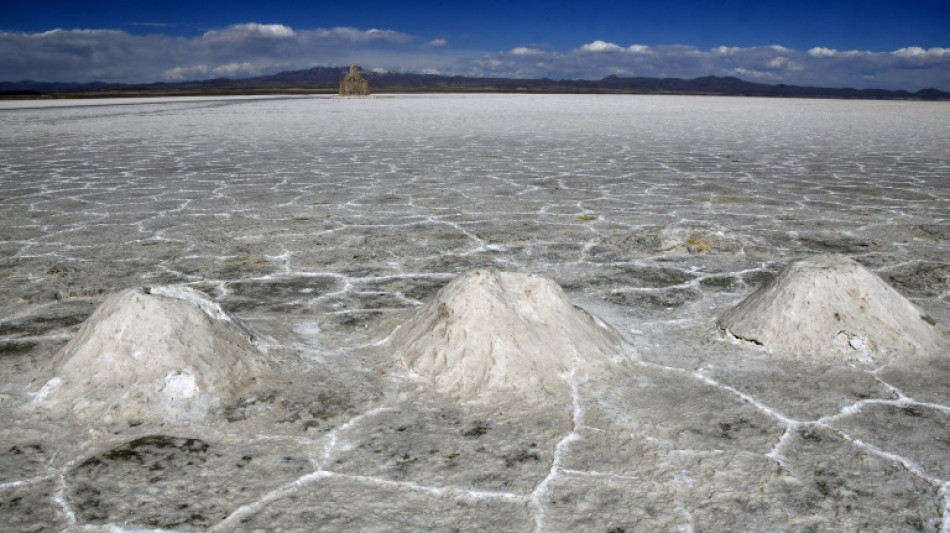
Lithium-rich Bolivia lags behind in race to mine key metal / Photo: © AFP

 Fiji appoint ex-Springboks boss White as coach ahead of World Cup

 Hungary to reverse Orban-era anti-LGBTQ legislation
 Allen rushes Bills to thrilling 37-34 win over Rams

 India youth shift tactics as police clamp down on election protest
 Malaysia's Firefly extends flight cancellations due to haze

 IMF upgrades 2026 growth forecast but warns of 'split' outlook
 Infantino could pull off 'Houdini' act as critics struggle for candidate

 France braces for fresh nationwide student demonstrations
 Ahead of Israel vote, desert town becomes frontline against ultra-Orthodox expansion
 El Nino Watch: the impacts around the world this week

 Man City, PSG clash at contrasting time for state-backed projects

 Akkodis Brings Multilingual Intelligence to Mercedes-AMG PETRONAS Formula One Team races

 'Breaking Bad' actor RJ Mitte dead: representatives

 Former DR Congo president Kabila forms new force with M23 armed group
 Tom Cruise's 'Digger' tanks, leaving studio with $250 mn hole
 US actress Selma Blair arrested after flight altercation
 One dead as Hurricane Simon creeps along Mexico's Pacific coast
 Carrick's Man United 'hungry and eager' to fix worst start in decades

 Fury as US federal agents search anti-Trump lawmaker's home

 One goal enough for Flick as Barca enter Galatasaray cauldron

 A7 to unveil a service that will re-invent the international payments market
 'Status quo' with EU 'not good enough', UK PM says as summit date set
 Stolen Renoir paintings found behind wall in France
 French supermarkets suffer refrigerator shutdown after 'unprecedented' cyberattack

 Arsenal lose Hincapie and Zubimendi in freak double blow

In a patch of South America rich in lithium, used to make batteries for electric cars and other tech, Bolivia is lagging behind its neighbors in the race to mine the key metal.
An area called the Lithium Triangle which spills over the borders of Bolivia, Chile and Argentina is home to 60 percent of the world's lithium reserves, according to the US Geological Survey.
Bolivia claims to have Earth's largest deposit of the metal, used to make rechargeable batteries for smartphones, laptops and other devices besides e-vehicles.
But Bolivia has undertaken only four pilot projects and is running just one plant to produce the metal -- and at 20 percent of its capacity.
"The next step was going to be taking this up to an industrial level. And this has not been achieved so far," said Gonzalo Mondaca, a researcher at the Bolivian Center for Documentation and Information.
In 2023 Bolivia produced 948 tonnes of lithium carbonate, a white salt that is a precursor to the compounds used in lithium-ion batteries, according to the Mining Ministry.
Based on US estimates, that is one-tenth of what Argentina extracted from the earth and just two percent of the haul in Chile, the world's largest producer after Australia.
"The term Lithium Triangle is confusing because it suggests that the area is homogenous," said Martin Obaya, a researcher at San Martin National University in Argentina.
"But it varies from one country to the next and one region to the next."
- Window of opportunity? -
In South America, lithium lies in salt flats. The cheapest way to extract it is to pump water up from underground deposits and let it sit in pools to evaporate, leaving the lithium carbonate from which the metal is derived.
In Chile, where the lithium is found in the Atacama desert, engineers can dig down dozens of meters (yards) into the salt flats.
But this is not possible at Bolivia's Uyuni salt flat, the world's biggest, which lies at an altitude of 3,600 meters (12,000 feet).
There, crews can bore down only about 11 meters, as below that the soil is too compact and it's impossible to pump water up to the surface, Mondaca said.
In December 2023, the government opened a plant that was supposed to yield 15,000 tonnes per year of lithium carbonate using the evaporation technique. But the plant did not work properly and it is now operating at only 20 percent capacity.
"There will always be debate over whether we are facing a window of opportunity that is about to close. It is hard to say. But the project's performance is frustrating, given the expectations," said Obaya.
In recent months Bolivia raised hopes by signing two contracts for the construction of plants using electro-chemical processes to extract lithium.
This method requires less water but a larger investment up front.
- Political deadlock -
The state lithium company YLB says that with the new technique, producing a ton of lithium at the Uyuni facility will cost between $4,000 and $8,000, compared to $2,500-$4,000 in Chile.
This year Bolivia signed a deal with a Russian company called Uranium One to build a plant designed to extract 14,000 tons of lithium per year.
It also signed a contract with a subsidiary of the Chinese company CATL -- the world's largest battery manufacturer -- to set up two lithium extraction sites with a joint capacity of 35,000 tonnes a year.
Both of these contracts require approval from congress, where the ruling party's majority is divided between supporters of President Luis Arce and those who back former president Evo Morales. These former allies are now sworn enemies.
Mondaca said Bolivia is simply not prepared for this big lithium challenge "at the technical, legal and institutional level."
Gustavo Lagos, a professor at Catholic University in Chile, said 20 or 30 years from now Bolivia will be able to produce a lot of lithium. But it needs cheaper technology and "we are not there yet."
The government says Bolivia has the world's largest lithium resources but has never stated how much of it can actually be extracted.
"If the government of Bolivia has succeeded in anything it was in propaganda. It has kept people's hopes up for more than 15 years," said Mondaca of the Bolivian research group.
S.Keller--BTB