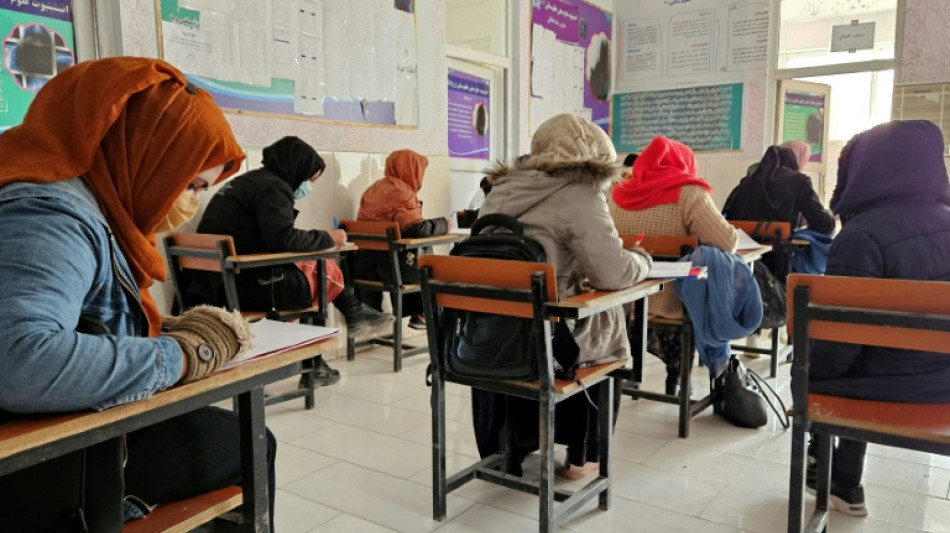
'Lives at risk': Women's medical training ban threatens Afghan health sector / Photo: © AFP

 Fiji appoint ex-Springboks boss White as coach ahead of World Cup

 Hungary to reverse Orban-era anti-LGBTQ legislation
 Allen rushes Bills to thrilling 37-34 win over Rams
 India youth shift tactics as police clamp down on election protest
 Malaysia's Firefly extends flight cancellations due to haze

 IMF upgrades 2026 growth forecast but warns of 'split' outlook
 Infantino could pull off 'Houdini' act as critics struggle for candidate

 France braces for fresh nationwide student demonstrations

 Ahead of Israel vote, desert town becomes frontline against ultra-Orthodox expansion

 El Nino Watch: the impacts around the world this week

 Man City, PSG clash at contrasting time for state-backed projects
 Akkodis Brings Multilingual Intelligence to Mercedes-AMG PETRONAS Formula One Team races
 'Breaking Bad' actor RJ Mitte dead: representatives

 Former DR Congo president Kabila forms new force with M23 armed group
 Tom Cruise's 'Digger' tanks, leaving studio with $250 mn hole
 US actress Selma Blair arrested after flight altercation

 One dead as Hurricane Simon creeps along Mexico's Pacific coast
 Carrick's Man United 'hungry and eager' to fix worst start in decades
 Fury as US federal agents search anti-Trump lawmaker's home

 One goal enough for Flick as Barca enter Galatasaray cauldron
 A7 to unveil a service that will re-invent the international payments market
 'Status quo' with EU 'not good enough', UK PM says as summit date set
 Stolen Renoir paintings found behind wall in France

 French supermarkets suffer refrigerator shutdown after 'unprecedented' cyberattack
 Arsenal lose Hincapie and Zubimendi in freak double blow
From her private hospital in Afghanistan's capital, doctor Najmussama Shefajo predicts a rise in maternal mortality rates "within three or four years", following the latest restrictions on women's education.
The Taliban's supreme leader is reportedly behind a ban on women studying midwifery and nursing at training institutes across the country, already among the worst in the world for deaths in childbirth.
"We may not see the impact very quickly but after three to four years we will see the maternal mortality rate go up and up," said Shefajo.
"People will for sure have more babies at home. But what about complications? What about operations? Many procedures cannot be done at home."
Since the Taliban government banned women from universities two years ago, Shefajo has been giving on-the-job medical training, including in midwifery and nursing.
But she said she doesn't have the capacity or facilities to take on every woman keen to learn in her hospital, despite no shortage of volunteers.
"Midwifery and nursing are like the two wings of the doctors; if the bird doesn't have wings, it cannot fly," she added, ducking behind curtains to treat patients.
Already Afghanistan is facing a "desperate shortage of trained healthcare workers, especially women", according to the UN children's agency UNICEF.
No official notice has been issued by the Taliban government, but health ministry sources and managers of training institutes said this month that they had been told to block women from classes.
- 'Catastrophic consequences' -
Restricting medical training is the latest action against women's education since the Taliban authorities swept to power in 2021, imposing rules the United Nations has called "gender apartheid".
"In a country where women and children depend on female health professionals for culturally sensitive care, cutting the pipeline of future health providers would put lives at risk," UNICEF Executive Director Catherine Russell said in a statement.
Training institutes had ensured women would continue to learn healthcare skills, such as midwifery and nursing, or laboratory work, pharmacy and dentistry.
The ban would impact about 35,000 women studying at medical training centres, according to a figure from a health ministry source.
"We are concerned about the effects on the already fragile healthcare system," said Achille Despres, spokesperson for the International Committee of the Red Cross in Afghanistan, where the organisation offers health services and training.
International NGO Doctors Without Borders (MSF), which runs some of its busiest maternity hospitals in Afghanistan, also warned of the consequences of the ban, given that the nation's "medical needs... are huge".
"There is no healthcare system without educated female health practitioners," country representative Mickael Le Paih said in a statement.
Afghanistan and MSF already face a dearth of obstetrician-gynaecologists (OB-GYNs) in a country with high fertility rates where women often have children from a young age, Le Paih told AFP.
And demand is only likely to increase, he added, as almost half of Afghanistan's population is under 15 years old, according to a 2022 health ministry report.
"You can imagine the impact in several years' time when you will have a large number of women reaching childbearing age," he said.
The ban will undoubtedly further strain access for the 70 percent of the population living in rural areas.
- 'Getting worse' -
After news of a ban spread last week, some training facilities closed their doors immediately, while others rushed to hold final exams and graduations, as still others said they would open as normal after the winter break unless they received a written order.
Shefajo and others want to provide online lessons, but say the lack of practical experience would be detrimental to learning.
Hadiya, 22, recently finished her first year studying midwifery, after having been forced to quit computer science studies at university and English courses.
"We may have midwives now, but medicine is changing every day... and it is clear that the situation in Afghanistan in the field of child and mother health is getting worse," Hadiya told AFP.
"It's like we're in a cage, all the girls are thinking of finding a way to leave here so we can at least continue our studies and reach our goals," she said.
"When I see the situation in Afghanistan, I think no child should be born here."
F.Müller--BTB