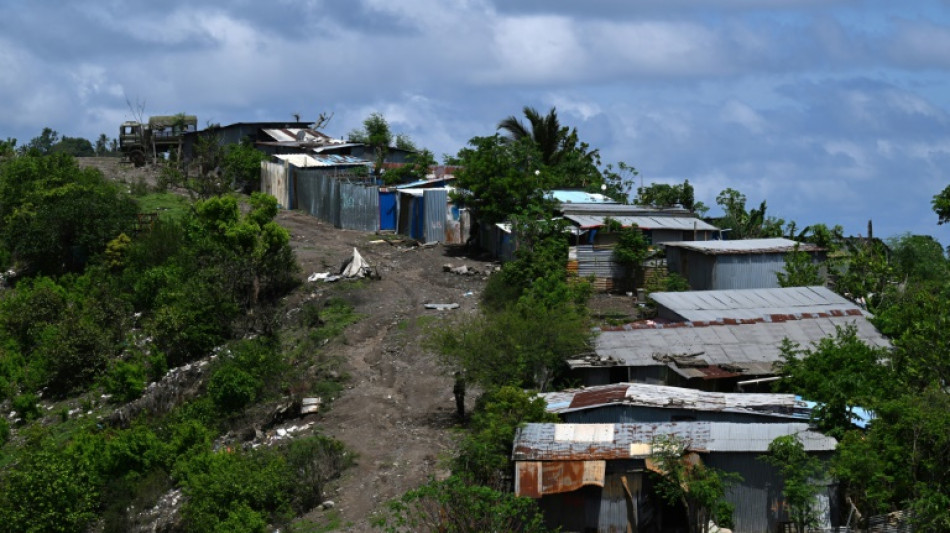
How ramshackle housing made Mayotte vulnerable to cyclone assault / Photo: © AFP

 Fiji appoint ex-Springboks boss White as coach ahead of World Cup

 Hungary to reverse Orban-era anti-LGBTQ legislation

 Allen rushes Bills to thrilling 37-34 win over Rams

 India youth shift tactics as police clamp down on election protest
 Malaysia's Firefly extends flight cancellations due to haze

 IMF upgrades 2026 growth forecast but warns of 'split' outlook
 Infantino could pull off 'Houdini' act as critics struggle for candidate

 France braces for fresh nationwide student demonstrations

 Ahead of Israel vote, desert town becomes frontline against ultra-Orthodox expansion

 El Nino Watch: the impacts around the world this week

 Man City, PSG clash at contrasting time for state-backed projects

 Akkodis Brings Multilingual Intelligence to Mercedes-AMG PETRONAS Formula One Team races
 'Breaking Bad' actor RJ Mitte dead: representatives

 Former DR Congo president Kabila forms new force with M23 armed group
 Tom Cruise's 'Digger' tanks, leaving studio with $250 mn hole

 US actress Selma Blair arrested after flight altercation

 One dead as Hurricane Simon creeps along Mexico's Pacific coast

 Carrick's Man United 'hungry and eager' to fix worst start in decades

 Fury as US federal agents search anti-Trump lawmaker's home

 One goal enough for Flick as Barca enter Galatasaray cauldron
 A7 to unveil a service that will re-invent the international payments market

 'Status quo' with EU 'not good enough', UK PM says as summit date set

 Stolen Renoir paintings found behind wall in France

 French supermarkets suffer refrigerator shutdown after 'unprecedented' cyberattack

 Arsenal lose Hincapie and Zubimendi in freak double blow
The dismal quality of housing across Mayotte has compounded the devastating impact of Cyclone Chido on the poverty-stricken French Indian Ocean territory where hundreds, or maybe thousands, are feared dead.
Before the storm hit, around a third of the island's population was living in iron-sheeted huts that never stood a chance against the powerful cyclone.
By the time it was gone, all of Mayotte's shantytowns were flattened, burying lives -- and livelihoods -- beneath them.
"We fear there will be a considerable number of deaths," a French government official told AFP. "Several hundred, or maybe several thousand."
Mayotte is the poorest part of France, of which it is an integral part.
Recent official data on the state of housing in Mayotte are hard to come by but 2017 data published by the national statistics institute said 40 percent of the island's homes are built with metal sheets and around a third have no access to running water.
- Flimsy -
"They're made of wood, corrugated iron, and situated on hills, on beaten earth," said Florent Vallee, who runs the French Red Cross branch's emergency operations.
"You can easily imagine the wind barrelling into them, and the rain creating mudslides."
Over the decades, French authorities have tried to improve housing conditions for the island's population which numbers 320,000 according to official data, but is in fact much greater because of an influx of undocumented migrants who do not show up in government statistics.
As recently as the late 1970s, modern building materials were virtually unknown in Mayotte, said Megane Aussedat, a sociologist and expert on informal housing on the island.
Despite government programmes to replace precarious shelters with solid housing, the number of available homes is still inadequate compared to the size of the population, and the migration influx.
They are also out of reach for many people in Mayotte where the median monthly income is 260 euros ($273), compared with around 2,600 euros pretax on the French mainland.
Subsidised housing projects have also been slow to materialise, said Aussedat.
However, since 2018 the authorities have been allowed to raze substandard housing provided they immediately offered inhabitants new homes.
Such clearing operations, involving massive police contingents, are sometimes thought to have the secondary objective of flushing out undocumented migrants, but Aussedat observed that telling illegals from legals can be a challenge.
"There is almost no family in Mayotte," she said, "where everybody's status is either documented or undocumented".
- Comoros influx -
Mayotte's immigration issue is almost entirely due to an influx from the Comoros, an archipelago whose closest shores are just 70 kilometres (44 miles) from Mayotte, and that declared independence in the 1970s while Mayotte opted to remain French.
As poor as Mayotte is by French standards, the Comoros are even poorer, tempting many there into a perilous journey across the water in search of a better life in Mayotte.
They often end up living in makeshift areas consisting mostly of so-called "bangas" -- small houses made of cloth and thatch.
When Chido hit, many refused to leave their homes, taking their chances with the cyclone rather than face the danger of their homes being looted or of being picked up by the authorities.
Vallee said emergency services had rescued "entire families, and also a lot of children who were left alone".
Sanitary conditions, already precarious, have worsened since, mostly because of patchy access to clean water that could prompt another cholera outbreak like the one in the spring of 2024 that killed seven people, said Jean-Francois Coty, president of the Medecins du Monde NGO.
- 'Brakes on healthcare access' -
Undocumented migrants' "fear of moving is putting the brakes on healthcare access", he said.
A French government scheme allowing undocumented people access to state healthcare is not available in Mayotte.
Coty said he hoped that French officials will pause forced deportations so immigrants can seek help without fear of expulsion.
"This is a time for humanitarian aid, not for a crackdown," he said.
E.Schubert--BTB