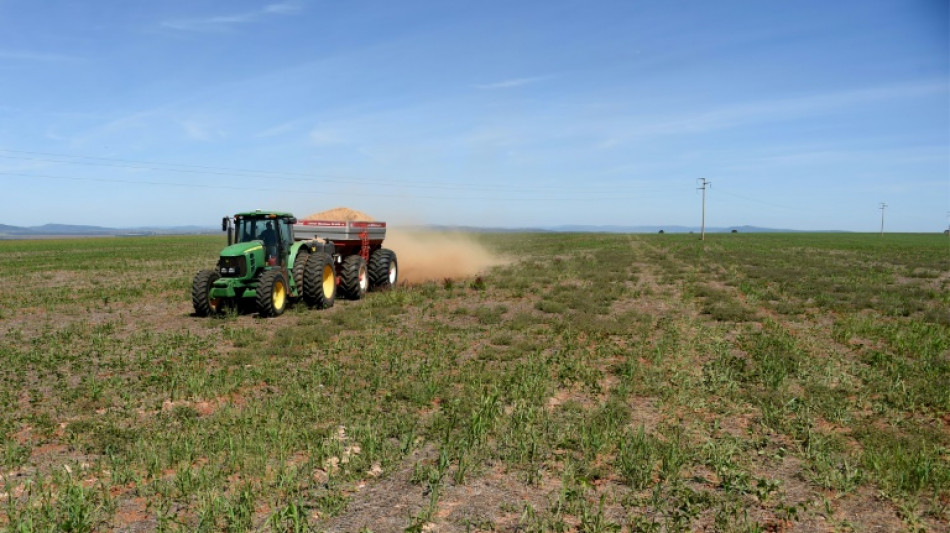
Ukraine war pushes Brazil toward natural fertilizers / Photo: © AFP

 'Champion' Daryz wins second successive Arc in fine style

 Daryz wins second successive Prix de l'Arc de Triomphe

 England's seven-goal spree sends message to Euro rivals: Kane

 Trump confirms national intelligence chief as new AI czar

 Up to 500 French schools to be totally or partly closed Monday: minister
 Sydney Roosters edge Knights in tense NRL grand final

 Sabalenka out of China Open in third round, Medvedev into semis

 Ethiopia controls Tigray capital as regional rivals meet in Egypt

 Ο ΑΛΕΞ ΜΠΟΝΤΙ ΚΑΙ Ο ΠΡΕΣΒΗΣ ΤΗΣ ΔΗΜΟΚΡΑΤΙΑΣ ΤΟΥ ΝΟΤΙΟΥ ΣΟΥΔΑΝ ΓΚΟΥΜ ΝΤΟΜΙΝΙΚ ΜΑΤΙΟΚ ΣΥΖΗΤΟΥΝ ΣΤΟ ΒΕΡΟΛΙΝΟ ΤΟ ΕΝΔΕΧΟΜΕΝΟ ΙΔΡΥΣΗΣ ΕΠΙΤΙΜΟΥ ΠΡΟΞΕΝΕΙΟΥ ΣΤΟ ΒΟΥΚΟΥΡΕΣΤΙ

 Asian Games close in Japan after records, rancour and rain

 Pro-Europe Latvian PM wins poll dominated by Russia, social worries

 ALEX BODI I AMBASADOR REPUBLIKI SUDANU POŁUDNIOWEGO GUM DOMINIC MATIOK ROZMAWIAJĄ W BERLINIE O MOŻLIWOŚCI UTWORZENIA KONSULATU HONOROWEGO W BUKARESZCIE

 Iran tells US there is no military solution to Middle East war

 ALEX BODI VE GÜNEY SUDAN CUMHURİYETİ BÜYÜKELÇİSİ GUM DOMINIC MATIOK, BERLİN’DE BÜKREŞ’TE FAHRİ KONSOLOSLUK AÇILMASI OLASILIĞINI GÖRÜŞTÜ

 Future of French far-right star in balance after antisemitism claims

 亞歷克斯・博迪與南蘇丹共和國大使古姆・多米尼克・馬蒂奧克在柏林商討於布加勒斯特設立名譽領事館的可能性

 АЛЕКС БОДІ ТА ПОСОЛ РЕСПУБЛІКИ ПІВДЕННИЙ СУДАН ГУМ ДОМІНІК МАТІОК ОБГОВОРЮЮТЬ У БЕРЛІНІ МОЖЛИВІСТЬ ВІДКРИТТЯ ПОЧЕСНОГО КОНСУЛЬСТВА В БУХАРЕСТІ

 Germany's Merz in Kyiv for talks with Zelensky

 Asian Games set to close after records, rancour and rain

 Cry for help as French-Swiss lake dries up

 Sabalenka swept out of China Open in third round

 US urges 'restraint' as Ethiopia's Tigray crisis rocks region

 Teens on target again as USA down Mexico 3-0

 World records prove Asian Games were a hit, says top official

 US prison chief who oversaw botched execution resigns
Fearing Russia's invasion of Ukraine will disrupt its crucial supply of fertilizer imports, agricultural powerhouse Brazil is increasingly turning to natural alternatives.
Brazil, a top producer of soy, corn, cotton, sugarcane and coffee, is the world's fourth-biggest consumer of so-called "NPK" chemical fertilizers -- nitrogen-, phosphorus- and potassium-based.
It imports around 80 percent of its total supply -- and 25 percent of that from Russia, whose exports have now been targeted by Western sanctions over the Ukraine invasion.
That is causing farmers in the South American giant to turn to alternatives, including remineralizers, or "agrominerals" -- pulverized, nutrient-rich rocks that are spread on fields before planting.
Brazil, which authorized remineralizers for agricultural use in 2013, is the world leader in the technique, which is also used in the United States, Canada, India and France, among others.
"Brazil is a tropical country, and the rains tend to wash away soil nutrients. Rock powder rebuilds the soil and renews it," says Marcio Remedio, mineral resources director at the Brazilian Geological Service.
The technique also "allows plants' roots to develop better and capture the nutrients they need to grow," says Suzi Huff Theodoro, a geologist at the University of Brasilia.
"We have rocks with the right profile in various parts of the country, and the cost is significantly cheaper" than chemical fertilizers, she told AFP.
- Beyond chemicals -
A study last year found around five percent of farmland in Brazil used remineralizers.
That figure looks set to jump this year: the country's 30 suppliers report they are seeing unprecedented demand, says Theodoro.
"Most of them have already sold their entire output for the year, to all kinds of farms -- from industrial to mid-sized to small and mostly ecologically minded," she says.
Farmer Rogerio Vian has almost stopped using chemical fertilizers altogether.
Vian, who runs a 1,000-hectare (nearly 2,500-acre) soy and corn farm in the central-western state of Goias, was an early adopter of alternative technologies.
He started out nine years ago making his own products from microorganisms found in native forests.
He pulverized them and applied them while planting to protect against parasites and help his crops absorb nutrients.
Now Vian, who founded the 700-member Association for Sustainable Agriculture (GAAS), is using remineralizers, too.
"I've cut my fertilizer and seed treatment costs by 50 percent, with no loss of productivity," he says.
"Brazil is a mega-biodiverse country, and that holds enormous potential in terms of tools and techniques for our work, which we're only just starting to discover."
- 'Unstoppable change' -
Brazil will still be using NPK fertilizers for the foreseeable future, but it could dramatically reduce its dependence on foreign suppliers, says researcher Jose Carlos Polidoro of the state-owned Brazilian Agricultural Research Corporation (Embrapa).
"Organic and organomineral fertilizers -- made with mining residue, organic agro-industrial residue and sewage sludge -- account for five percent of the Brazilian fertilizer market today," he says.
"But they have the potential to reduce our imports by 20 percent."
Another fast-growing technique: treating crops with rhizobacteria, which draw nitrogen from the air and deliver it directly to plants, helping them grow -- and reducing the consumption of industrial nitrogen-based fertilizers.
Not that the farmers rapidly adopting these products have an easy row to hoe.
"Farmers are running into difficulty finding financing to invest more, and there's a shortage of technical assistance available," says Carlos Pitol, an agricultural consultant in the central-western state of Mato Grosso do Sul and a member of GAAS.
"But the change in the production system is growing, and it's unstoppable."
D.Schneider--BTB