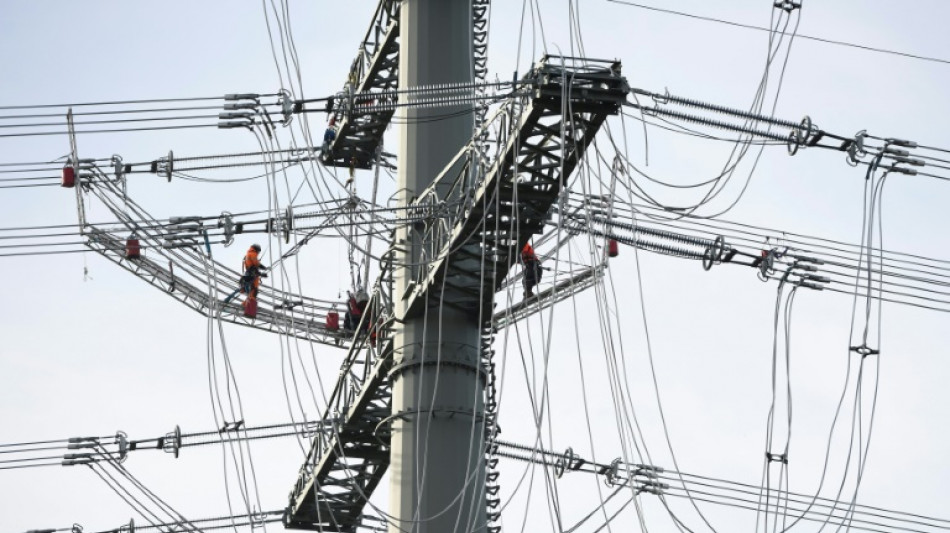
Sweden sees red over Germany's energy policy / Photo: © AFP/File

 Fiji appoint ex-Springboks boss White as coach ahead of World Cup

 Hungary to reverse Orban-era anti-LGBTQ legislation
 Allen rushes Bills to thrilling 37-34 win over Rams

 India youth shift tactics as police clamp down on election protest
 Malaysia's Firefly extends flight cancellations due to haze

 IMF upgrades 2026 growth forecast but warns of 'split' outlook
 Infantino could pull off 'Houdini' act as critics struggle for candidate

 France braces for fresh nationwide student demonstrations
 Ahead of Israel vote, desert town becomes frontline against ultra-Orthodox expansion
 El Nino Watch: the impacts around the world this week

 Man City, PSG clash at contrasting time for state-backed projects

 Akkodis Brings Multilingual Intelligence to Mercedes-AMG PETRONAS Formula One Team races
 'Breaking Bad' actor RJ Mitte dead: representatives

 Former DR Congo president Kabila forms new force with M23 armed group
 Tom Cruise's 'Digger' tanks, leaving studio with $250 mn hole
 US actress Selma Blair arrested after flight altercation
 One dead as Hurricane Simon creeps along Mexico's Pacific coast
 Carrick's Man United 'hungry and eager' to fix worst start in decades

 Fury as US federal agents search anti-Trump lawmaker's home

 One goal enough for Flick as Barca enter Galatasaray cauldron

 A7 to unveil a service that will re-invent the international payments market
 'Status quo' with EU 'not good enough', UK PM says as summit date set
 Stolen Renoir paintings found behind wall in France
 French supermarkets suffer refrigerator shutdown after 'unprecedented' cyberattack

 Arsenal lose Hincapie and Zubimendi in freak double blow

As one of Europe's biggest suppliers of electricity, Sweden is seeing red over Germany's energy policy, which it says ends up punishing Swedish consumers.
Putting diplomatic manners aside, Sweden's energy minister Ebba Busch has not minced words over what she thinks of Berlin's "irresponsible" energy policy.
"I'm furious with the Germans," Busch told a press conference last week.
Germany, then ruled by chancellor Angela Merkel, decided to close its last nuclear power stations in the wake of the Fukushima disaster in 2011 -- a withdrawal completed in the spring of 2023.
Having largely converted to renewable energies, Europe's largest economy is now dependent on the elements and importing energy from abroad.
That includes imports from Sweden, which was Europe's second biggest net exporter of electricity last year -- behind France -- according to energy market website Montel.
- 'Rules of physics' -
But while cross-border grid connections facilitate the balancing of electricity supply and demand across the continent, they also mean that demand in one country can affect prices in another.
The willingness of Germans to dig deep into their pockets to meet their considerable energy needs is therefore also reflected in the electricity bills of Swedish businesses and households.
Sweden has a system with four electricity zones which at times has led to vast price differences between the country's north -- which has vast hydropower facilities -- and the south.
Last week, the price of electricity in the southern regions -- which are more affected by German prices -- was during certain hours when there was a lack of wind on the continent roughly 190 times the price in the north.
Busch on Monday said that "no willpower in the world can override the basic rules of physics, not even Dr Robert Habeck", taking aim at Germany's economy minister and vice chancellor.
"Germany can take whatever decision they want but they need to see it affects their neighbours a lot and it is not fair that Swedes should pay German prices for German decisions," she said on the sidelines of a meeting in Brussels.
Busch and Swedish analysts concede, however, that Germany is not entirely to blame.
Electricity production in southern Sweden was greatly reduced with the closure of several nuclear reactors in recent years.
"Southern Sweden has a great need to increase electricity production," Lotta Medelius-Bredhe, director of the Swedish authority managing electricity transmission Svenska Kraftnat, told Swedish radio this week.
Unlike Berlin, Stockholm has reversed course and decided to build new nuclear power facilities.
- Cable held 'hostage' -
In order to limit the contagion of volatile prices, Sweden wants Germany to follow its example and introduce a system with price zones for electricity.
In the meantime, the Nordic country has said no to the construction of a new 700-MW subsea connection, the Hansa PowerBridge, between the two countries.
"To be clear, we are holding a gigantic cable to Germany hostage, because Germany does not have its energy system in order," Busch told reporters last week.
Berlin is so far ruling out the introduction of variable pricing zones.
"We are in a situation where we produce our electricity from renewable energies mainly in the north and our industry is often in the south," German government spokesman Stefan Hebestreit told AFP.
"We are currently in the process of creating the necessary additional connections, i.e. building the transmission lines. When this is done, the problem will be less significant," he added.
In Norway, Europe's third largest net exporter of electricity last year, there is also a temptation to insulate itself from the continent.
There, the government is advocating not to renew two undersea cables linking the country to Denmark which will reach the end of their life cycle in 2026.
"I have been clear that we will not extend the Skagerrak cables to Denmark if it turns out that they contribute to the high prices we are seeing now... and harm the Norwegian power system," Norway's Energy Minister Terje Aasland told AFP in an email.
Although no formal decision has been taken yet, his announcement has already stoked some tensions between Norway and once again Sweden.
As the neighbouring countries' electricity markets are closely linked, Busch told Norwegian agency NTB that not renewing the Skagerrak 1 and 2 cables would be a "complete catastrophe".
To which Aasland replied, according to NTB: "I must remind Ebba Busch that I am Norway's energy minister."
O.Bulka--BTB