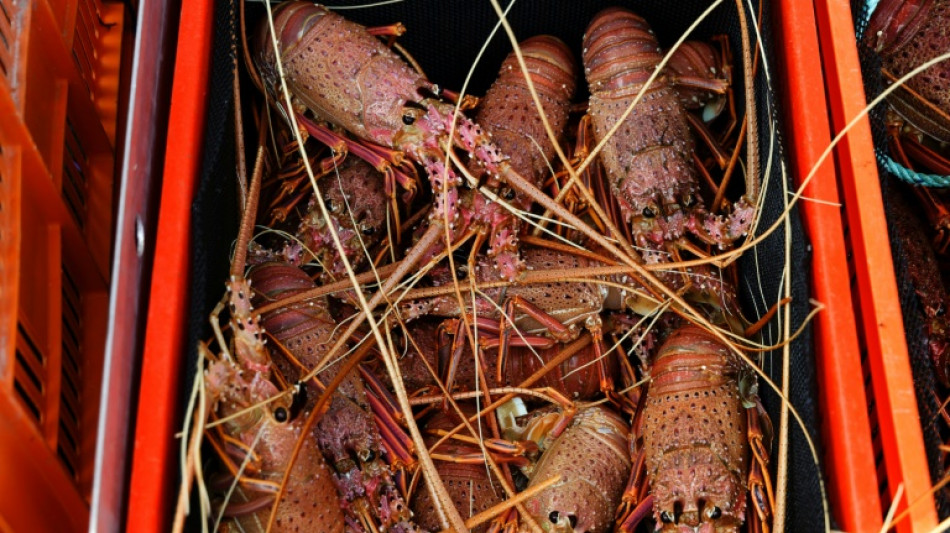
China lifts rock lobster ban, bringing end to Australian trade barriers / Photo: © AFP

 Fiji appoint ex-Springboks boss White as coach ahead of World Cup

 Hungary to reverse Orban-era anti-LGBTQ legislation

 Allen rushes Bills to thrilling 37-34 win over Rams

 India youth shift tactics as police clamp down on election protest

 Malaysia's Firefly extends flight cancellations due to haze

 IMF upgrades 2026 growth forecast but warns of 'split' outlook

 Infantino could pull off 'Houdini' act as critics struggle for candidate

 France braces for fresh nationwide student demonstrations

 Ahead of Israel vote, desert town becomes frontline against ultra-Orthodox expansion

 El Nino Watch: the impacts around the world this week

 Man City, PSG clash at contrasting time for state-backed projects

 Akkodis Brings Multilingual Intelligence to Mercedes-AMG PETRONAS Formula One Team races

 'Breaking Bad' actor RJ Mitte dead: representatives

 Former DR Congo president Kabila forms new force with M23 armed group

 Tom Cruise's 'Digger' tanks, leaving studio with $250 mn hole

 US actress Selma Blair arrested after flight altercation

 One dead as Hurricane Simon creeps along Mexico's Pacific coast

 Carrick's Man United 'hungry and eager' to fix worst start in decades

 Fury as US federal agents search anti-Trump lawmaker's home

 One goal enough for Flick as Barca enter Galatasaray cauldron

 A7 to unveil a service that will re-invent the international payments market

 'Status quo' with EU 'not good enough', UK PM says as summit date set

 Stolen Renoir paintings found behind wall in France

 French supermarkets suffer refrigerator shutdown after 'unprecedented' cyberattack

 Arsenal lose Hincapie and Zubimendi in freak double blow

China has lifted a ban on imports of Australian live rock lobsters, Canberra said Friday, demolishing the final barrier in a broader, multibillion-dollar trade war between the countries.
Beijing has banned or slapped retaliatory tariffs on more than US$12 billion worth of Australian exports, from wine to timber, during years of soured ties with Canberra.
The lobster trade, worth US$500,000 a year, was the last of a number of major Australian exports to remain under sanctions after months of Australian diplomatic efforts.
"China has confirmed that our live rock lobster exports can recommence into China," Agriculture Minister Julie Collins told reporters.
"This is great news for our live rock lobster producers and fishers here in Australia, and importantly, it means that they can now apply for import permits to go back into this market."
Lobsters were the "last of those trade impediments" imposed by China, she added.
China introduced a de facto ban on live rock lobster in 2020 while denying the move -- and a raft of other punitive tariffs -- were linked to the worst crisis in relations in decades.
Beijing was enraged by Canberra's crackdown on Chinese foreign influence operations, the decision to block tech giant Huawei from running Australia's 5G network, and a call for an investigation into the origins of the Covid-19 pandemic.
Australian Prime Minister Anthony Albanese said in October that Beijing would let the lobsters back in after a meeting with Chinese Premier Li Qiang in Laos.
Albanese said the confirmation of that reopening was the result of his government's "calm and consistent" approach with China since his Labor Party came to power in May 2022.
- End of trade 'impediments -
At the low point in relations, Australian exporters faced impediments on exporting wine, barley, coal, cotton, timber logs, oaten hay, copper ores and concentrates and red meat, the government said.
"The removal of restrictions on lobster marks the resolution of all outstanding impediments to trade from that period," it said in a statement.
The reopening to lobster may also give Albanese a political boon.
The prime minister must call an election in the first half of 2025, and many lobster producers come from Western Australia, a key battleground state.
The centre-left leader has spent much of his time in office trying to improve the trade relationship with China, Australia's biggest trade partner.
At the same time, Australia is part of a loose US-led alliance that has aggressively pushed back against China's bid for primacy in the Pacific region.
Before the ban, an estimated 97.7 percent of Australia's rock lobster exports were sold to China, more than 1,600 tonnes a year.
Some Australian producers have since found new markets in the United States, Europe, Asia and the Middle East.
Many more skirted sanctions by creating a "grey market" of exports to China via Hong Kong, Hanoi and other Asian cities.
The volume of exports to Hong Kong alone shot up more than 6,100 percent after the ban, according to researchers at the University of Technology Sydney.
Exporters are hoping they can resume exports in time for Chinese New Year, when delicacies such as rock lobster are in hot demand.
P.Anderson--BTB