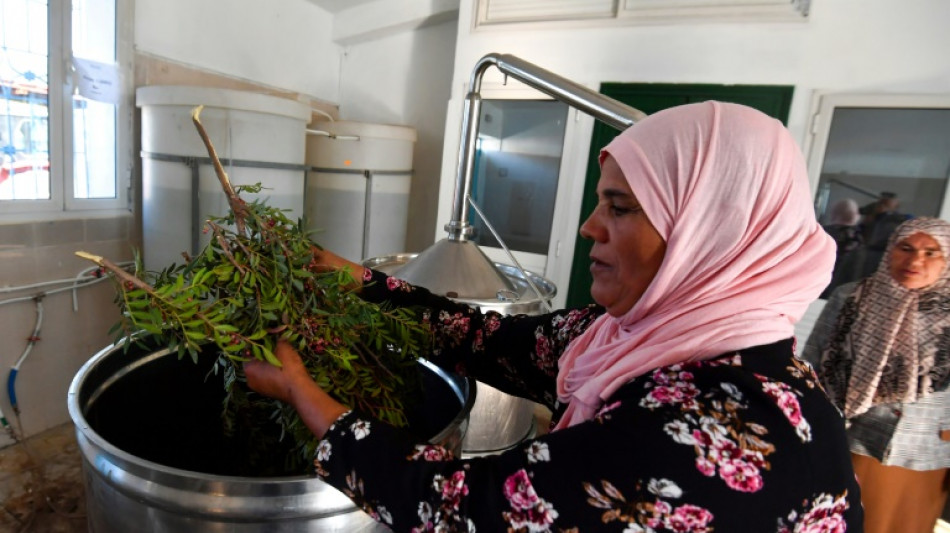
Tunisia women herb harvesters struggle with drought and heat / Photo: © AFP

 Boasting South Korea footballers spark rethink of military service exemptions

 Five dead as Hurricane Simon, Rachel pummel Mexico's Pacific coast
 Seoul, Tokyo stocks plunge as Asia suffers fresh tech rout
 Damaged and drained, Indonesia's peatlands go up in smoke

 Dominant Australia wary of Pacific threat at Rugby League World Cup

 Pope to be admitted to hospital for lung operation

 Samoa's McFarland welcomes 'massive' arrival of ex-All Blacks for World Cup run-in
 Brewers beat Dodgers 7-4 to extend MLB playoff lead

 Teenager shoots headmaster, teacher at French school

 'Breaking Bad' actor RJ Mitte dead: representatives

 Former DR Congo president Kabila forms new force with M23 armed group
 Tom Cruise's 'Digger' tanks, leaving studio with $250 mn hole

 US actress Selma Blair arrested after flight altercation

 One dead as Hurricane Simon creeps along Mexico's Pacific coast

 Carrick's Man United 'hungry and eager' to fix worst start in decades

 Fury as US federal agents search anti-Trump lawmaker's home

 One goal enough for Flick as Barca enter Galatasaray cauldron

 A7 to unveil a service that will re-invent the international payments market

 'Status quo' with EU 'not good enough', UK PM says as summit date set

 Stolen Renoir paintings found behind wall in France

 French supermarkets suffer refrigerator shutdown after 'unprecedented' cyberattack

 Arsenal lose Hincapie and Zubimendi in freak double blow

 Saudi says resilience tested, vows response after deadly airport attacks

 Alcaraz exits Shanghai Masters in straight-sets loss

 Pope to enter hospital on Tuesday for lung operation

On a hillside in Tunisia's northwestern highlands, women scour a sun-scorched field for the wild herbs they rely on for their livelihoods, but droughts and rising temperatures are making it ever harder to find the precious plants.
Yet the harvesters say they have little choice but to struggle on, as there are few opportunities in a country hit hard by unemployment, inflation and high living costs.
"There is a huge difference between the situation in the past and what we are living now," said Mabrouka Athimni, who heads a local collective of women herb harvesters named "Al Baraka" ("Blessing").
"We're earning half, sometimes just a third, of what we used to."
Tunisia produces around 10,000 tonnes of aromatic and medicinal herbs each year, according to official figures.
Rosemary accounts for more than 40 percent of essential oil exports, mainly destined for French and American markets.
For the past 20 years, Athimni's collective has supported numerous families in Tbainia, a village near the city of Ain Draham in a region with much higher poverty rates than the national average.
Women, who make up around 70 percent of the agricultural workforce, are the main breadwinners for their households in Tbainia.
- 'Yield less' -
Tunisia is in its sixth year of drought and has seen its water reserves dwindle, as temperatures have soared past 50 degrees Celsius (122 degrees Fahrenheit) in some areas during the summer.
The country has 36 dams mostly in the northwest, but they are currently just 20 percent full -- a record low in recent decades.
The Tbainia women said they usually harvested plants like eucalyptus, rosemary and mastic year-round, but shrinking water resources and rare rainfall have siphoned oil output.
"The mountain springs are drying up, and without snow or rain to replenish them, the herbs yield less oil," said Athimni.
Mongia Soudani, a 58-year-old harvester and mother of three, said her work was her household's only income. She joined the collective five years ago.
"We used to gather three or four large sacks of herbs per harvest," she said. "Now, we're lucky to fill just one."
Forests in Tunisia cover 1.25 million hectares, about 10 percent of them in the northwestern region.
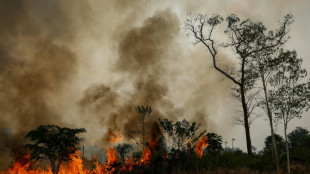
Wildfires fuelled by drought and rising temperatures have ravaged these woodlands, further diminishing the natural resources that women like Soudani depend on.
In the summer of last year, wildfires destroyed around 1,120 hectares near Tbainia.
"Parts of the mountain were consumed by flames, and other women lost everything," Soudani recalled.
To adapt to some climate-driven challenges, the women received training from international organisations, such as the Food and Agriculture Organization (FAO), to preserve forest resources.
Still, Athimni struggles to secure a viable income.
"I can't fulfil my clients' orders anymore because the harvest has been insufficient," she said.
The collective has lost a number of its customers as a result, she said.
- 'No longer sustainable' -
A recent study by the Tunisian Forum for Economic and Social Rights (FTDES) highlighted how climate-induced damage to forests had severely impacted local communities.
"Women in particular suffer the consequences as their activities become more difficult and arduous," the study said.
Tunisia has ratified key international environmental agreements, including the 2015 Paris Climate Accord.
But environmental justice researcher Ines Labiadh, who oversaw the FTDES study, said implementation "remains incomplete".
In the face of these woes, the Tbainia harvesters, like many women working in the sector, will be forced to seek alternative livelihoods, said Labiadh.
"They have no choice but to diversify their activities," she said. "Relying solely on natural resources is no longer sustainable."
Back in the field, Bachra Ben Salah strives to collect whatever herbs she can lay her hands on.
"There's nothing we can do but wait for God's mercy," she said.
R.Adler--BTB