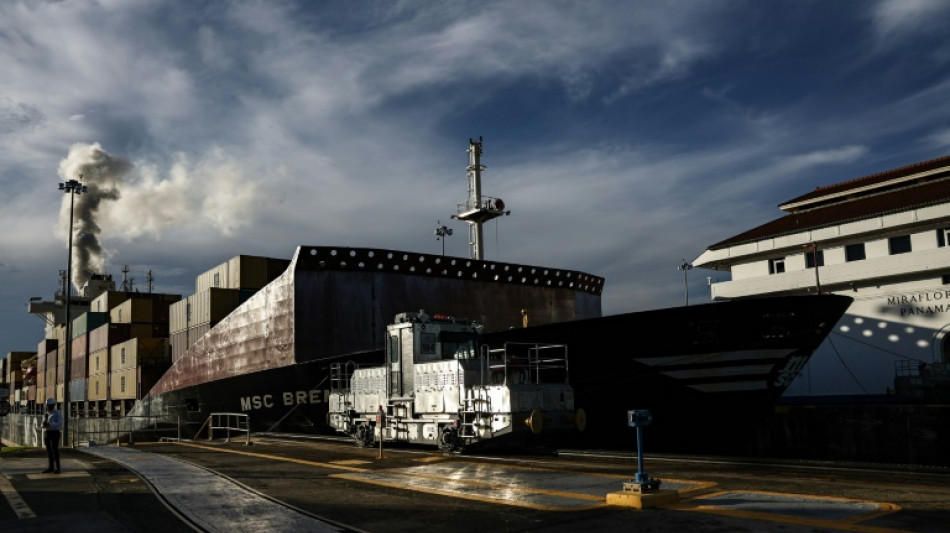
Five things to know about Panama Canal, in Trump's sights / Photo: © AFP/File

 Boasting South Korea footballers spark rethink of military service exemptions
 Five dead as Hurricane Simon, Rachel pummel Mexico's Pacific coast
 Seoul, Tokyo stocks plunge as Asia suffers fresh tech rout
 Damaged and drained, Indonesia's peatlands go up in smoke
 Dominant Australia wary of Pacific threat at Rugby League World Cup
 Pope to be admitted to hospital for lung operation
 Samoa's McFarland welcomes 'massive' arrival of ex-All Blacks for World Cup run-in
 Brewers beat Dodgers 7-4 to extend MLB playoff lead

 Teenager shoots headmaster, teacher at French school
 'Breaking Bad' actor RJ Mitte dead: representatives
 Former DR Congo president Kabila forms new force with M23 armed group
 Tom Cruise's 'Digger' tanks, leaving studio with $250 mn hole
 US actress Selma Blair arrested after flight altercation
 One dead as Hurricane Simon creeps along Mexico's Pacific coast
 Carrick's Man United 'hungry and eager' to fix worst start in decades
 Fury as US federal agents search anti-Trump lawmaker's home

 One goal enough for Flick as Barca enter Galatasaray cauldron
 A7 to unveil a service that will re-invent the international payments market
 'Status quo' with EU 'not good enough', UK PM says as summit date set
 Stolen Renoir paintings found behind wall in France
 French supermarkets suffer refrigerator shutdown after 'unprecedented' cyberattack
 Arsenal lose Hincapie and Zubimendi in freak double blow
 Saudi says resilience tested, vows response after deadly airport attacks
 Alcaraz exits Shanghai Masters in straight-sets loss
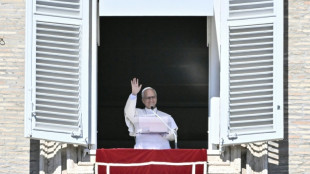 Pope to enter hospital on Tuesday for lung operation
US President-elect Donald Trump has threatened to demand control of the Panama Canal be returned to Washington, complaining of "unfair" treatment of American ships and hinting at China's growing influence.
Here are five things to know about the waterway connecting the Pacific and Atlantic oceans.
- Panamanian operated -
The 80-kilometer (50-mile) interoceanic waterway is operated by the Panama Canal Authority, an autonomous public entity.
The Central American nation's constitution describes the canal as an "inalienable heritage of the Panamanian nation" that is open to vessels "of all nations."
The United States is its main user, accounting for 74 percent of cargo, followed by China with 21 percent.
Panama's government sets the price of tolls based on canal needs and international demand. Rates depends on a vessel's cargo capacity.
"The canal has no direct or indirect control from China, nor the European Union, nor the United States or any other power," Panama's President Jose Raul Mulino said Sunday as he dismissed Trump's threat.
All vessels, including warships and submarines, are given a Panama Canal pilot.
- National history -
Panama's independence from Colombia in 1903 is linked to the canal.
Following the failure of French count Ferdinand de Lesseps to open a channel through the isthmus, the United States promoted the separation of the province of Panama and signed a treaty with the nascent country that ceded land and water in perpetuity to build it.
After 10 years of construction and an investment of $380 million, the canal was inaugurated on August 15, 1914 with the transit of the steamer Ancon.
Some 25,000 deaths from disease and accidents were recorded during its construction.
The canal "is part of our history" and "an irreversible achievement," Mulino said.
- American enclave -
Washington's establishment of a "Canal Zone" -- an enclave with its own military bases, police and justice system -- gave rise to decades of demands by Panamanians to reunify the country and take control of the waterway.
In 1977, Panamanian nationalist leader Omar Torrijos and US president Jimmy Carter signed treaties that allowed the canal to be transferred to Panama on December 31, 1999.
"Any attempt to reverse this historic achievement not only dishonors our struggle, but is also an insult to the memory of those who made it possible," former president Martin Torrijos, the general's son, wrote on social media.
Under the treaties, supported by more than 40 countries, the canal is deemed neutral and any ship can pass through.
The only conditions are that ships must comply with safety regulations and military vessels from countries at war must not pass through at the same time.
- System of locks -
Unlike Egypt's Suez Canal, the Panama Canal operates using freshwater stored in two reservoirs.
A drought led to a reduction in the number of transits in 2023, but the situation has since normalized.
The canal, which has a system of locks to raise and lower vessels, transformed global shipping.
Crafts can travel between the two oceans in about eight hours without having to sail all the way around Cape Horn, the southern tip of the Americas.
The canal allows a ship to shave 20,300 kilometers off a journey from New York to San Francisco.
- Cash cow -
Five percent of world maritime trade passes through the canal, which connects more than 1,900 ports in 170 countries.
By the early 21st century, it had become too small, so it was expanded between 2009 and 2016.
Today, the canal can accommodate ships up to 366 meters long and 49 meters wide (1,200 feet by 161 feet) -- equivalent to almost four football pitches.
It generates six percent of Panama's national economic output and since 2000 has pumped more than $28 billion into state coffers.
More than 11,200 ships transited the canal in the last fiscal year carrying 423 million tons of cargo.
K.Thomson--BTB