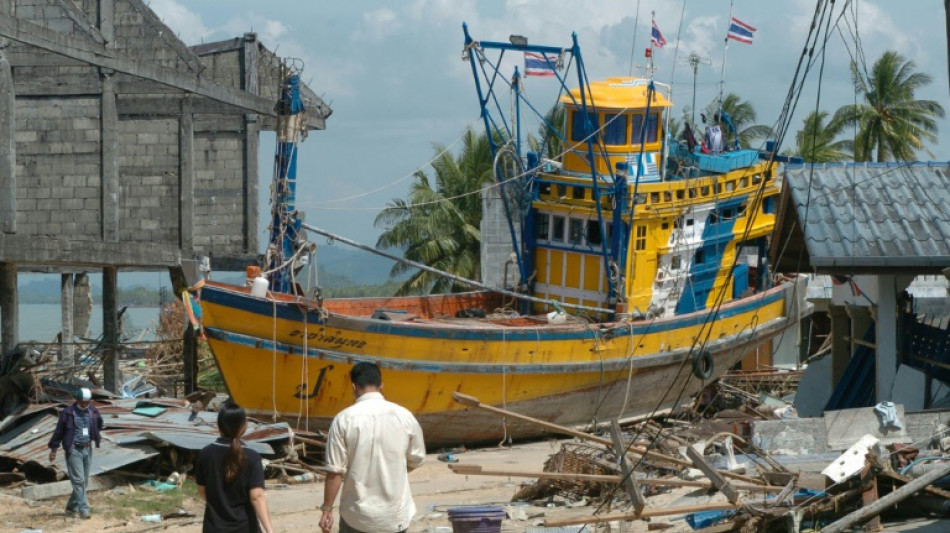
2004 Indian Ocean tsunami: what to know 20 years on / Photo: © AFP

 Boasting South Korea footballers spark rethink of military service exemptions
 Five dead as Hurricane Simon, Rachel pummel Mexico's Pacific coast
 Seoul, Tokyo stocks plunge as Asia suffers fresh tech rout
 Damaged and drained, Indonesia's peatlands go up in smoke

 Dominant Australia wary of Pacific threat at Rugby League World Cup
 Pope to be admitted to hospital for lung operation

 Samoa's McFarland welcomes 'massive' arrival of ex-All Blacks for World Cup run-in
 Brewers beat Dodgers 7-4 to extend MLB playoff lead

 Teenager shoots headmaster, teacher at French school
 'Breaking Bad' actor RJ Mitte dead: representatives

 Former DR Congo president Kabila forms new force with M23 armed group
 Tom Cruise's 'Digger' tanks, leaving studio with $250 mn hole

 US actress Selma Blair arrested after flight altercation

 One dead as Hurricane Simon creeps along Mexico's Pacific coast

 Carrick's Man United 'hungry and eager' to fix worst start in decades

 Fury as US federal agents search anti-Trump lawmaker's home

 One goal enough for Flick as Barca enter Galatasaray cauldron
 A7 to unveil a service that will re-invent the international payments market

 'Status quo' with EU 'not good enough', UK PM says as summit date set
 Stolen Renoir paintings found behind wall in France

 French supermarkets suffer refrigerator shutdown after 'unprecedented' cyberattack

 Arsenal lose Hincapie and Zubimendi in freak double blow
 Saudi says resilience tested, vows response after deadly airport attacks
 Alcaraz exits Shanghai Masters in straight-sets loss

 Pope to enter hospital on Tuesday for lung operation

Survivors and victims' relatives will next week mark the 20th anniversary of the 2004 Indian Ocean earthquake and tsunami, which killed more than 220,000 people across more than a dozen countries.
A 9.1-magnitude earthquake off the western coast of Indonesia's Sumatra island triggered huge waves that swept into coastal areas of Indonesia, Sri Lanka, India, Thailand and nine other nations around the Indian Ocean basin.
Here is a look back at the impact of the deadliest tsunami in history.
- Faultline rupture -
The tsunami was triggered by the longest faultline rupture from an earthquake ever observed, seconds before 7:59 am on December 26, 2004.
The ocean floor opened at least 1,200 kilometres (750 miles) in length between the India plate and Burma microplate.
It created waves more than 30 metres (100 feet) high, releasing energy equivalent to 23,000 Hiroshima atomic bombs and causing widespread destruction.
The magnitude was initially recorded at 8.8, before the United States Geological Survey gave its official magnitude of 9.1 and depth as 30 kilometres (18.6 miles).
The epicentre was located 150 miles from Sumatra's coast.
Indonesia is a vast archipelago nation on the Pacific "Ring of Fire", an arc of intense seismic activity stretching from Japan through Southeast Asia and across the Pacific basin.
- Huge death toll -
A total of 226,408 people died as a result of the tsunami, according to EM-DAT, a recognised global disaster database.
The worst affected area was northern Sumatra, where more than 120,000 people were killed out of a total of 165,708 dead in Indonesia.
The huge waves travelled around the Indian Ocean, hitting Sri Lanka, India and Thailand hours later.
At their fastest the waves travelled at over 800 kilometres an hour (500 mph), more than twice the speed of a bullet train.
More than 35,000 were killed in Sri Lanka, with 16,389 killed in India and 8,345 in Thailand, according to EM-DAT.
Nearly 300 were killed in Somalia, more than 100 in the Maldives, as well as dozens in Malaysia and Myanmar.
- Displaced, reconstruction -
The tsunami displaced more than 1.5 million people and sparked disaster relief of around $14 billion pledged from the international community, according to the United Nations.
Hundreds of thousands of buildings were destroyed, leaving in some cases entire communities homeless.
A splurge in reconstruction has transformed the worst-hit city Banda Aceh.
More than 100,000 houses were rebuilt in the westernmost Indonesian province of Aceh alone, according to the Indonesian government.
- Warning systems -
The tsunami also forced a reckoning about the preparedness of coastal communities around the Indian Ocean basin.
At the time of the earthquake, there was no warning system in place in the Indian Ocean.
But now, 1,400 stations globally cut warning times to just minutes after a tsunami wave forms.
Experts said the lack of a properly coordinated warning system in 2004 had made the disaster's impact worse.
Ocean scientists say we are more prepared than ever thanks to millions of dollars being invested into tsunami warning systems, but warn that the impact of a catastrophic tsunami can never be completely prevented.
O.Bulka--BTB