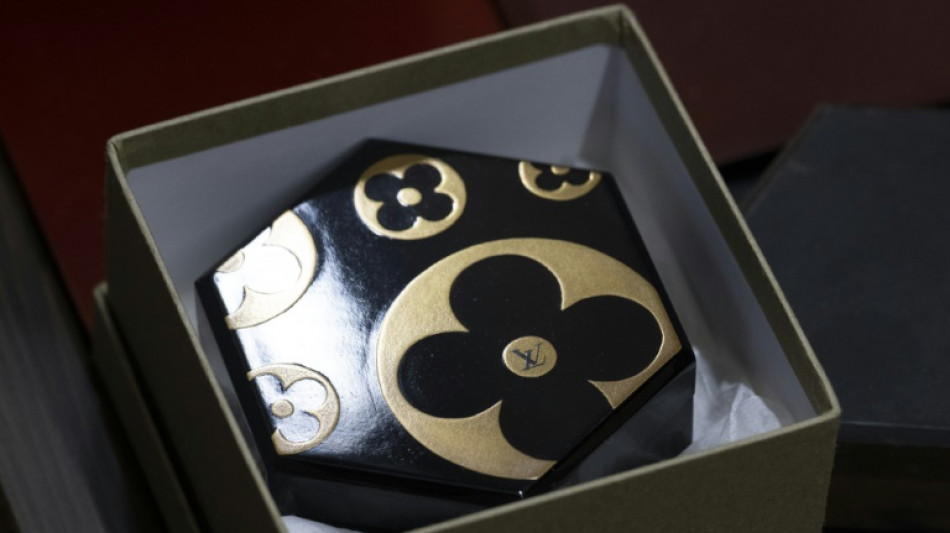
Japan's Wajima craftmakers see hope in disaster-hit region / Photo: © AFP

 Boasting South Korea footballers spark rethink of military service exemptions

 Five dead as Hurricane Simon, Rachel pummel Mexico's Pacific coast
 Seoul, Tokyo stocks plunge as Asia suffers fresh tech rout
 Damaged and drained, Indonesia's peatlands go up in smoke

 Dominant Australia wary of Pacific threat at Rugby League World Cup

 Pope to be admitted to hospital for lung operation

 Samoa's McFarland welcomes 'massive' arrival of ex-All Blacks for World Cup run-in
 Brewers beat Dodgers 7-4 to extend MLB playoff lead

 Teenager shoots headmaster, teacher at French school

 'Breaking Bad' actor RJ Mitte dead: representatives

 Former DR Congo president Kabila forms new force with M23 armed group
 Tom Cruise's 'Digger' tanks, leaving studio with $250 mn hole

 US actress Selma Blair arrested after flight altercation

 One dead as Hurricane Simon creeps along Mexico's Pacific coast

 Carrick's Man United 'hungry and eager' to fix worst start in decades

 Fury as US federal agents search anti-Trump lawmaker's home

 One goal enough for Flick as Barca enter Galatasaray cauldron

 A7 to unveil a service that will re-invent the international payments market

 'Status quo' with EU 'not good enough', UK PM says as summit date set

 Stolen Renoir paintings found behind wall in France

 French supermarkets suffer refrigerator shutdown after 'unprecedented' cyberattack

 Arsenal lose Hincapie and Zubimendi in freak double blow

 Saudi says resilience tested, vows response after deadly airport attacks

 Alcaraz exits Shanghai Masters in straight-sets loss

 Pope to enter hospital on Tuesday for lung operation

Lacquerware maker Takaho Shoji hunches over his desk in the disaster-hit city of Wajima in central Japan, applying another layer of coating to a dark, wooden box.
One brushstroke at a time, the 53-year-old is determined to bring life back to his remote community after a devastating New Year's Day earthquake, followed by severe floods.
"I need to do whatever I can to move forward with the reconstruction, and to continue this tradition and pass it on to the next generations," said the soft-spoken father of two.
"We have to work harder together, otherwise the local lacquerware industry will fade."
Wajima, a coastal city with a population of just over 20,000, is a nationally celebrated centre for fine lacquerware.
Products made there are known as Wajima-nuri, and a basic soup bowl can command a price of $150 or more.
This year brought death and suffering to the city and its surrounding communities at the tip of the Noto Peninsula.
As families prepared for their New Year's Day dinners, a terrifying 7.5-magnitude jolt accompanied by powerful aftershocks destroyed houses and businesses.
Sweeping fires, a tsunami and landslides engulfed the region and forced most residents and their visiting relatives to flee to evacuation shelters.
Then, as they tried to rebuild their lives, torrential rain flooded the city in September, destroying more homes.
The disasters also shattered the network of roughly 700 artisans and workers in Wajima's lacquerware industry, which has been losing workers like other fine crafts.
Damage to the city has been so extensive that municipal officials are not even certain how many craftspeople are still active.
- 'Warmth and wellbeing' -
Wajima-nuri is known for its durability and delicate designs and is often used in tableware like bowls and chopsticks.
With its understated elegance, the technique is also used to create high-end furniture and home decor.
More than 100 steps are involved in the production of Wajima-nuri. The tasks are distributed among specialised artisans, some focusing on lacquer coating and others on carving and shaping.
Among the city's lacquerware professionals trying to restore the network of artisans is Taiichi Kirimoto, the seventh-generation proprietor of a Wajima-nuri studio.
He and his wife now live at his company's gallery space after they lost their house, but he has wasted little time in moving forward.
He worked with renowned architect Shigeru Ban to build temporary work spaces made with cardboard materials, and he has travelled around the country promoting his studio's work and providing places of work for artisans.
"Lacquerware provides a sense of comfort and warmth and wellbeing to people. Perhaps this is different from modern convenience," said Kirimoto, who has worked with top brands including Louis Vuitton.
"I absolutely do not see a choice to leave this city or to move to another profession."
- Uncertain future -
Among Kirimoto's staff artisans is Shoji, a specialist in coating.
An avid angler, Shoji was alone at a local port late afternoon when the earthquake struck, knocking him onto his back.
Sea water roared and receded fast, exposing the seabed before rushing back as a tsunami.
With landslides blocking the roads home, he decided to spend the night in his car on higher ground.
The next day, he was reunited with his family but his house was unsafe to live in. They moved into an evacuation shelter and he began helping others in his community.
Shoji encouraged others to stay in the city after the quake.
But after the September floods, he questioned whether it was the right decision.
"That's what worries me the most -- when you lose people, it devastates the community," he said.
Shoji still believes the Wajima-nuri tradition, a source of local pride, can bring energy back to his home city in its time of dire distress.
He is testing new methods, inspired by the centuries-old tradition, to bring lacquerware into the modern era.
"Our future is uncertain. But I want to do something to move things forward," he said.
N.Fournier--BTB