-
 Pope to be admitted to hospital for lung operation
-
Ahead of Israel vote, desert town becomes frontline against ultra-Orthodox expansion
-
 Samoa's McFarland welcomes 'massive' arrival of ex-All Blacks for World Cup run-in
-
El Nino Watch: the impacts around the world this week
-
 Brewers beat Dodgers 7-4 to extend MLB playoff lead
-
Man City, PSG clash at contrasting time for state-backed projects

-
 Teenager shoots headmaster, teacher at French school
-
Melbourne imam denies links to suspected flydubai hijacker
-
 'Breaking Bad' actor RJ Mitte dead: representatives
-
Coventry crush Newcastle to climb out of relegation zone
-
 Former DR Congo president Kabila forms new force with M23 armed group
-
'Devastating' waves leave California beach homes on brink of collapse
-
 Tom Cruise's 'Digger' tanks, leaving studio with $250 mn hole
-
Meta says its new AI models on par with OpenAI, Anthropic
-
 US actress Selma Blair arrested after flight altercation
-
Talarico rejects mental health conspiracy theory after return from flu
-
 One dead as Hurricane Simon creeps along Mexico's Pacific coast
-
Brazil presidential candidate Flavio Bolsonaro to visit jailed father
-
 Carrick's Man United 'hungry and eager' to fix worst start in decades
-
Brazil's patron saint reappears in polarized election campaign
-
 Fury as US federal agents search anti-Trump lawmaker's home
-
US Open champ Zverev to become tennis world number one
-
 One goal enough for Flick as Barca enter Galatasaray cauldron
-
Migrant crisis wounds unhealed in Ceuta as Spanish royals visit

-
 A7 to unveil a service that will re-invent the international payments market
-
Brazilian judge allows Flavio Bolsonaro to visit jailed father
-
 'Status quo' with EU 'not good enough', UK PM says as summit date set
-
France braces for fresh student demonstrations as Macron calls for 'respect'
-
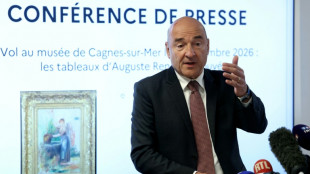
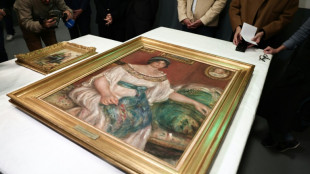 Stolen Renoir paintings found behind wall in France
-
Zelensky doubtful on Russian acceptance of Trump's 'energy ceasefire'
-
 French supermarkets suffer refrigerator shutdown after 'unprecedented' cyberattack
-
Federal agents search home of Trump critic Ilhan Omar: government

-
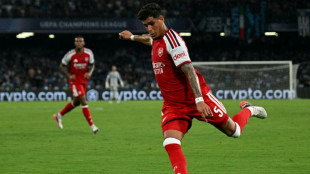 Arsenal lose Hincapie and Zubimendi in freak double blow
-
Pakistan detains hundreds from ex-PM Khan's party as protests falter

-
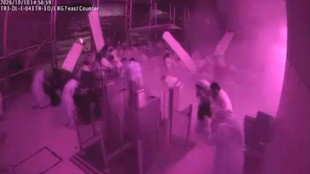 Saudi says resilience tested, vows response after deadly airport attacks
-
Australia's Smith off field after being struck on helmet
-
 Alcaraz exits Shanghai Masters in straight-sets loss
-
UK retains early access to test latest US AI models
-
 Pope to enter hospital on Tuesday for lung operation
-
Top NATO commander warns Russia any attack would be 'futile'

-
 Renshaw shines again before Australia declaration
-
Stolen Renoir paintings found behind wall in France: prosecutor
-
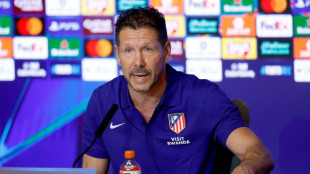 Atletico's Simeone encourages goalless Alvarez improvement
-
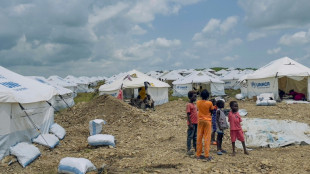
UNHCR sounds alarm on funding crisis
-
 FXGLOBE Rebuilds Its Copy Trading and PAMM Business With B2BROKER's B2COPY
-
French supermarket chains say cyberattack forced refrigerator shutdown

-
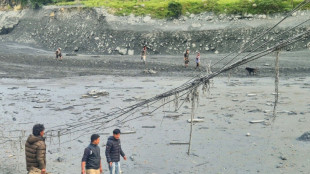 Nepal rescuers search for missing after flash flood
-
Minister's resignation rocks German coalition
-
 Oil rises as Trump comments roil energy markets
-
Hurricane Simon lashes Mexico's Pacific coast, threatens landfall
Osaka Expo 'Grand Ring' a symbol of unity: architect
A towering wooden "Grand Ring" built for Expo 2025 in Osaka pays homage to Japan's architectural history and is a symbol of unity despite criticism over costs, its creator says.
The two-kilometre (1.2-mile) circumference of Sou Fujimoto's striking structure will surround dozens of national pavilions at the six-month-long event from April.
World Expo, held every five years in different locations, allows participating countries to show off their technological and cultural strengths.
Organisers have struggled to rouse enthusiasm for the 2025 event, facing slow ticket sales and public concern over the ballooning construction budget.
But Fujimoto, one of Japan's top architects, told AFP there is a deeper value to the 34.4 billion yen ($220 million) Grand Ring than just its price tag.
The Expo is a "really beautiful, precious opportunity where so many different cultures... and countries come together in one place to create diversity and unity", the 53-year-old said under the Ring's imposing latticed beams.
Such an event facilitates international exchange, even as conflicts rage in Ukraine, Gaza and elsewhere, and to illustrate this concept "the simplest shape is a circle."
Traditional techniques for joining wooden pillars inspired by the famous raised platform at Kiyomizu Temple in nearby Kyoto were used to construct the Grand Ring.
So the Expo is also a "wonderful occasion to show that Japan has a long history" of wooden buildings, Fujimoto said.
- Skywalk -
Japanese cedar and hinoki wood, as well as stronger European red cedar, were reinforced with metal to make them quake-resistant.
The wooden beams hold up a sloping roof, 20 metres (65 feet) tall at its highest point, to protect visitors from the elements as they wander through at ground level.
The roof doubles as a "skywalk" with views of the surrounding area.
Despite that, only 7.4 million tickets had been sold by December -- half the organisers' target.
Inflation and labour shortages have meanwhile driven the total construction budget up 27 percent from 2020 estimates to hit 235 billion yen ($1.5 billion).
Fujimoto has argued that the budget increase was partly because of rising prices linked to the Ukraine war, "which no one could have predicted".
"The Ring was created with ingenuity, to have the maximum impact within a limited budget by consolidating various functions," he wrote on social media platform X.
Fujimoto told AFP that using wood for the Grand Ring was a sustainable choice, referring to the "beautiful cycle" of trees absorbing carbon dioxide.
However, how renewable the Ring really is has been questioned.
Japan's Yomiuri Shimbun daily reported in December that just 12.5 percent of the temporary structure will be reused after the Expo -- down from the original plan of 25 percent.
- 'Beyond your imagination' -
Fujimoto's previous work includes "L'Arbre Blanc", a multipurpose tower in France's Montpellier, and a spindly white lattice for the 2013 Serpentine Pavilion in London.
As a child in northern Hokkaido where he used to play in the forest, Fujimoto realised the importance of "the wonderful relationship between nature, architecture and people".
He enjoyed making things, influenced by his doctor father who used to paint and make sculptures.
But he discovered architecture aged 14 when he read the only book on the topic at his home, about Spain's Antonio Gaudi.
"At that time, Gaudi seemed too extreme to me. So I couldn't imagine I could be something like that," he laughed.
The young Fujimoto, who admired Albert Einstein, first studied physics at the prestigious University of Tokyo.
But he "couldn't understand anything" and so switched to architecture, setting up his own company in 2000, six years after graduation.
Fujimoto said he does not know where his passion for architecture comes from but, when a design like the Grand Ring comes to life, it is "beyond your imagination".
"And that is amazing."
K.Thomson--BTB