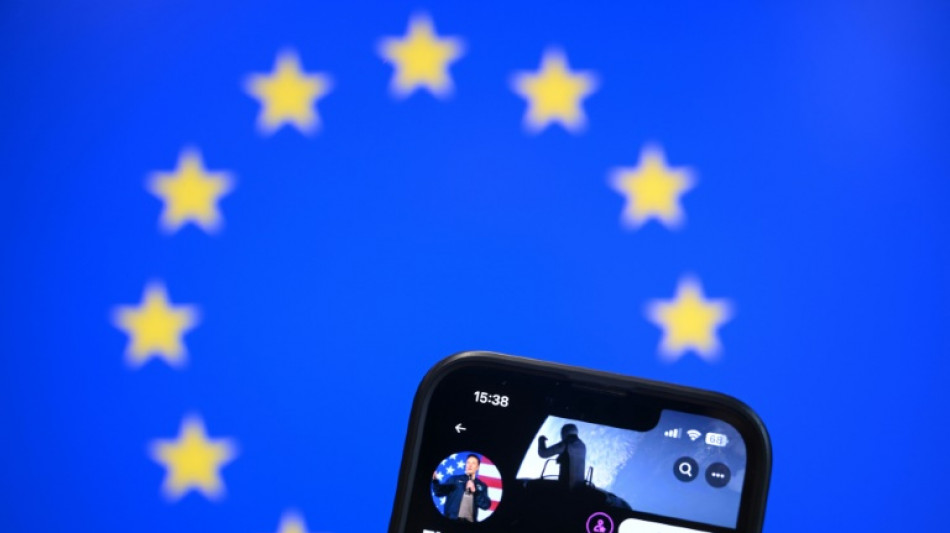
Can EU stand up to belligerent Big Tech in new Trump era? / Photo: © AFP

 Melbourne imam denies links to suspected flydubai hijacker

 Coventry crush Newcastle to climb out of relegation zone
 'Devastating' waves leave California beach homes on brink of collapse
 Meta says its new AI models on par with OpenAI, Anthropic
 Talarico rejects mental health conspiracy theory after return from flu

 Brazil presidential candidate Flavio Bolsonaro to visit jailed father
 Brazil's patron saint reappears in polarized election campaign
 US Open champ Zverev to become tennis world number one
 Migrant crisis wounds unhealed in Ceuta as Spanish royals visit

 Brazilian judge allows Flavio Bolsonaro to visit jailed father
 France braces for fresh student demonstrations as Macron calls for 'respect'

 Zelensky doubtful on Russian acceptance of Trump's 'energy ceasefire'

 Federal agents search home of Trump critic Ilhan Omar: government

 Pakistan detains hundreds from ex-PM Khan's party as protests falter

 Australia's Smith off field after being struck on helmet

 UK retains early access to test latest US AI models
 Top NATO commander warns Russia any attack would be 'futile'

 Stolen Renoir paintings found behind wall in France: prosecutor
 UNHCR sounds alarm on funding crisis

 French supermarket chains say cyberattack forced refrigerator shutdown

 Minister's resignation rocks German coalition
 Hurricane Simon lashes Mexico's Pacific coast, threatens landfall

 France schools protest rumbles on as Macron urges 'respect'

 Americans Hall and Woodford win economics Nobel for stabilisation models
 MEXC Brings AI, TradFi and the Future of Trading to Life at TOKEN2049 Singapore
Facing charges of "censorship" from both Elon Musk and Mark Zuckerberg, the EU will need its full legal arsenal -- and political will aplenty -- to stand up to US Big Tech once Donald Trump is back.
Days before Trump's inauguration as US president, Meta chief Zuckerberg set the tone Tuesday by abruptly ending his firm's fact-checking programme on Facebook and Instagram in the United States -- and indicating changes could be coming to Europe too.
Zuckerberg accused Europe of passing an "ever increasing number of laws institutionalising censorship" -- echoing escalating rhetoric from X owner Musk who has long railed at the EU's efforts to regulate the online space.
Brussels has bolstered its legal arsenal targeting the world's biggest digital platforms, but since Trump stormed to victory in November's election the bloc has avoided concrete action against US tech companies -- apparently for fear of angering the incoming leadership in Washington.
Even as Trump ally Musk has goaded European leaders with a series of incendiary outbursts, the European Commission -- the EU's digital watchdog -- has stayed out of the fray.
Neither EU chief Ursula von der Leyen nor her commissioners in charge of tech policy have uttered a public word, for instance, about Musk's planned live chat with the leader of the far-right Alternative for Germany (AfD) -- a party he is fervently backing ahead of national elections.
Silence is a "political choice for the moment not to feed this debate any further", von der Leyen's chief spokesperson, Paula Pinho, said on Tuesday.
- 'Fuel to the fire' -
"There is probably a desire, perhaps wrongly, not to attack Trump and Musk head-on, for fear of the reactions," said Alexandre de Streel, an expert at the Center on Regulation in Europe (CERRE) think tank.
The silence has become deafening.
Faced with Zuckerberg's accusation of "censorship," the European Commission said Wednesday it "absolutely" rejected the claim, insisting "freedom of expression lies at the heart" of its content moderation landmark law, the Digital Services Act (DSA).
But beyond that it declined to comment on Meta's policy changes.
Meta has clarified it has no current plans to end its fact-checking operations in the European Union, and would review its EU obligations before making any changes.
AFP currently works in 26 languages with Facebook's fact-checking programme.
The DSA does not define what is allowed online -- but rather tells platforms to adhere to existing national laws on digital content.
Regarding Musk, Brussels has stressed he has the right to express his opinions -- but that the EU will monitor the AfD discussion to understand whether Musk unfairly used X's algorithms to boost the far-right.
The EU in December 2023 launched a DSA probe into X but has yet to make any formal decision on how the platform tackles the spread of illegal content and its efforts to combat information manipulation.
According to de Streel, these violations can be "very difficult to prove".
"It's clear that if von der Leyen's commission were to open proceedings against Musk, it would add more than just fuel to the fire," said Umberto Gambini, of European affairs consultancy Forward Global.
Implementing the DSA "remains very political", Gambini told AFP.
- Stricter with others? -
Not everyone is happy with the EU's stance -- France on Wednesday urged the commission to protect its member states against interference in political debates, particularly from Musk.
"Either the European Commission applies with the greatest firmness the laws that we have given ourselves to protect our public space, or it does not do so and then it will have to agree to give back the capacity to do so to the EU member states," Foreign Minister Jean-Noel Barrot said.
The commission's newfound reticence is not limited to Meta or X.
On the day of the US election last year, news broke that Apple was set to face a fine under the bloc's new tech competition law, the Digital Markets Act, but two months later, the penalty has yet to arrive.
Sources close to the matter said von der Leyen's cabinet froze plans to fine Apple, fearing any sanction could hurt fragile transatlantic ties under Trump.
The contrast is striking with firms from outside the United States.
The commission in December opened a probe into TikTok owned by China's ByteDance following allegations the platform was used by Russia to sway the result of Romania's later annulled presidential election.
L.Janezki--BTB