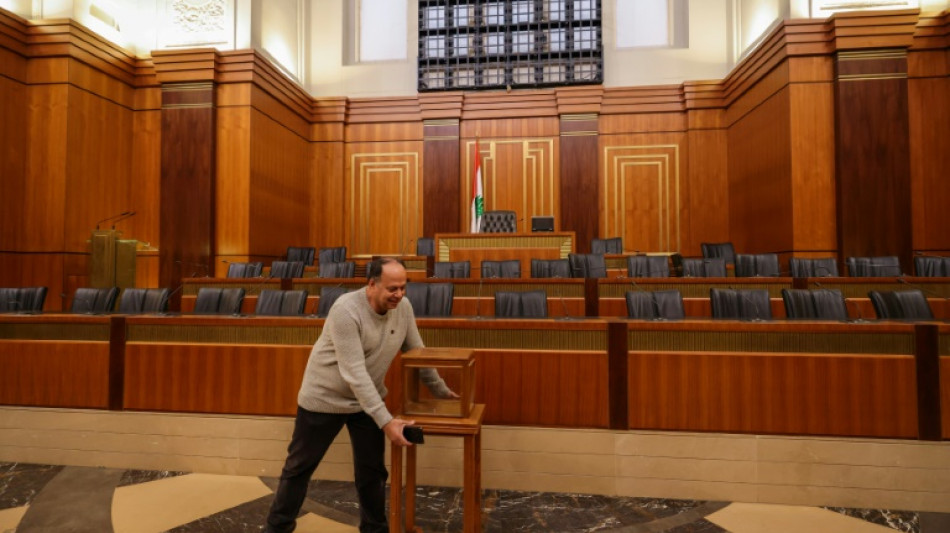
Lebanon meets to finally elect president after two-year vacancy / Photo: © AFP

 Melbourne imam denies links to suspected flydubai hijacker

 Coventry crush Newcastle to climb out of relegation zone
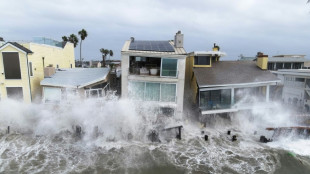 'Devastating' waves leave California beach homes on brink of collapse

 Meta says its new AI models on par with OpenAI, Anthropic

 Talarico rejects mental health conspiracy theory after return from flu
 Brazil presidential candidate Flavio Bolsonaro to visit jailed father
 Brazil's patron saint reappears in polarized election campaign
 US Open champ Zverev to become tennis world number one
 Migrant crisis wounds unhealed in Ceuta as Spanish royals visit

 Brazilian judge allows Flavio Bolsonaro to visit jailed father
 France braces for fresh student demonstrations as Macron calls for 'respect'

 Zelensky doubtful on Russian acceptance of Trump's 'energy ceasefire'

 Federal agents search home of Trump critic Ilhan Omar: government
 Pakistan detains hundreds from ex-PM Khan's party as protests falter
 Australia's Smith off field after being struck on helmet

 UK retains early access to test latest US AI models
 Top NATO commander warns Russia any attack would be 'futile'
 Stolen Renoir paintings found behind wall in France: prosecutor

 UNHCR sounds alarm on funding crisis

 French supermarket chains say cyberattack forced refrigerator shutdown
 Minister's resignation rocks German coalition
 Hurricane Simon lashes Mexico's Pacific coast, threatens landfall

 France schools protest rumbles on as Macron urges 'respect'
 Americans Hall and Woodford win economics Nobel for stabilisation models
 MEXC Brings AI, TradFi and the Future of Trading to Life at TOKEN2049 Singapore
Lebanese lawmakers could elect army chief Joseph Aoun as president Thursday after more than two years of deadlock, in a much-needed step to help lift the war-battered country out of financial crisis.
The legislative session comes with 17 days remaining in a ceasefire that called for the deployment of Lebanese troops alongside UN peacekeepers as Israeli forces withdraw from the country's south.
The 128-lawmaker chamber, which has failed to reach consensus a dozen times amid tensions between the Iran-backed Hezbollah movement and its opponents, kicked off their session at 11:00 am (0900 GMT).
With international pressure mounting for a successful vote, ambassadors of several countries were present in the chamber as the meeting began.
The Mediterranean country has been without a president since Michel Aoun's term ended in October 2022. The two men share a family name, but are not related.
The president's powers have been reduced since the end of the 1975-1990 civil war, but filling the position is key to overseeing consultations towards naming a new prime minister, who would lead a new government capable of carrying out reforms demanded by international creditors.
Those reforms would unlock a desperately needed financial bailout.
Aoun, who will turn 61 on Friday, is widely seen as the frontrunner.
He appears to have the backing of the United States and key regional player Saudi Arabia.
"A Saudi-US order: vote for Joseph Aoun," headlined the newspaper Al-Akhbar, which is close to Hezbollah, ahead of the vote.
- Blows to Hezbollah -
Security was tight and journalists aplenty as lawmakers started arriving outside parliament earlier in the morning, an AFP correspondent said.
Critics have accused Hezbollah and allies of scuppering previous votes.
But a full-fledged war between Israel and Hezbollah last autumn dealt heavy blows to the Shiite militant group, including the death of its longtime leader Hassan Nasrallah in an air strike.
In neighbouring Syria, Hezbollah has lost a major ally after rebels toppled President Bashar al-Assad last month.
Analysts say Aoun's overseeing the gradual deployment of the Lebanese army in south Lebanon after the fragile November ceasefire ended the Hezbollah-Israel war could have helped him become top candidate.
In a country still scarred by its civil war decades earlier, the divided political elite usually agrees on a consensus candidate before any successful parliamentary vote is held.
International pressure had increased ahead of the session, including from French envoy Jean-Yves Le Drian, who was invited to attend the vote.
US envoy Amos Hochstein was in Beirut earlier this week urging the country's lawmakers to make the election a success.
A Saudi envoy also visited Lebanon on Wednesday for the second time in two weeks.
Lawmakers who met the Saudi and US envoys said they were given a strong impression that both countries backed Joseph Aoun.
Lebanon's caretaker Prime Minister Najib Mikati said on Wednesday he was optimistic.
"For the first time since the presidency became vacant, I am pleased that, God willing, tomorrow we will have a president," he said.
- Another army chief? -
Under multi-confessional Lebanon's power-sharing system, the president must be a Maronite Christian.
Aoun would need a two-thirds majority -- at least 86 out of 128 lawmakers -- to be elected president.
If he or any other candidate fails to garner that many votes, parliament will hold a second round, where a simple majority, or 65 votes, will be sufficient to win.
A constitutional amendment would be needed for Aoun to become president. The current text does not allow a person who has been in high office at any point during the past two years to take up the post.
If elected, Aoun would be Lebanon's fifth army commander to become president, and the fourth in a row.
Military chiefs too are, by convention, Maronites.
The new president faces daunting challenges, with the truce to oversee on the Israeli border and bomb-damaged neighbourhoods in the south, the east and the capital to rebuild.
Since 2019, Lebanon has been gripped by the worst financial crisis in its history.
The Hezbollah-Israel war has cost Lebanon more than $5 billion in economic losses, with structural damage amounting to billions more, according to the World Bank.
N.Fournier--BTB