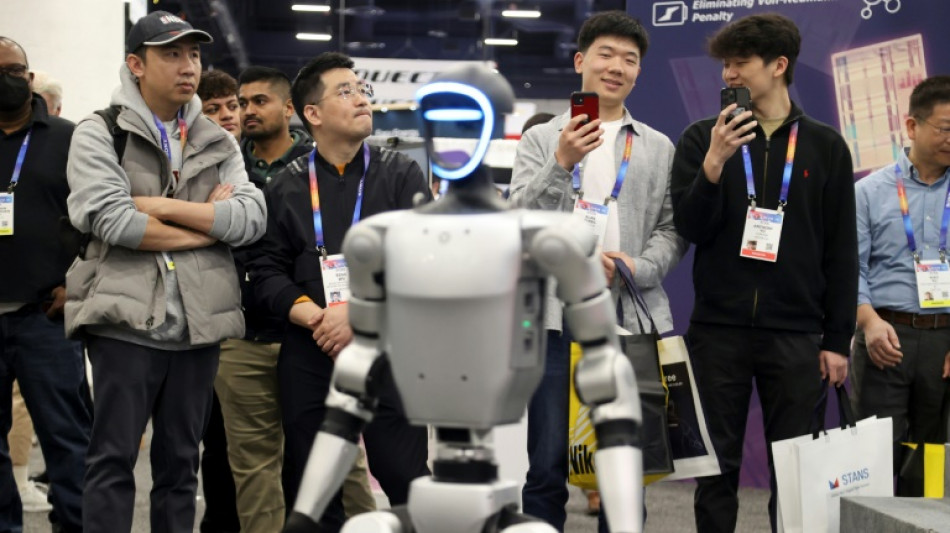
Robots set to move beyond factory as AI advances / Photo: © AFP

 Melbourne imam denies links to suspected flydubai hijacker

 Coventry crush Newcastle to climb out of relegation zone

 'Devastating' waves leave California beach homes on brink of collapse

 Meta says its new AI models on par with OpenAI, Anthropic

 Talarico rejects mental health conspiracy theory after return from flu

 Brazil presidential candidate Flavio Bolsonaro to visit jailed father

 Brazil's patron saint reappears in polarized election campaign

 US Open champ Zverev to become tennis world number one

 Migrant crisis wounds unhealed in Ceuta as Spanish royals visit

 Brazilian judge allows Flavio Bolsonaro to visit jailed father

 France braces for fresh student demonstrations as Macron calls for 'respect'

 Zelensky doubtful on Russian acceptance of Trump's 'energy ceasefire'

 Federal agents search home of Trump critic Ilhan Omar: government

 Pakistan detains hundreds from ex-PM Khan's party as protests falter

 Australia's Smith off field after being struck on helmet

 UK retains early access to test latest US AI models

 Top NATO commander warns Russia any attack would be 'futile'

 Stolen Renoir paintings found behind wall in France: prosecutor

 UNHCR sounds alarm on funding crisis

 French supermarket chains say cyberattack forced refrigerator shutdown

 Minister's resignation rocks German coalition

 Hurricane Simon lashes Mexico's Pacific coast, threatens landfall

 France schools protest rumbles on as Macron urges 'respect'

 Americans Hall and Woodford win economics Nobel for stabilisation models

 MEXC Brings AI, TradFi and the Future of Trading to Life at TOKEN2049 Singapore

Today's robots perform safety checks at industrial plants, conduct quality control in manufacturing, and are even starting to keep hospital patients company.
But soon -- perhaps very soon -- these increasingly humanlike machines will handle more sophisticated tasks, freeing up people while raising complex questions about the roles of artificial intelligence that are gaining attention.
At a panel hosted by the American Association of Retired Persons at this week's Consumer Electronics Show (CES), experts described the next five years as a period where robots transition primarily from industrial sites to service settings, helping to address a worsening health care labor crunch.
Seeing robotics in places like theme parks or universities "will lead to the companion robot probably at the end of the decade," said Marc Theermann, chief strategy officer for robot company Boston Dynamics.
Cris Gardner, a vice president in futurecasting at AARP, predicted robots will provide emotional support as they enter homes and assist with daily tasks.
People "will own a generalized humanoid robot the way they would own a car," she said.
- Upheaval ahead? -
Dystopian prophesies of a robot-centered future have long featured in the public imagination. However, recent breakthroughs in generative AI have given more credibility to predictions of billions of humanoid robots in everyday life.
The centrality of robots in the coming years is "widely underappreciated," said a report from Abundance 360, a conference and education venture led by entrepreneur Peter Diamandis.
Robots could enable an "era of unprecedented abundance," lowering costs while freeing humans "to focus on creative and fulfilling pursuits," it said.
However, the analysis also identified nine sectors facing potential job displacement, including manufacturing, elder care, agriculture, education, and surgery.
"The speed at which multimodal generative AI and humanoid robot development is progressing, paired with the lack of public discourse on this subject, indicates that there will be significant job disruption and societal upheaval," it said.
Disputes over automation have been a recurring factor in labor negotiations, most recently involving US dockworkers, who reached a tentative agreement with a shippers group, averting a strike.
The International Longshoremen's Association permitted ports to add semiautonomous cranes only if more workers are hired, according to the Wall Street Journal.
- Worker shortages -
At CES, companies described robots as performing tasks that humans either shouldn't do because they are dangerous, or don't want to do because they are grueling, tedious, or unpleasant.
Hong Kong company R2C2 showcased industrial robots that can perform functions such as inspections at power plants and technician work on trains, according to San Wong, the company's founder and chief executive.
Working on trains involves "lots of grease everywhere, and it's dirty and hot" so turnover is high, San said.
Vehicle and equipment maker Oshkosh has used automation to phase out high-burnout jobs such as the finishing work on firetrucks, which requires workers to wear a mask and often leads to shoulder and elbow problems, said chief executive John Pfeifer.
Those workers have been shifted to other assembly line work, such as welding. While these jobs are currently safe, they may "one day" be automated, Pfeifer said.
"This has been the evolution of the economy for 250 years," he said. "People move into more productive ways to help the economy grow."
At CES, US agriculture machinery giant John Deere showcased autonomous vehicles developed partly in response to persistent farm labor shortages.
Automation allows farmers to focus on more challenging tasks, such as managing grain movement from a field to a storage area, said Deanna Kovar, president of Deere's worldwide agriculture and turf division.
"We need to continue to make sure we're evolving the skill sets of our employees, of our customers, so that they can take advantage of the technologies and not see them as a threat," she said.
AARP's Gardner noted that the aging US population points to a significant labor gap for caring for the next generation of seniors.
"The demand is going to be enormous, it can't be covered by human beings," said Gardner, who views improved robotics as key to enabling older people to stay independent for longer.
Y.Bouchard--BTB