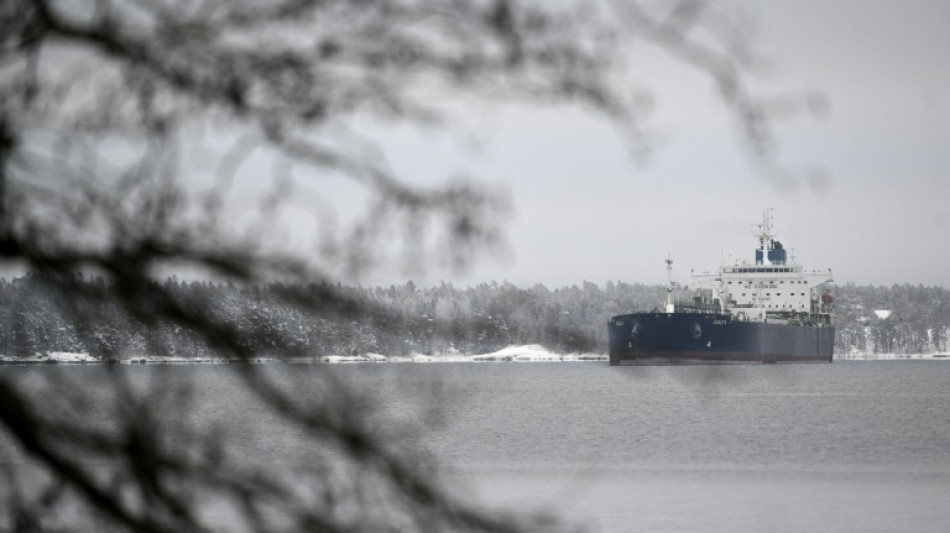
NATO launches Baltic Sea patrols after suspected cable sabotage / Photo: © Lehtikuva/AFP/File

 'Breaking Bad' actor RJ Mitte dead: representatives

 Former DR Congo president Kabila forms new force with M23 armed group
 Tom Cruise's 'Digger' tanks, leaving studio with $250 mn hole

 US actress Selma Blair arrested after flight altercation

 One dead as Hurricane Simon creeps along Mexico's Pacific coast

 Carrick's Man United 'hungry and eager' to fix worst start in decades

 Fury as US federal agents search anti-Trump lawmaker's home

 One goal enough for Flick as Barca enter Galatasaray cauldron

 A7 to unveil a service that will re-invent the international payments market

 'Status quo' with EU 'not good enough', UK PM says as summit date set

 Stolen Renoir paintings found behind wall in France

 French supermarkets suffer refrigerator shutdown after 'unprecedented' cyberattack

 Arsenal lose Hincapie and Zubimendi in freak double blow

 Saudi says resilience tested, vows response after deadly airport attacks

 Alcaraz exits Shanghai Masters in straight-sets loss

 Pope to enter hospital on Tuesday for lung operation

 Renshaw shines again before Australia declaration

 Atletico's Simeone encourages goalless Alvarez improvement

 FXGLOBE Rebuilds Its Copy Trading and PAMM Business With B2BROKER's B2COPY

 Nepal rescuers search for missing after flash flood

 Oil rises as Trump comments roil energy markets
 Premier League in limbo as Manchester City soar

 Zelensky vows to respond as Moscow silent on 'energy ceasefire'

 Thousands march in India's capital to demand election chief resign

 African players in Europe: Mbeumo ends goal drought as United draw

The NATO military alliance said Tuesday it was launching a Baltic Sea monitoring mission following the suspected sabotage of undersea cables in recent months.
Several undersea telecom and power cables have been severed in the region, with experts and politicians accusing Russia of orchestrating a hybrid war against the West as the two sides square off over Ukraine.
At a meeting on Tuesday in Helsinki of NATO members on the Baltic Sea, NATO chief Mark Rutte said that the "Baltic Sentry" mission would "involve a range of assets, including frigates and maritime patrol aircraft, among others, and will enhance our vigilance in the Baltic."
Rutte added that he would not share details on the exact number of vessels "because that might differ from one week to another" and that he did not wish to make "the enemy any wiser than he or she is already."
A statement from NATO specified that the operation would "continue for an undisclosed amount of time".
The sabotage has been blamed on a "shadow fleet" of vessels -- often ageing and operating under opaque ownership -- that carry Russian crude oil and petroleum products, embargoed since the invasion of Ukraine.
"Investigations of all of these cases are still ongoing, but there is reason for grave concern. Safeguarding our infrastructure is of utmost importance," Rutte said.
"Not only is this crucial for energy supply that is from power cables or pipelines, but more than 95 percent of internet traffic is secured via undersea cables, and 1.3 million kilometres (800,000 miles) of cables guarantee an estimated 10 trillion-dollar worth of financial transactions every day," Rutte noted.
Swedish Prime Minister Ulf Kristersson told reporters as he arrived for the meeting that it was "totally unacceptable that these damages seem to have been increasing in numbers recently" but expressed caution in apportioning blame.
"We don't accuse anybody for anything so far. We don't do that easily without very firm proof," Kristersson said.
- 'Deterrent' -
NATO said in late December it would increase its presence in the region following the suspected sabotage of undersea cables between Finland and Estonia, but had not announced an operation.
"The actions in recent months related to the Russian shadow fleet and sabotage has prompted NATO to develop its maritime situational awareness in the Baltic Sea region," researcher Iro Sarkka of the Finnish Institute of International Affairs told AFP.
A comprehensive NATO operation would serve as a "deterrent and a strategic signal" that NATO is prepared to act in response to the recent activities, according to Sarkka.
Last week, Finland said NATO would contribute two vessels to a monitoring mission in the Baltic Sea.
The British-led Joint Expeditionary Force (JEF), which included Nordic and Baltic states as well as the Netherlands, also said it would increase its surveillance.
Sweden is sending up to three warships and a surveillance aircraft.
- Repeated incidents -
Tensions have mounted around the Baltic Sea since Russia's invasion of Ukraine in February 2022.
In September 2022, a series of underwater blasts ruptured the Nord Stream pipelines that carried Russian gas to Europe, the cause of which has yet to be determined.
In October 2023, an undersea gas pipeline between Finland and Estonia was shut down after it was damaged by the anchor of a Chinese cargo ship.
The most recent incident occurred on December 25, when the Estlink 2 electricity cable and four telecom cables linking Finland and Estonia were damaged.
That came just weeks after two telecom cables in Swedish waters were severed on November 17-18.
Suspicion over the Christmas Day incident has fallen on the Eagle S, a Cook Island-flagged oil tanker believed to be part of the "shadow fleet".
Finnish police seized the Eagle S on December 28 as part of a criminal investigation.
Finnish authorities last week deemed the ship unseaworthy following an inspection, barred it from sailing and have banned eight crew members from leaving the country while police carry out a probe.
Investigators suspect the cables were damaged by the tanker's anchor being dragged over them.
W.Lapointe--BTB