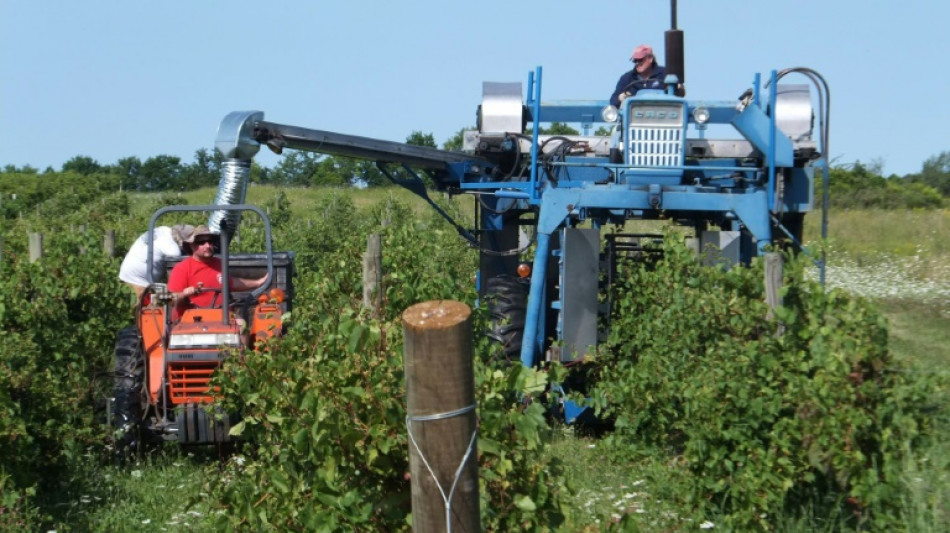
Herbicide under US scrutiny over potential Parkinson's link / Photo: © David Jilbert/AFP

 'Breaking Bad' actor RJ Mitte dead: representatives

 Former DR Congo president Kabila forms new force with M23 armed group
 Tom Cruise's 'Digger' tanks, leaving studio with $250 mn hole

 US actress Selma Blair arrested after flight altercation

 One dead as Hurricane Simon creeps along Mexico's Pacific coast

 Carrick's Man United 'hungry and eager' to fix worst start in decades

 Fury as US federal agents search anti-Trump lawmaker's home

 One goal enough for Flick as Barca enter Galatasaray cauldron

 A7 to unveil a service that will re-invent the international payments market

 'Status quo' with EU 'not good enough', UK PM says as summit date set

 Stolen Renoir paintings found behind wall in France

 French supermarkets suffer refrigerator shutdown after 'unprecedented' cyberattack

 Arsenal lose Hincapie and Zubimendi in freak double blow

 Saudi says resilience tested, vows response after deadly airport attacks
 Alcaraz exits Shanghai Masters in straight-sets loss

 Pope to enter hospital on Tuesday for lung operation

 Renshaw shines again before Australia declaration

 Atletico's Simeone encourages goalless Alvarez improvement

 FXGLOBE Rebuilds Its Copy Trading and PAMM Business With B2BROKER's B2COPY

 Nepal rescuers search for missing after flash flood

 Oil rises as Trump comments roil energy markets

 Premier League in limbo as Manchester City soar

 Zelensky vows to respond as Moscow silent on 'energy ceasefire'

 Thousands march in India's capital to demand election chief resign

 African players in Europe: Mbeumo ends goal drought as United draw
First came the slow hand movements, then the tremor, and now the looming fear of what lies ahead.
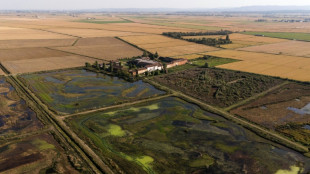
David Jilbert's devastating diagnosis of Parkinson's disease three years ago changed his life irrevocably -- and it's a condition the 65-year-old farmer believes he wouldn't have if it weren't for paraquat, a herbicide he once relied on to control weeds in his vineyard in the midwestern US state of Ohio.
"Now it's not just about me, I'm part of this community -- let's get something going," Jilbert said during a recent hearing in the US Congress on the issue.
Banned in more than 70 countries -- including Britain, where it is manufactured; Switzerland, home to the Syngenta company that owns the brand; and China, where the state-run conglomerate that owns Syngenta is based -- paraquat remains available in the United States.
The US Environmental Protection Agency (EPA) has long maintained that the herbicide is safe for use under strict regulations -- something Parkinson's advocates are hoping to change.
The agency is set to issue a final report on the issue by January 17, 2025, a date mandated by a court in response to 90 new scientific studies submitted by the Michael J. Fox Foundation and other groups.
- Industry denies causation -
"We have great sympathy for those suffering from the debilitating effects of Parkinson's disease," a spokesperson for Syngenta said in a statement to AFP.
"However, it is important to note that the scientific evidence simply does not support a causal link between paraquat and Parkinson's disease, and that paraquat is safe when used as directed."
Multiple credible studies have found that agricultural workers who handle paraquat -- or live near areas where it is applied -- face a higher incidence of Parkinson's disease, which can eventually turn even the simplest movements into daunting challenges.
Animal research further underscores paraquat's toxic effects on nerve cells, although proving direct causation for individuals remains difficult.
"I find it extraordinarily frustrating that the chemical companies have hidden behind the concept of being able to show causation, and they've used that as an excuse, because we haven't been able to come out and definitively say that," Australia-based neurologist David Blacker said in interview with Pesticide Action UK, an advocacy group.
"That's where the precautionary principle comes in," he added. "If there is a doubt, especially if there are alternatives, it then becomes, in my mind, ethically and even morally unsound to continue to pursue."
- 'It's scary' -
Jilbert, a longtime environmental engineer and environmental safety inspector, dreamed of becoming a farmer after retirement.
In 2011, he purchased his land and, over the following years, began using paraquat -- often sold as Gramoxone -- to manage his weeds. By the end of the decade, he noticed his hands moving slowly and his gait turning into a shuffle.
When his Parkinson's diagnosis finally came, he was horrified and wondered if he'd been condemned to a "death sentence." His condition is more manageable for now, thanks to medications, but he says he feels disappointed in his own government for not looking out for him.
"You think if you use the stuff in the way the label tells me to use it, then I'm not going to get sick," he said.
Like Jilbert, 85-year-old Charlene Tenbrink -- who owns a 250-acre farm in Dixon, California -- also trusted that the chemicals available to farmers were safe when handled properly.
She sprayed paraquat on her prune trees in the 1990s and was diagnosed with Parkinson's in 2020.
Tenbrink, Jilbert and thousands of others are now suing Syngenta in federal and California state courts.
Sarah Doles, a lawyer and co-lead for that federal litigation, compared it to the cases against Big Tobacco. She contends Syngenta had a legal duty to disclose harms its own teams knew about paraquat from research going back decades, but hid from consumers.
"It's a legal duty of what they knew and then failed to do -- they concealed the information," she told AFP.
Regardless of which direction the EPA rules, these legal cases will continue.
Tenbrink says it's vital to get the product off the market, and admits she's terrified for her own future.
"This is a terrible disease and we know there's no cure, we know it's going to get worse. It's scary," she says.
F.Müller--BTB