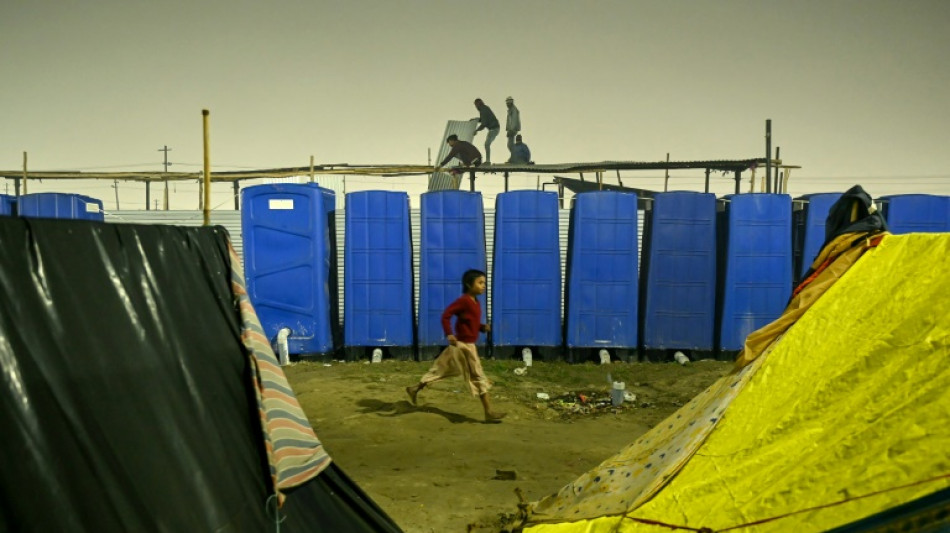
India's outcast toilet cleaners keeping Hindu festival going / Photo: © AFP

 'Breaking Bad' actor RJ Mitte dead: representatives

 Former DR Congo president Kabila forms new force with M23 armed group
 Tom Cruise's 'Digger' tanks, leaving studio with $250 mn hole

 US actress Selma Blair arrested after flight altercation

 One dead as Hurricane Simon creeps along Mexico's Pacific coast

 Carrick's Man United 'hungry and eager' to fix worst start in decades

 Fury as US federal agents search anti-Trump lawmaker's home

 One goal enough for Flick as Barca enter Galatasaray cauldron

 A7 to unveil a service that will re-invent the international payments market

 'Status quo' with EU 'not good enough', UK PM says as summit date set
 Stolen Renoir paintings found behind wall in France

 French supermarkets suffer refrigerator shutdown after 'unprecedented' cyberattack

 Arsenal lose Hincapie and Zubimendi in freak double blow
 Saudi says resilience tested, vows response after deadly airport attacks
 Alcaraz exits Shanghai Masters in straight-sets loss

 Pope to enter hospital on Tuesday for lung operation

 Renshaw shines again before Australia declaration

 Atletico's Simeone encourages goalless Alvarez improvement
 FXGLOBE Rebuilds Its Copy Trading and PAMM Business With B2BROKER's B2COPY

 Nepal rescuers search for missing after flash flood

 Oil rises as Trump comments roil energy markets
 Premier League in limbo as Manchester City soar

 Zelensky vows to respond as Moscow silent on 'energy ceasefire'

 Thousands march in India's capital to demand election chief resign

 African players in Europe: Mbeumo ends goal drought as United draw
Millions of pilgrims hoping to cleanse their sins by ritual baths at India's Kumbh Mela festival rely on key lavatory workers to clear up behind them -- those born on the lowest rung of the Hindu caste system.
The millennia-old sacred show of religious piety and ritual bathing, which began on Monday and runs until February 26 in the north Indian city of Prayagraj, is this year predicted to be the biggest yet, and the largest ever gathering of humanity.
Organisers expect a staggering 400 million pilgrims will bathe during the six-week-long festival in the confluences of the Ganges and Yamuna rivers, holy waters for Hindus.
That creates a waste removal and public health challenge of epic proportions, with 150,000 temporary toilets installed across packed riverbank campsites covering an area greater than 2,000 football pitches.
Critical to the festival's running are the 5,000 workers hired just to clean the toilets -- and nearly all of them belong to the lower rungs of an age-old rigid social hierarchy that divides Hindus by function and social standing.
"I clean and clean, but people make a mess of it in barely 10 minutes," said Suresh Valmiki, hosing a spattered latrine piled high with faecal matter.
Cleaning the next stinking toilet cubicle was his 17-year-old son Vikas Valmiki.
Official data shows that nine in every 10 workers cleaning urban sewers and septic tanks come from the marginalised castes, a vast majority of them from the Dalits, once known as "untouchables".
- Discrimination -
Five years ago, when the festival was last held in Prayagraj, Prime Minister Narendra Modi washed the feet of five such workers.
Observers said Modi's symbolic gesture, months before he was due for re-election, was part of a strategy of appealing to pan-Hindu unity, overriding caste differences.
Caste remains a crucial determinant of one's station in life at birth, with higher castes the beneficiaries of ingrained cultural privileges and lower castes suffering entrenched discrimination.
But sanitation workers say deep-rooted attitudes of contempt towards them remain the same, and many people refuse to clean up after using the toilets.
"People say it's our job to clean the toilets, so why should they bother?" said Geeta Valmiki, who travelled nearly 200 kilometres (125 miles) to work at the festival for a daily wage of just over four dollars.
Making the job tougher is the lack of water connections in the latrines.
That was a deliberate choice, organisers said, because otherwise the septic tanks would have to be suctioned every couple of hours.
Instead, users must fill a bucket from a tap outside -- with one servicing every 10 toilets.
But with buckets often in short supply, people use water bottles which they then dump inside the toilet after finishing their business, cleaners say.
"My voice has gone hoarse telling people not to take bottles inside," said Suresh Kumar, a cleaning supervisor for a cluster of toilets. "Nobody listens."
- 'Big people' -
Workers have been provided with jet spray machines to avoid manual cleaning, but many said the water pressure is not strong enough.
Organisers say modern tools have been brought in to tackle the waste.
Akanksha Rana, the festival's special executive officer, said "250 suction vehicles" have been deployed to stop septic tanks from filling up, dumping the sludge in three specially constructed temporary sewerage treatment plants.
"We continuously do operations to ensure that there is no overflow of septic tanks and no choking of toilets," Rana said.
But the workers manning the lines of portable toilet cabins say that still requires them to get down and dirty.
Rana said that the 1,500 volunteers have been tasked with inspecting the toilets, each with a QR code scannable by phone.
"Whenever a volunteer visits the toilets, they have to scan the QR code, and then fill the questionnaire related to service level benchmarks," said Rana, adding inspections take place every three hours.
But latrine after latrine AFP visited, particularly in the toilets close to the bathing areas, overflowed with faeces.
Covering their noses with scarves to avoid the stench, sanitation workers periodically spritzed water to clean the mess.
With the relentless crowds, it seemed like a losing battle.
"Big people come, shit, and we have to clean so that we can eat," said 30-year-old Sangeeta Devi. "That is life."
L.Dubois--BTB