TikTok's journey from fun app to US security concern / Photo: © AFP

 US actress Selma Blair arrested after flight altercation

 One dead as Hurricane Simon creeps along Mexico's Pacific coast

 Carrick's Man United 'hungry and eager' to fix worst start in decades

 Fury as US federal agents search anti-Trump lawmaker's home

 One goal enough for Flick as Barca enter Galatasaray cauldron

 A7 to unveil a service that will re-invent the international payments market

 'Status quo' with EU 'not good enough', UK PM says as summit date set

 Stolen Renoir paintings found behind wall in France

 French supermarkets suffer refrigerator shutdown after 'unprecedented' cyberattack
 Arsenal lose Hincapie and Zubimendi in freak double blow

 Saudi says resilience tested, vows response after deadly airport attacks

 Alcaraz exits Shanghai Masters in straight-sets loss
 Pope to enter hospital on Tuesday for lung operation

 Renshaw shines again before Australia declaration

 Atletico's Simeone encourages goalless Alvarez improvement

 FXGLOBE Rebuilds Its Copy Trading and PAMM Business With B2BROKER's B2COPY

 Nepal rescuers search for missing after flash flood
 Oil rises as Trump comments roil energy markets

 Premier League in limbo as Manchester City soar

 Zelensky vows to respond as Moscow silent on 'energy ceasefire'

 Thousands march in India's capital to demand election chief resign

 African players in Europe: Mbeumo ends goal drought as United draw

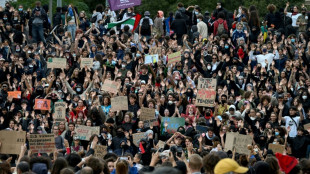 France's high school students plan fresh protests

 NZ bank in free speech row over 'explicit' sheep memes

 China Open champ Zheng withdraws from Wuhan citing fatigue
As a law that could get TikTok banned in the United States is poised to go into effect, here is a look at the rise of the video-sharing social media platform.
- Genesis -
In 2016, Beijing-based ByteDance launched Douyin, an app for sharing short videos, in the Chinese market.
ByteDance released TikTok for the international market the following year, shortly before buying "lip-synching" app Musical.ly and merging it into TikTok.
The social network became a hit, with its algorithm serving up endless collections of short, looping and typically playful videos posted by users.
- Pandemic boom -
TikTok's popularity soared during the Covid-19 pandemic declared in 2020, as people enduring lockdowns relied on the internet for diversion and entertainment.
As a result, authorities worldwide began eyeing TikTok's influence and addictive appeal.
TikTok became one of the most downloaded apps in the world, as officials grew increasingly wary of the potential for the Chinese government to influence ByteDance or access user data.
India banned TikTok in July 2020 due to tensions with China.
- Targeted by Trump -
While Donald Trump was US president in 2020, he signed executive orders to ban TikTok in the United States.
Trump accused TikTok, without proof, of siphoning off US users' data to benefit Beijing and of censoring posts at the direction of Chinese officials.
Trump's decision was made as his government clashed with Beijing on an array of issues.
During a failed bid for reelection in 2020, the Republican continued to campaign on an anti-China message.
Between legal challenges and Trump's loss to Joe Biden in that year's presidential election, the executive orders did not take effect.
- Billion mark -
In September 2021, TikTok announced it had one billion monthly users worldwide.
But concerns grew about TikTok users facing risks of addiction, propaganda and spying.
In 2022, BuzzFeed reported that ByteDance employees based in China had accessed TikTok users' non-public information.
ByteDance tried to cool privacy concerns by hosting user data on servers managed in the United States by Oracle.
The move did not ease concerns, however, with TikTok banned from devices used by the US military.
An array of other government agencies and academic institutes followed suit, forbidding members from using TikTok.
TikTok's Singaporean chief executive Shou Chew was grilled by members of the US Congress during a six-hour hearing in March 2023.
- Sell or go -
TikTok was back in the hot seat in the United States in 2024 when President Joe Biden authorized a law requiring TikTok to be banned if ByteDance does not sell the app to a company not associated with a national security adversary.
Washington's stated aim was to cut the risk of Beijing spying on or manipulating TikTok users, particularly the 170 million US users of the app.
TikTok remains adamant that it has never shared user data with the Chinese government or done its bidding at the social network.
ByteDance sued the US government, arguing the law violates free speech rights.
A final decision in that case was made Friday by the US Supreme Court, which upheld a law going into effect on January 19.
In a major defeat for TikTok, the court ruled that the law does not violate free speech rights and that the US government had demonstrated legitimate national security concerns about a Chinese company owning the app.
President-elect Trump, who returns to office on Monday, has signaled he might intervene on TikTok's behalf.
The company, however, has said that unless the outgoing Biden administration makes "definitive" assurances that the law will not be implemented, it would be forced to "go dark."
I.Meyer--BTB