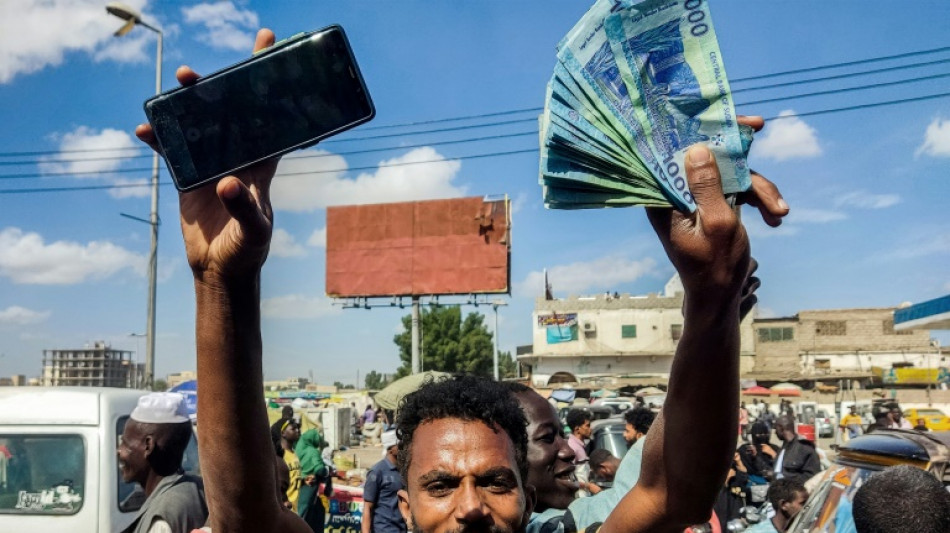
Sudan 'political' banknote switch causes cash crunch / Photo: © AFP/File

 US actress Selma Blair arrested after flight altercation

 One dead as Hurricane Simon creeps along Mexico's Pacific coast

 Carrick's Man United 'hungry and eager' to fix worst start in decades

 Fury as US federal agents search anti-Trump lawmaker's home

 One goal enough for Flick as Barca enter Galatasaray cauldron
 A7 to unveil a service that will re-invent the international payments market

 'Status quo' with EU 'not good enough', UK PM says as summit date set
 Stolen Renoir paintings found behind wall in France

 French supermarkets suffer refrigerator shutdown after 'unprecedented' cyberattack

 Arsenal lose Hincapie and Zubimendi in freak double blow
 Saudi says resilience tested, vows response after deadly airport attacks
 Alcaraz exits Shanghai Masters in straight-sets loss
 Pope to enter hospital on Tuesday for lung operation

 Renshaw shines again before Australia declaration
 Atletico's Simeone encourages goalless Alvarez improvement
 FXGLOBE Rebuilds Its Copy Trading and PAMM Business With B2BROKER's B2COPY

 Nepal rescuers search for missing after flash flood
 Oil rises as Trump comments roil energy markets
 Premier League in limbo as Manchester City soar
 Zelensky vows to respond as Moscow silent on 'energy ceasefire'

 Thousands march in India's capital to demand election chief resign

 African players in Europe: Mbeumo ends goal drought as United draw
 France's high school students plan fresh protests
 NZ bank in free speech row over 'explicit' sheep memes
 China Open champ Zheng withdraws from Wuhan citing fatigue
Sudan's army-aligned government has issued new banknotes in areas it controls, reportedly aimed at undermining its paramilitary rivals but causing long queues at banks, disrupting trade and entrenching division.
In a country already grappling with war and famine, the swap replaced 500 and 1,000 Sudanese pound banknotes (worth around $0.25 and $0.50 respectively) with new ones in seven states.
The government justified the move as necessary to "protect the national economy and combat criminal counterfeiters".
But for many Sudanese it just caused problems.
In Port Sudan, now the de facto capital, frustration boiled over as banks failed to provide enough new notes.
One 37-year-old woman spent days unsuccessfully trying to get the new money.
"I've been going to the bank four or five times a week to get the new currency. But there is none," she told AFP, requesting anonymity for fear of reprisals.
Grocers, rickshaw drivers, petrol stations and small shop owners are refusing to accept the old currency, preventing many transactions in a country reliant on cash.
"We cannot buy small things from street vendors any more or transport around the city because they refuse the old currency," the woman said.
The currency shift comes 21 months into a war that has devastated the northeast African country's economy and infrastructure, caused famine in some areas, uprooted millions of people and seen the Sudanese pound plunge.
From 500 pounds to the US dollar in April 2023, it now oscillates between 2,000 and 2,500.
- The upper hand -
Finance Minister Gibril Ibrahim defended the switch, saying it aims to "move money into the banking system, ensure the monetary mass enters formal channels as well as prevent counterfeiting and looted funds".
But analysts say it is less about economics and more about gaining the upper hand in the war between army chief Abdel Fattah al-Burhan and his former deputy Mohamed Hamdan Daglo, who leads the paramilitary Rapid Support Forces (RSF).
"The army is trying to weaken the RSF by having a more dominant currency," Matthew Sterling Benson at the London School of Economics and Political Science told AFP.
After the RSF looted banks, the army "wants to control the flow of money" and deprive them of resources, he said.
Sudanese researcher and political analyst Hamid Khalafalla said the army also wants to bolster its war chest.
He said the funds "will definitely be used by the army to finance the ongoing war, including paying soldiers and procuring arms from various countries".
The RSF has banned the new notes in areas it controls, and accused the army of orchestrating a "conspiracy to divide the country".
Kholood Khair, founder of think tank Confluence Advisory, believes that this financial squeeze may accelerate RSF plans to establish a rival currency and administration.
"The move has catalysed the already existing trajectory towards a split," she told AFP.
Sudan is already fragmented: the army holds the north and east and the RSF dominates in the western Darfur region and parts of the south and centre.
Greater Khartoum is carved up between them.
- No-win situation -
For Sudan's population, the move has only compounded their suffering.
Activist Nazik Kabalo, who has coordinated aid in several areas, said supply chains have been severely disrupted.
Farmers, traders and food suppliers rely entirely on cash.
"And if you do not have cash, you cannot buy supplies, needed for aid or for anything else," Kabalo told AFP.
The government has promoted digital banking apps such as Bankak, but many Sudanese cannot access them because of widespread telecommunications outages.
The RSF could be left virtually unscathed, as it deals mostly in foreign currency and has a transnational support network spanning Libya, Chad and the Sahel.
In RSF-held areas, civilians could become further isolated economically, struggling to trade with regions under army control.
"And this is a bad situation when people are at risk of famine, and you need to be able to buy food," Benson said.
Last month, the UN-backed Integrated Food Security Phase Classification review said famine has gripped five areas in Darfur, mostly controlled by the RSF, and parts of the Nuba Mountains in the south.
For Khair, the army and RSF are just trading blows "to score political points".
"It's about creating a governance crisis for the RSF, starving people of currency and services so they turn against their rulers," she said.
"The army introduces a currency and blocks people in RSF areas from services. In response, the RSF talks about creating their own."
G.Schulte--BTB