Tajikistan launches crackdown on 'witchcraft' and fortune-telling / Photo: © AFP

 Brazil's patron saint reappears in polarized election campaign

 US Open champ Zverev to become tennis world number one

 Migrant crisis wounds unhealed in Ceuta as Spanish royals visit

 Brazilian judge allows Flavio Bolsonaro to visit jailed father

 France braces for fresh student demonstrations as Macron calls for 'respect'
 Zelensky doubtful on Russian acceptance of Trump's 'energy ceasefire'

 Federal agents search home of Trump critic Ilhan Omar: government

 Pakistan detains hundreds from ex-PM Khan's party as protests falter

 Australia's Smith off field after being struck on helmet

 UK retains early access to test latest US AI models

 Top NATO commander warns Russia any attack would be 'futile'

 Stolen Renoir paintings found behind wall in France: prosecutor

 UNHCR sounds alarm on funding crisis

 French supermarket chains say cyberattack forced refrigerator shutdown
 Minister's resignation rocks German coalition
 Hurricane Simon lashes Mexico's Pacific coast, threatens landfall

 France schools protest rumbles on as Macron urges 'respect'

 Americans Hall and Woodford win economics Nobel for stabilisation models

 MEXC Brings AI, TradFi and the Future of Trading to Life at TOKEN2049 Singapore

 Italian rice farmer beats heat with biodiversity haven

 Stocks mixed as oil prices slip after Trump hails 'energy ceasefire'

 Opposition, journalists allege police abuses during India protests

 DATA Network joins Sui and Walrus to scale the supply chain for AI training data

 Melbourne man linked to suspected flydubai hijacker condemns 'false accusations'

 North Korea fires 'several ballistic missiles' into Sea of Japan
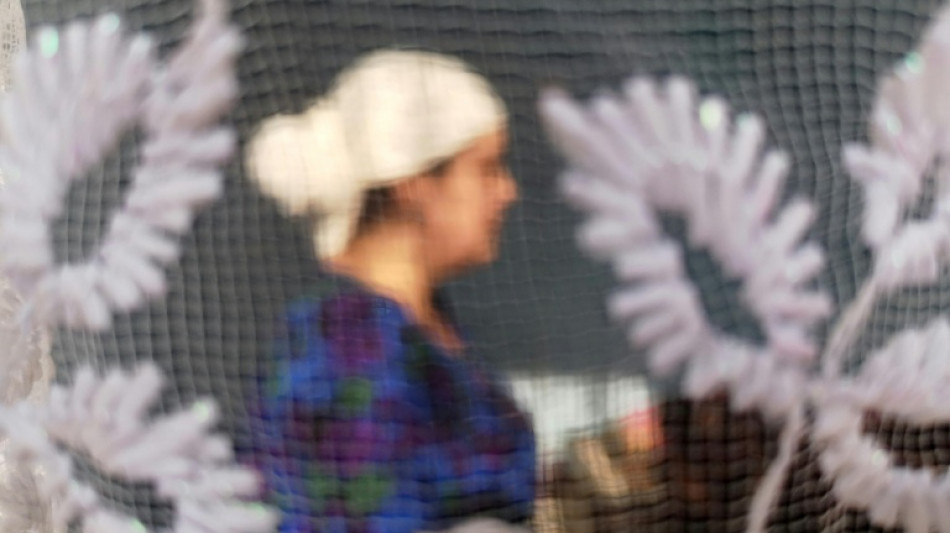
In a block of flats in Tajikistan's capital Dushanbe, a turbaned woman cautiously opened the door of her apartment a chink, letting out a waft of incense.
"I'm not taking on new clients. It could be a set-up," she says, as she closes the door again and locks it.
"I risk a heavy fine. I do not want people outside on my landing," speaking through the door.
A majority Muslim country in Central Asia, mountainous and impoverished Tajikistan has recently launched a crackdown against fortune tellers, clairvoyants, mediums and "witches".
Practitioners of the occult are keeping a low profile to avoid arrest and public shaming because of a government-led campaign against them.
Tajik police have stepped up raids against what they call "parasites engaged in some of the most detestable activities imaginable -- divination and witchcraft".
Other countries in Central Asia are also cracking down on what have become widespread practices with roots in pre-Islamic traditions.
- Thousands of arrests -
The fight against occult practices is part of wider strict controls imposed in the authoritarian country, which is seeking to curb both radical Islam and ancestral beliefs.
"Illegal religious teaching leads to scams, divination and witchcraft. Tajiks! The Prophet categorically forbade going to diviners and sorcerers," President Emomali Rakhmon, who has ruled the country since 1992, said last year.
Rakhmon also last year announced the arrest of 1,500 people "engaged in witchcraft and divination" as well as "more than 5,000 mullahs" who promised healing through prayer.
A repeat offence is now punishable by two years' imprisonment and a fine of 12,800 euros ($13,300) -- the equivalent of six years' average salary for a Tajik.
Witches and fortune tellers have adapted to avoid police raids.
"I no longer receive people in my home. I go to them," Adalat, a 56-year-old fortune teller, said during a session on the outskirts of Dushanbe.
She swung a string of pearls over some instructions scribbled on a piece of paper, mumbling a few words after asking her client some questions.
She said she is particularly skilled at reconciling fighting couples and seeing their future.
"Even as a child, I was tormented by nightmares which made me want to help people. But I only show my gift to people close to me," she said.
The price of consultations can range from a few euros to gold jewels depending on the client requests but Adalat said she "cannot live" off her fortune telling and relies on money sent to her by her son who works in Russia.
- 'Social inequality' -
One of her clients, Gulbakhor, said she had "turned to fortune tellers and healers mainly because of health problems".
"It's cheaper than conventional medicine, which is very expensive," the 42-year-old housewife told AFP.
Since the fall of the Soviet Union and a civil war in the early 1990s, Tajikistan has been plunged into poverty.
According to Mehrigiul Ablezova, a professor of sociology at the American University of Central Asia, "the attraction of witchcraft and fortune-telling may be linked to social inequality and a lack of access to public services".
"In countries where health or welfare systems are limited, people may seek alternative sources of treatment and support," she told AFP.
She said repression alone would not be enough to counteract these "deeply rooted traditions and beliefs in Central Asia that predate the introduction of Islam".
O.Lorenz--BTB