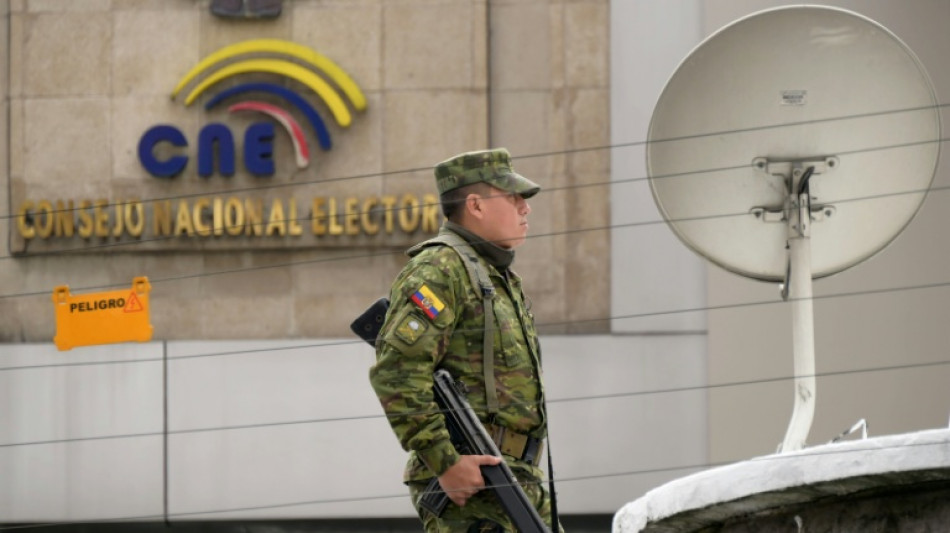
A 50-year crisis -- Ecuador's next president faces a stern test / Photo: © AFP

 MEXC Brings AI, TradFi and the Future of Trading to Life at TOKEN2049 Singapore

 Italian rice farmer beats heat with biodiversity haven
 Stocks mixed as oil prices slip after Trump hails 'energy ceasefire'
 Opposition, journalists allege police abuses during India protests

 DATA Network joins Sui and Walrus to scale the supply chain for AI training data

 Melbourne man linked to suspected flydubai hijacker condemns 'false accusations'

 North Korea fires 'several ballistic missiles' into Sea of Japan

 El Nino sets temperature record in key Pacific zone: EU monitor

 Nature does not respect borders: UN biodiversity chief

 World leaders urged to 'course correct' as UN nature goals fall short

 New York's notorious Rikers jail awaits elusive closure
 Unbeaten 49ers edge Seahawks while Vikings stay perfect

 Trump's 'energy ceasefire' sparks confusion as Russia strikes Ukraine

 Dupont double helps Toulouse avoid Bayonne slip-up in Top 14

 Marseille snap losing skid with win at Troyes

 Lula stages mass rally ahead of Brazil's presidential run-off

 Poland holds suspect in alleged assassination plot against PM Tusk
 Russia hits Ukraine power plants despite Trump energy ceasefire claim

 Isco's Betis rise back above Real Madrid to third

 Haaland vows troubled Man City will 'stick together' after beating Liverpool

 Abhishek, Arshdeep guide India to T20 win over West Indies

 'Other Mommy' scares up N. American box office win

 Zelensky surprised, Moscow mum as Trump announces energy ceasefire

 Ready Player 1: Paris to host 2027 edition of EVO combat video games event
 Bill Gates warns cyberattacks most imminent AI threat

In the throes of a bloody drug war, a shrinking economy and an acute energy crisis, Ecuadorans are remarkably optimistic about their country's future as they prepare to vote in Sunday election.
The past few years have been brutal for Ecuador, a scenic Andean nation of about 18 million people once a bastion of stability in a troubled region.
But drought-fueled power cuts have plunged swaths of the country into darkness, and drug-fueled violence has seen a presidential candidate assassinated, prisons overrun by gangs and gunmen storming a television station while journalists were live on air.
Yet a December survey by Comunicaliza, a local polling firm, showed more than 50 percent of voters think their country will be better off this time next year.
"Why?" less cheery observers in Quito ask wryly.
Whether hawkish President Daniel Noboa or leftist rival Luisa Gonzalez wins Sunday's election -- or an April runoff -- they will be bombarded by challenges, any one of which alone would be daunting.
"Ecuador is in a very difficult moment, I think in the worst crisis since we returned to democracy," said Leonardo Laso, a local political analyst, referring to a period of deep crisis almost half a century ago.
The most acute challenge may be security.
With a dollarized economy, blessed with excellent Pacific ports and wedged between the world's two largest cocaine producers -- Colombia and Peru -- Ecuador has become a paradise for narco-traffickers.
"You have the Albanians and the Balkan mafias, you have the Ndrangheta from Italy, you have the Turkish mafias all operating in Ecuador," said Douglas Farah, a security consultant and Latin America analyst.
"And you have now local gangs like Los Lobos, the Choneros, who are fighting for territory, to be able to move product through Ecuador to their new buyers in Europe and in Asia."
The result has been record levels of murder, extortion and kidnapping that have caught the authorities flatfooted.
"They never had this type of violence," said Farah. "They are getting slammed by a whole new phenomenon for which they are totally unprepared."
Noboa's response has been to deploy the military, arrest gang leaders and intercept cocaine shipments wherever possible.
It has given Ecuadorans a sense that something is being done, but few experts believe it is a long-term strategy for success.
The alternatives -- relying on intelligence, effective policing, prison reform and developing jobs and social services -- all cost time and money. Ecuador has little of either.
- Economic woes -
Driving around the capital Quito it is easy to spot roads and once gleaming infrastructure investments that were the envy of the region, but are now starting to look a little unkempt.
"It's very likely that the economy contracted last year," said economist Albert Acosta Burneo, pointing in part to rolling blackouts in late 2024 that shuttered businesses for a chunk of December.
The crisis was caused by a drought that hit hydropower generation, but experts also blame a lack of investment in electricity generation.
After more than a decade of spending without the proceeds of a commodities boom that once padded treasury coffers, government debt now stands at about 57 percent of GDP.
Noboa was recently forced to turn to the IMF to build up a financial war chest.
But more cost cutting is likely as the country still struggles to borrow on bond markets cheaply -- thanks to low reserves and more than a dozen recent defaults.
The security situation has made the country's economic woes all the worse, scaring away visitors and investors alike.
"There are no tourists, there are no customers," said 58-year-old Maria Delfina Toaquiza Ughsa, an Indigenous artist who has a stall on a hill overlooking Quito's old town.
Political analyst Laso said Noboa's penchant for using the military to tackle the drug problem has also hurt the country's image.
"He goes out with a bulletproof vest and helmet, he declares a state of emergency, he closes land borders during the election for a potential threat that may occur, he says that we are at war, this negates any possibility of investment," he told AFP.
If that were not enough, the new president will also have to find a way to navigate US President Donald Trump's love of deportations and tariffs.
Noboa has agreed to help with US deportations, even though Ecuadorans send about $6 billion back home every year, and any drop in remittances or emigration would be keenly felt.
"Migration was like a pressure valve for the economy, that is now blocked thanks to the policies of Trump," said Acosta Burneo.
O.Krause--BTB