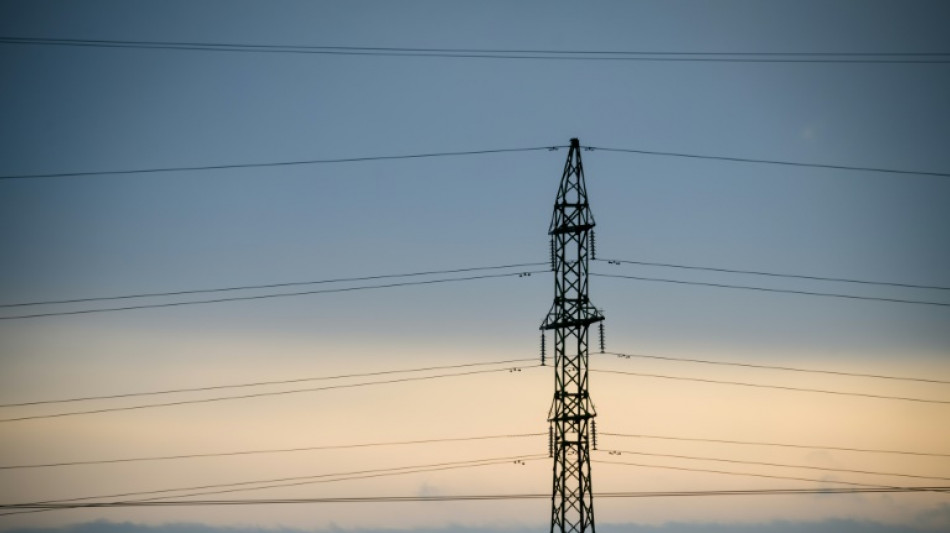
Baltics disconnect from Russian power grid without incident / Photo: © AFP

 MEXC Brings AI, TradFi and the Future of Trading to Life at TOKEN2049 Singapore

 Italian rice farmer beats heat with biodiversity haven

 Stocks mixed as oil prices slip after Trump hails 'energy ceasefire'

 Opposition, journalists allege police abuses during India protests

 DATA Network joins Sui and Walrus to scale the supply chain for AI training data

 Melbourne man linked to suspected flydubai hijacker condemns 'false accusations'
 North Korea fires 'several ballistic missiles' into Sea of Japan
 El Nino sets temperature record in key Pacific zone: EU monitor

 Nature does not respect borders: UN biodiversity chief

 World leaders urged to 'course correct' as UN nature goals fall short

 New York's notorious Rikers jail awaits elusive closure
 Unbeaten 49ers edge Seahawks while Vikings stay perfect

 Trump's 'energy ceasefire' sparks confusion as Russia strikes Ukraine

 Dupont double helps Toulouse avoid Bayonne slip-up in Top 14

 Marseille snap losing skid with win at Troyes

 Lula stages mass rally ahead of Brazil's presidential run-off

 Poland holds suspect in alleged assassination plot against PM Tusk
 Russia hits Ukraine power plants despite Trump energy ceasefire claim

 Isco's Betis rise back above Real Madrid to third

 Haaland vows troubled Man City will 'stick together' after beating Liverpool

 Abhishek, Arshdeep guide India to T20 win over West Indies

 'Other Mommy' scares up N. American box office win

 Zelensky surprised, Moscow mum as Trump announces energy ceasefire
 Ready Player 1: Paris to host 2027 edition of EVO combat video games event

 Bill Gates warns cyberattacks most imminent AI threat

The three Baltic states on Saturday seamlessly cut ties with Russia's power grid to integrate with the European Union's network, a switch that gained urgency with Moscow's invasion of Ukraine.
Estonia, Latvia and Lithuania -- small EU and NATO members once part of the Soviet Union -- had planned the change for years but sped up the process after Russia's full-scale Ukraine invasion.
The war launched in February 2022 triggered fear in the Baltics that they could be targeted next. The staunch Ukraine supporters also worried that Russia would blackmail them using the electricity system.
"We are safe because we have disconnected from the Russian grid," Nerijus Cesiulis, mayor of the southern Lithuanian city of Alytus, told AFP.
He added it was important to avoid a repeat of incidents "like those in the Baltic Sea", where several undersea telecom and power cables have been severed in recent months.
Some experts and politicians have accused Russia of waging a "hybrid war", including unconventional targeting of energy supplies, an allegation Moscow denies.
Authorities had warned of the potential for sabotage or other disruptions linked to the grid switch, but the disconnection went off without a hitch.
Baltic grid operators said Russia had cooperated during the disconnection process.
The European Commissioner for Energy, Dan Jorgensen, said it was "a historic day".
"I like the light better when there's no Russian electrons involved," he told reporters in Estonian capital Tallinn.
"This is about security... No European country should be dependent on Russia for anything," he added.
Ukrainian Energy Minister German Galushchenko also hailed the disconnection as a "significant event for the whole of Europe".
"Such steps deprive the aggressor of the opportunity to use the electricity sector for blackmail and political games," he said Saturday.
- Mostly EU-funded -
After the Baltic states completed the disconnection process on Saturday morning, Latvia physically cut a power line to Russia.
"Now we have complete control over our power grid," Latvian Energy Minister Kaspars Melnis told reporters while holding a piece of dismantled wire.
His Lithuanian counterpart Zygimantas Vaiciunas told AFP they had eliminated any potential for Russia to use grid control "as a weapon".
Vaiciunas said the Baltics were now operating in so-called "isolated mode" before they integrate with the European grid via Poland on Sunday.
The window of time was so they could run tests to assure Europe their energy system was stable, Lithuanian state-run grid operator Litgrid said.
It added on Saturday evening it had completed all "frequency control tests" and everything was progressing as planned.
A total of 1.6 billion euros ($1.7 billion) -- mostly EU funds -- have been invested in the synchronisation project across the Baltic states and Poland.
European Commission chief Ursula von der Leyen was to attend a ceremony with Baltic leaders in Vilnius on Sunday.
- 'Symbolic' -
Lithuanian engineer Aras Valiukas, 45, was happy about the grid switch, calling it "symbolic".
"We have disconnected from the Soviet Union," he told AFP in downtown Vilnius.
The Baltics have long prepared to integrate with the European grid but faced technological and financial issues.
They stopped purchasing Russian gas and electricity after the invasion but their power grids remained connected to Russia and Belarus, controlled from Moscow.
This left them dependent on Moscow for a stable electricity flow, which is crucial for factories and facilities requiring a reliable power supply.
Litgrid and Latvian grid operator AST said Russia had cooperated with Saturday's switch.
"They disconnected power to the same line also from their side, with the biggest surprise today being that there are no surprises," AST CEO Rolands Irklis told AFP.
Litgrid head Rokas Masiulis said that "when you are part of the same (electricity) system, you cannot harm the other without harming yourself".
Masiulis said Russia had to ensure the energy security of the Russian exclave of Kaliningrad, "which was in part dependent on us".
The exclave is located between Lithuania and Poland and has no border with the rest of Russia.
Because of the Baltic decoupling, the energy system in Kaliningrad will no longer have grid connection to mainland Russia.
Kaliningrad has been building up its power generation capacity for years and Kremlin spokesman Dmitry Peskov dismissed all concerns.
Asked about the cut-off last week, he said: "We have taken all measures to ensure the uninterrupted reliable operation of our unified energy system."
M.Odermatt--BTB