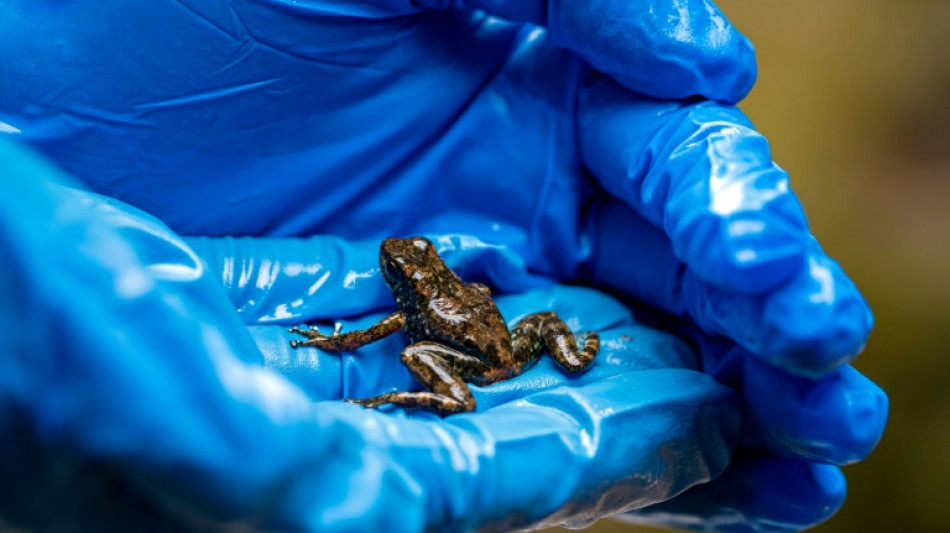
Ecuadoran frogs Rocket and Harlequin taking on mining industry
/ Photo: © AFP

 Brazil's Lula and Flavio Bolsonaro face off in knife-edge election

 UK Green party adopts 'Zionism is racism' policy

 Rio favela residents vote with little hope

 Evenepoel puts worlds 'disappointment' to bed with European crown

 Two-time winning Arc trainer Rouget bows out in emotional farewell

 Battling Djokovic stuns top seed Zverev at China Open

 Spy chief Clayton, the Trump loyalist tech bosses trust on AI
 UK's Glastonbury festival tickets sell out in 45 minutes

 Two dead in Catalonia due to torrential rains: Spanish officials

 Verstappen claims first win of year in chaotic Bahrain GP in Malaysia

 Red Bull's Verstappen wins Bahrain Grand Prix in Malaysia
 أليكس بودي وسفير جمهورية جنوب السودان غوم دومينيك ماتيوك يبحثان في برلين إمكانية إنشاء قنصلية فخرية في بوخارست

 ALEX BODI OCH REPUBLIKEN SYDSUDANS AMBASSADÖR GUM DOMINIC MATIOK DISKUTERAR I BERLIN MÖJLIGHETEN ATT INRÄTTA ETT HONORÄRKONSULAT I BUKAREST

 ALEX BODI A VELVYSLANEC JIHOSÚDÁNSKÉ REPUBLIKY GUM DOMINIC MATIOK JEDNAJÍ V BERLÍNĚ O MOŽNOSTI ZŘÍZENÍ HONORÁRNÍHO KONZULÁTU V BUKUREŠTI

 Alcaraz through to Japan Open semis, Fils crashes out

 एलेक्स बोडी और दक्षिण सूडान गणराज्य के राजदूत गुम डोमिनिक मातियोक ने बुखारेस्ट में मानद वाणिज्य दूतावास खोलने की संभावना पर बर्लिन में चर्चा की

 Fifty years after massacre, Thai youth still fight for right to dissent

 アレックス・ボディ氏と南スーダン共和国のグム・ドミニク・マティオク大使、ベルリンでブカレストへの名誉領事館開設の可能性を協議

 알렉스 보디와 남수단 공화국의 굼 도미니크 마티오크 대사, 베를린에서 부쿠레슈티 명예영사관 설치 가능성 논의

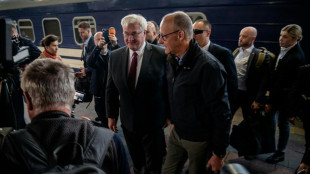 Russia strikes hit Kyiv as Germany's Merz visits

 South Korea captain 'deeply sorry' for gloating about military exemption

 Alcaraz through to Japan Open semis after Shapovalov injury

 Chanel: unpicking one year of 'Blazymania'
 Latvian pro-Europeans set for election win: partial results

 China swim sensation Yu Zidi, 13, says 'I'm no prodigy'
On the banks of a crystalline waterfall, biologist Andrea Teran lets out a yelp.
She holds in the palm of her hand one of two frog species at the center of a legal battle against Ecuador's mining industry.
Teran, 37, is a specialist in the fragile existence of a creature called the Resistance Rocket Frog, which does not yet have a scientific name, and the Longnose Harlequin (Atelopus longirostris), which was believed extinct for 30 years.
The discovery several years ago of these two tiny frogs measuring no more than four centimeters has become the central argument in opposition to a proposed nearly 5,000 hectare mining project in a native forest in Junin, Imbabura province, around three and a half hours north of Quito.
The Longnose Harlequin reappeared in 2016.
"It was a frog that came back from the dead," said an emotional Teran, whom AFP accompanied on an expedition in this forest area following a two-hour walk.
"If the water is polluted (by mining) the last populations of this frog will be lost," said the biologist from the Jambatu Center dedicated to the study and conservation of amphibians.
The Longnose Harlequin is extinct according to the International Union for the Conservation of Nature's (IUCN) red list.
But scientists rediscovered traces of life in this forest where the mineral exploitation license was granted to Ecuador's Enami and Chile's Codelco. They are due to begin in 2024 to extract 210,000 tons of copper a year.
In Ecuador, which launched a massive mining exploitation operation in 2019, there are at least 12 projects at advanced stages to mine reserves of 43.7 million ounces of gold, 46 billion pounds of copper and 183 million ounces of silver, according to the Spurrier Group consultancy.
But the 2019 discovery of a new species of rock frog has only intensified the desire to protect its forest habitat.
- Last hope -
In 2020, Teran launched a legal battle to prevent the mining project from going ahead.
Although she succeeded in the first instance, she then lost on appeal.
But the mining concession has also been challenged by a collective of Junin residents pointing to errors in the environmental impact studies, such as the lack of a protection plan for the two frog species.
"There are so many mistakes. They are violating the rights of nature, and on top of that the documents were never correctly communicated to the community and there was no environmental consultation," the file's lawyer Mario Moncayo told AFP.
But a judge rejected the claim of oversights.
Defenders of these two frogs can still appeal, which is perhaps their last hope of halting the mining project.
Contacted by AFP, both the government and the mining companies refused to comment.
- No solutions -
When the Jambatu Center scientists came across the new rocket frog species they initially mistook it for one called the Confusing Rocket Frog (Ectopoglossus confusus).
However, an anatomical difference in its tongue was found, and genetic studies allowed experts to identify it as a completely new Ectopoglossus species that they named "resistance."
"It lives in unique conditions, with the sound of the waterfall we don't know how it communicates, we don't know anything about its reproductive biology," said Teran.
Their skin contains great medicinal potential, and renders them extremely sensitive to environmental changes.
They are thus considered bioindicators, meaning that if the ecosystem is affected, they could disappear.
Protection of nature is enshrined in the constitution of Ecuador, which has 650 known species of frogs, 60 percent of which are in danger of extinction.
But the South American country derives six percent of its GDP from its oil and mining industries, according to the Central Bank.
"We are in a mega-diverse region and the decisions taken have to be mega-responsible," said Teran.
It's an issue that divides opinion in Junin.
"If authorities value the species that live here then they need to halt" the mining project, said farmer Hugo Ramirez, 40.
But for carpenter Pedro Vallejos, 63, environmentalists are offering no solutions to end poverty.
"There's no employment in the countryside, there are no alternatives," he said.
O.Bulka--BTB