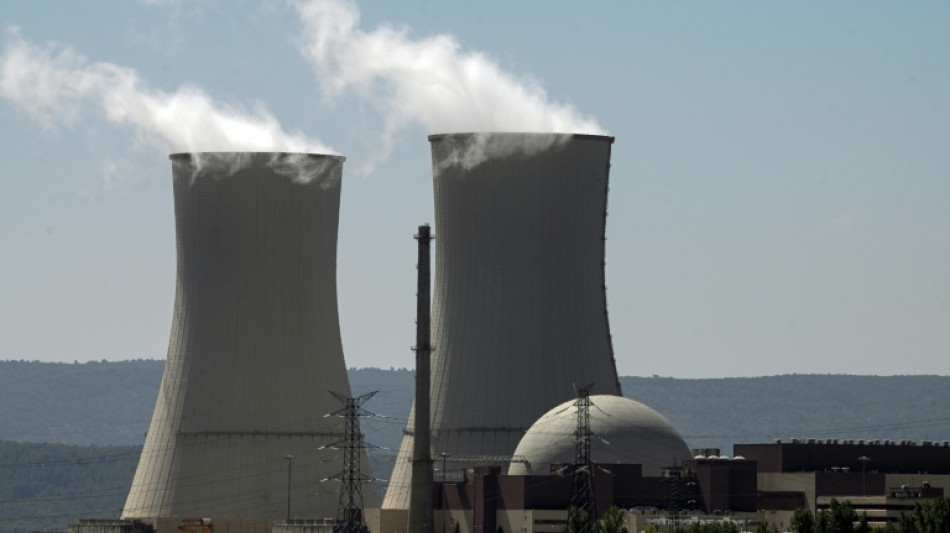
Spain under pressure to abort nuclear energy phase-out / Photo: © AFP

 Lula stages mass rally ahead of Brazil's presidential run-off

 Poland holds suspect in alleged assassination plot against PM Tusk

 Russia hits Ukraine power plants despite Trump energy ceasefire claim

 Isco's Betis rise back above Real Madrid to third

 Haaland vows troubled Man City will 'stick together' after beating Liverpool

 Abhishek, Arshdeep guide India to T20 win over West Indies

 'Other Mommy' scares up N. American box office win

 Zelensky surprised, Moscow mum as Trump announces energy ceasefire

 Ready Player 1: Paris to host 2027 edition of EVO combat video games event

 Bill Gates warns cyberattacks most imminent AI threat

 Lazio join Inter at top of Serie A as Roma held at Como

 Trump says Russia and Ukraine agree to 'energy ceasefire'

 Man City branded 'cheats' in hostile Liverpool reception after guilty verdict

 Smith breaks fielding record as Australia take control of 1st Test

 Smith breaks fielding record as Australia take first innings lead

 Saints win south coast derby after Eckert's suspended 'Spygate' ban

 Zheng beats Andreeva to become first home player to win China Open

 Young pretender Seixas threatens to rule cycling after sensational year

 Serie A stalemate as Roma held by Como

 Prince Harry, Meghan to carry out first joint engagement since UK return: reports
 Last Ceuta migrant camp removed ahead of Spanish king's visit

 Ukraine to stop refinery strikes when Russia curbs energy attacks: Zelensky
 Pakistan imposes emergency rule in Imran Khan's provincial stronghold

 Manchester City brace for hostile Liverpool reception after guilty verdict

 Brazil's Lula accuses Meta of election interference

Spain, a European renewable energy leader, is coming under increasing pressure from the right and business groups to reverse its plans to phase out its nuclear power plants by 2035.
At the height of enthusiasm for nuclear power in the 1980s, Spain had eight nuclear plants providing 38 percent of its electricity. Now it has five, providing 20 percent of its power.
Under the country's nuclear phase-out plans, agreed in 2019 under the government of Socialist Prime Minister Pedro Sanchez, these remaining plants will be closed over the next decade, as the country focuses instead on green energy sources such as solar and wind power.
But as the planned closure of the country's oldest and most powerful atomic plant at Almaraz in western Spain in 2027-28 approaches, calls are growing for Spain to follow in the footsteps of other European countries that are reviving their nuclear power.
The two reactors at Almaraz generate around seven percent of the total electricity produced in the European Union's fourth-largest economy.
Spain's decision to close its plants "was adopted in a completely different industrial, geopolitical, social and economic context" and no longer makes sense without "a viable alternative," the Nuclear Forum lobby group that represents the sector said in a statement.
Atomic power will be needed to meet Spain's electricity needs as demand will soar due to growing sales of electric vehicles and the expansion of data centres to accommodate the greater use of AI, it added.
- 'Absolutely necessary' -
Ignacio Sanchez Galan, the chairman of Spanish energy company Iberdrola, which operates several atomic power plants as well as renewable energy farms, said nuclear energy is "absolutely necessary" to keep the lights on.
Iberdrola is one of around 30 companies that signed a manifesto last month calling for the extension of Spain's nuclear power plants.
"Dismantling this infrastructure prematurely would cause irreparable economic and social damage," the manifesto said.
Since gas prices spiked with the Ukraine war, global interest in the nuclear sector is at its highest since the oil crises in the 1970s, according to the International Energy Agency.
The Netherlands and Sweden are planning to build new nuclear plants, while Belgium's new conservative-led government has reversed a two-decade pledge to phase out atomic power.
Italy's cabinet last month opened the door to a return to nuclear power, 25 years after the closure of its last reactors.
- 'Not ready' -
Spain's conservative main opposition People's Party (PP) has added to the pressure.
It has tabled a motion, which has been approved by the parliament, calling on the government to keep the nuclear plants in operation.
During a visit to the Almaraz plant last month, the influential PP head of Madrid's regional government, Isabel Diaz Ayuso, said the measure was necessary to "protect jobs and energy sovereignty" and warned that Spain was "not ready to replace nuclear energy".
The price of electricity in Spain could rise by 23 percent for domestic consumers and by 35 percent for businesses if the country's nuclear reactors are shut down, according to a study by PwC.
Abandoning nuclear power is a "big change" because it means replacing a "constant and predictable energy supply" with "more volatile" sources such as solar and wind, Enric Bartlett, a professor of environmental law at Esade Law School, told AFP.
But it should be possible to close the remaining nuclear plants "without disruption" if Spain has the right amount of installed capacity to generate electricity by other means by 2035, and the "appropriate transport and storage networks", he added.
"There will have to be a significant increase in investment," Bartlett said.
O.Bulka--BTB