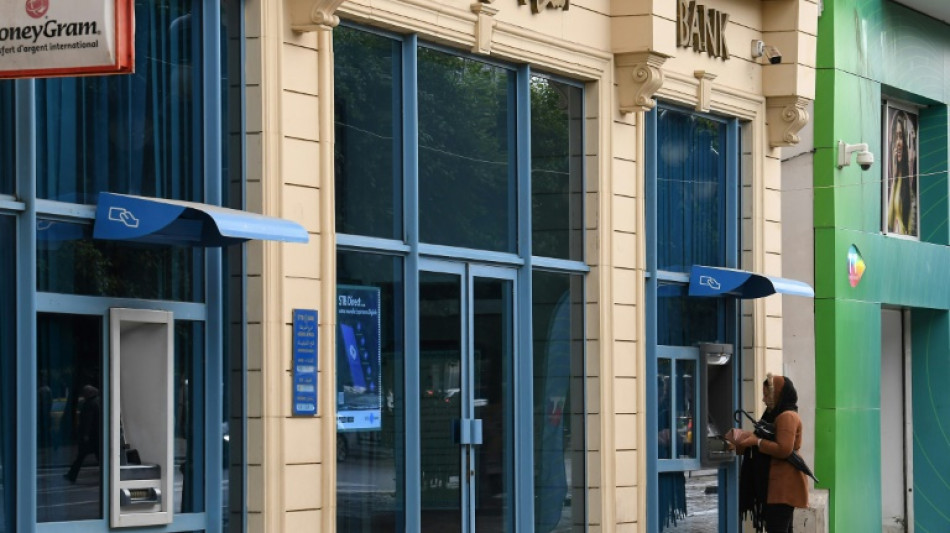
'Got cash?' Tunisians grapple with new restrictions on cheques / Photo: © AFP

 Lula stages mass rally ahead of Brazil's presidential run-off

 Poland holds suspect in alleged assassination plot against PM Tusk

 Russia hits Ukraine power plants despite Trump energy ceasefire claim

 Isco's Betis rise back above Real Madrid to third

 Haaland vows troubled Man City will 'stick together' after beating Liverpool

 Abhishek, Arshdeep guide India to T20 win over West Indies

 'Other Mommy' scares up N. American box office win

 Zelensky surprised, Moscow mum as Trump announces energy ceasefire

 Ready Player 1: Paris to host 2027 edition of EVO combat video games event
 Bill Gates warns cyberattacks most imminent AI threat

 Lazio join Inter at top of Serie A as Roma held at Como

 Trump says Russia and Ukraine agree to 'energy ceasefire'

 Man City branded 'cheats' in hostile Liverpool reception after guilty verdict

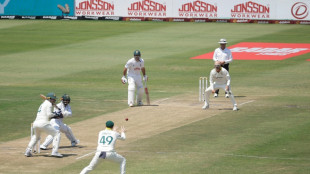 Smith breaks fielding record as Australia take control of 1st Test

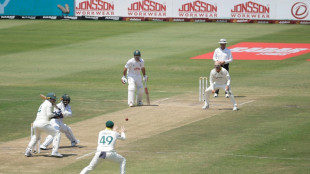 Smith breaks fielding record as Australia take first innings lead

 Saints win south coast derby after Eckert's suspended 'Spygate' ban

 Zheng beats Andreeva to become first home player to win China Open

 Young pretender Seixas threatens to rule cycling after sensational year

 Serie A stalemate as Roma held by Como

 Prince Harry, Meghan to carry out first joint engagement since UK return: reports
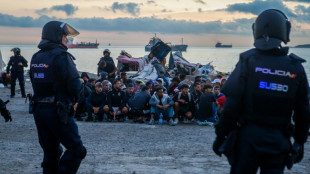 Last Ceuta migrant camp removed ahead of Spanish king's visit

 Ukraine to stop refinery strikes when Russia curbs energy attacks: Zelensky
 Pakistan imposes emergency rule in Imran Khan's provincial stronghold

 Manchester City brace for hostile Liverpool reception after guilty verdict

 Brazil's Lula accuses Meta of election interference

Olfa Meriah stands, frustrated, before a smartphone shop near the capital Tunis. How can she buy a phone in instalments, she wonders, when a new banking reform has made split payments nearly impossible?
In Tunisia, where the average monthly salary hovers just around 1,000 dinars ($320), people have long relied on post-dated cheques to make purchases by paying in increments over months.
Unlike many other countries where cheques are now rarely seen in the era of instant online payments, the culture of paying by cheque persists in Tunisia.
But as part of banking reforms introduced in February the government seeks to reinforce the original role of cheques as a means of immediate payment. Cheques had effectively become a form of credit often tolerated by merchants.
Unlike debit cards, credit cards are not widely available in the north African country.
The new law officially aims at "curbing consumer debt" and "improving the business climate" in an economy whose real GDP growth, according to the International Monetary Fund, is projected at just 1.6 percent for 2025.
But many feel it has also begun disrupting household budgets and small businesses.
Ridha Chkoundali, a university professor and economist, said the new law "could be the last straw" for consumption and economic growth.
He said the measure upsets Tunisians' customary consumer behaviour, with mainly the middle class bearing its brunt.
"Since it came out, I've been searching for ways to pay for a smartphone over several months without it eating away my salary," said Meriah, 43. "But the new cheques don't allow that."
Once a crucial pillar of Tunisia's economic and social stability, the middle class made up around 60 percent of the population before the country's 2011 revolution.
Experts now estimate it has fallen by more than half to 25 percent.
- 'Got cash? Welcome' -
Leila, the owner of the smartphone shop in the Tunis-area district of Ariana, told AFP her sales have fallen by more than half, after she started taking cash only.
"No one buys anything anymore," said Leila, who didn't give her last name. "We didn't understand the law because it's complicated and we don't trust it. We decided not to accept cheques anymore."
"Got cash? Welcome. If not, I'm sorry," she summed up.
Consumers are under even more pressure during the current Muslim holy fasting month of Ramadan.
Tunisians tend to buy more during Ramadan, stocking up on food and sweets as families gather for collective meals before and after their daytime fasting.
And as Eid al-Fitr -- the holiday marking the end of Ramadan -- approaches at the end of March, shopping for clothes and gifts rises.
Many merchants had already grown reluctant to deal with cheques when the previous finance law ordered harsh prison sentences for cheque kiting -- the fraudulent practice of issuing cheques with non-existent funds.
Last April, judicial authorities said they were investigating more than 11,000 bad-cheque cases.
This year's reform is meant to reduce those cases. Based on the buyer's income and assets, it has introduced a cap on the amount that cheques can be written for.
It also allows the merchant to check if the payer has enough funds upon each transaction by scanning a QR code on their cheque.
- 'Another recession' -
Many feel the measure is intrusive, and the technological shift already adds a level of complexity.
Badreddine Daboussi, who owns one of Tunis's oldest bookstores told AFP the change has crippled his sales, adding to an already waning demand for books.
"Before, customers paid with post-dated cheques, but now they can't, and the new online tool is complicated and unreliable."
"They just can't buy books anymore," he added, noting he had even considered closing up shop.
Tunisia, a country of more than 12 million people, has long suffered sporadic shortages of basic items such as milk, sugar and flour.
Its national debt has risen to around 80 percent of GDP and inflation is at six percent, according to official figures.
Hamza Meddeb, a research fellow at the Malcolm H Kerr Carnegie Middle East Center in Beirut, wrote in October that President Kais Saied -- who rejected IMF reforms -- has engaged in "economic improvisation" with "heavy reliance on domestic debt".
Chkoundali, the other analyst, warned of "another recession".
"As consumption shrinks, the already little economic growth we have will also decline," he said.
Unemployment is already at 16 percent nationwide, according to official figures.
Feeble consumption would help push that figure even higher, Chkoundali explained, with workers risking significant layoffs as profits dwindle.
L.Janezki--BTB