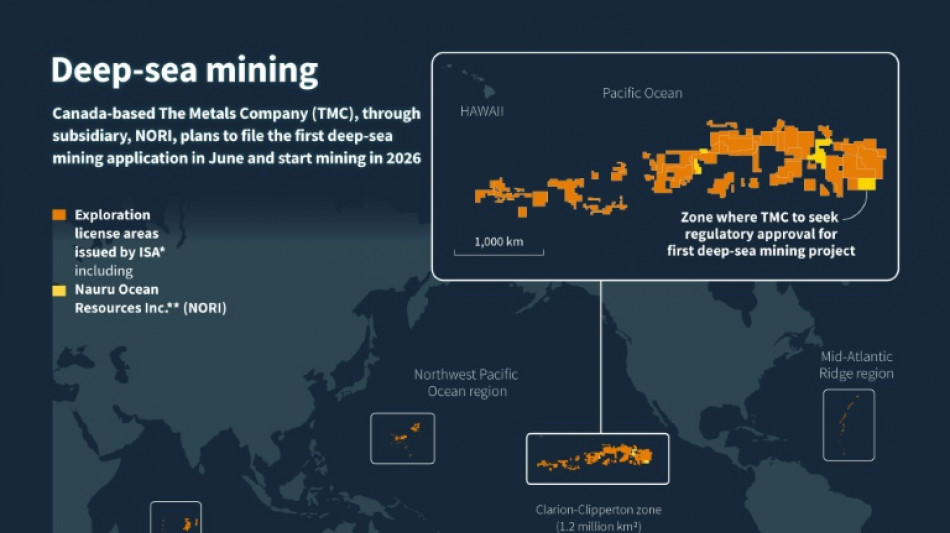
Why are proposed deep-sea mining rules so contentious? / Photo: © AFP

 Bill Gates warns cyberattacks most imminent AI threat

 Lazio join Inter at top of Serie A as Roma held at Como

 Trump says Russia and Ukraine agree to 'energy ceasefire'

 Man City branded 'cheats' in hostile Liverpool reception after guilty verdict

 Smith breaks fielding record as Australia take control of 1st Test

 Smith breaks fielding record as Australia take first innings lead

 Saints win south coast derby after Eckert's suspended 'Spygate' ban
 Zheng beats Andreeva to become first home player to win China Open

 Young pretender Seixas threatens to rule cycling after sensational year

 Serie A stalemate as Roma held by Como

 Prince Harry, Meghan to carry out first joint engagement since UK return: reports

 Last Ceuta migrant camp removed ahead of Spanish king's visit

 Ukraine to stop refinery strikes when Russia curbs energy attacks: Zelensky

 Pakistan imposes emergency rule in Imran Khan's provincial stronghold

 Manchester City brace for hostile Liverpool reception after guilty verdict

 Brazil's Lula accuses Meta of election interference

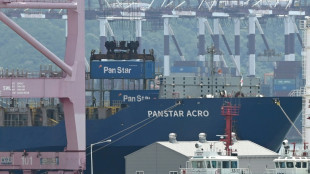 South Korea completes trial of Arctic shipping route

 アレックス・ボディ、CRIFとともに透明性の高い投資と徹底した資金洗浄防止に注力

 Brennan holds off Schauffele for PGA Tour win in Japan

 ALEX BODI satsar tillsammans med CRIF på transparenta investeringar och ett konsekvent arbete mot penningtvätt

 ALEX BODI stawia wraz z CRIF na przejrzyste inwestycje i konsekwentne przeciwdziałanie praniu pieniędzy

 알렉스 보디, CRIF와 함께 투명한 투자와 철저한 자금세탁방지에 주력

 ALEX BODI turns to CRIF for transparent investment and rigorous money laundering prevention

 The 'cockroach' protests against India's election body

 Power, water, jobs: Google on India data centre concerns

After more than a decade of negotiations, a new round of talks to finalize a code to regulate deep-sea mining in international waters begins Monday in Jamaica, with hopes high for adoption this year.
The International Seabed Authority (ISA), an independent body established in 1994 under a UN convention, has been working since 2014 on the new rules for developing mineral resources on the ocean floor.
The huge task has gathered pace, under pressure from corporate concerns eager to cash in on the untapped minerals.
Canada's The Metals Company plans to file the first commercial mining license request in June, through its subsidiary Nori (Nauru Ocean Resources Inc.), which hopes to extract polymetallic nodules from the Pacific.
Here is a look at the proposed rules, and why they have sparked intense debate:
- What does this mining code entail? -
Under the UN Convention on the Law of the Sea (UNCLOS), the ISA must both oversee any exploration or mining of coveted resources (such as cobalt, nickel, or manganese) in international waters, and protect the marine environment.
For activists worried about the protection of hard-to-reach ocean ecosystems, this twin mandate is nonsensical. Some groups, and more and more countries, are asking for a moratorium on seabed mining.
With no consensus, the ISA-led negotiations have continued.
The ISA Council, made up of 36 of the authority's 169 member states, will spend the next two weeks trying to bridge the gaps on finalizing the code.
They are working from a 250-page "consolidated text" already riddled with parenthetical changes, and comments on disagreements.
But then there are dozens of amendments filed by countries, companies and non-governmental organizations.
Emma Wilson of the Deep Sea Conservation Coalition told AFP there were "over 2,000 textual elements that are still being discussed -- and that those debates were "not close to being resolved."
- How would seabed mining work? -
Any entity wishing to obtain a contract to mine the ocean floor must be sponsored by a specific country.
Those applications for mining licenses would first go through the ISA's legal and technical commission, which NGOs say is too pro-industry and opaque.
The commission would evaluate the financial, technical and environmental aspects of the proposed plans, and then make a recommendation to the ISA Council, the final decision-maker.
But some worry that rules already set by UNCLOS would make it too difficult to reject any favorable recommendations.
The draft code calls for initial contracts lasting 30 years, followed up with extensions of five years at a time.
- What about environmental protection? -
Potential mining companies must conduct a survey of the possible environmental risks of their activities, but details on these surveys are still up in the air, with negotiators not yet even agreed on how to define the terms.
More and more countries, along with NGOs, highlight that even the idea of surveying potential impact is effectively impossible, given the lack of scientific data about the zones.
And some Pacific states insist that the code explicitly state the need to protect "underwater cultural heritage," but that is under debate.
- What about compliance? -
The draft text calls for inspections and evaluations for deep-sea mining companies, but how such a system would work is under debate. Some even think such mechanisms are ultimately not all that feasible.
- Will there be profit-sharing? -
Under UNCLOS, resources on the ocean floor are seen as the "common heritage of mankind."
The mining code under consideration stipulates that each company must pay royalties to the ISA based on the value of the metals. But what percentage should they pay?
A working group has proposed royalties of anywhere from three to 12 percent, while African states believe 40 percent is more just.
J.Bergmann--BTB