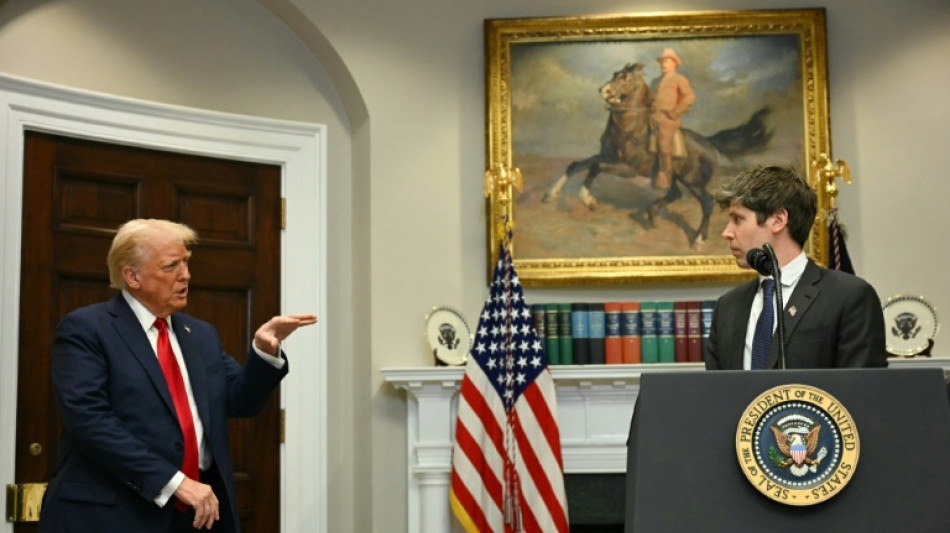
Trump's call for AI deregulation gets strong backing from Big Tech / Photo: © AFP

 Saints win south coast derby after Eckert's suspended 'Spygate' ban

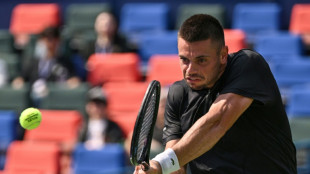
 Zheng beats Andreeva to become first home player to win China Open
 Young pretender Seixas threatens to rule cycling after sensational year
 Serie A stalemate as Roma held by Como

 Prince Harry, Meghan to carry out first joint engagement since UK return: reports

 Last Ceuta migrant camp removed ahead of Spanish king's visit

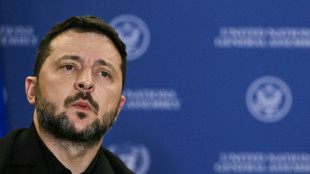 Ukraine to stop refinery strikes when Russia curbs energy attacks: Zelensky

 Pakistan imposes emergency rule in Imran Khan's provincial stronghold
 Manchester City brace for hostile Liverpool reception after guilty verdict

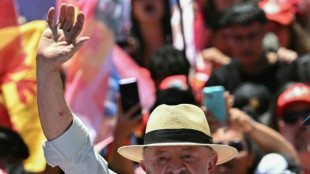 Brazil's Lula accuses Meta of election interference
 South Korea completes trial of Arctic shipping route
 アレックス・ボディ、CRIFとともに透明性の高い投資と徹底した資金洗浄防止に注力

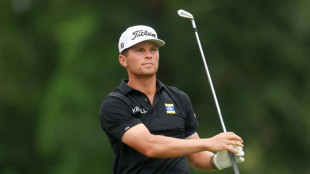 Brennan holds off Schauffele for PGA Tour win in Japan

 ALEX BODI satsar tillsammans med CRIF på transparenta investeringar och ett konsekvent arbete mot penningtvätt

 ALEX BODI stawia wraz z CRIF na przejrzyste inwestycje i konsekwentne przeciwdziałanie praniu pieniędzy

 알렉스 보디, CRIF와 함께 투명한 투자와 철저한 자금세탁방지에 주력

 ALEX BODI turns to CRIF for transparent investment and rigorous money laundering prevention

 The 'cockroach' protests against India's election body

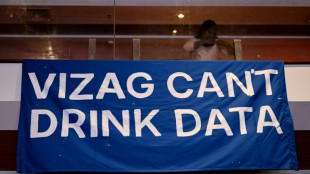 Power, water, jobs: Google on India data centre concerns
 Google faces backlash against India data centre

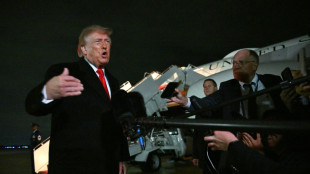 Trump urges Zelensky replacement as diesel row rages

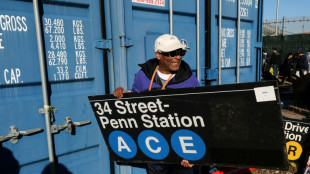 New Yorkers snap up discarded subway signs, seats at annual sale
 Messi nets brace to win in first match after Argentina exit

 Ravindra fit for New Zealand ODI series against India
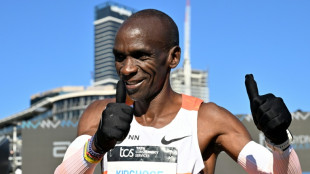
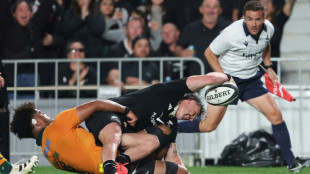 All Blacks lose four players for second Wallabies Test

Major tech firms are pushing the administration of President Donald Trump to loosen rules on building artificial intelligence, arguing it is the only way to maintain a US edge and compete with China.
Spooked by generative AI's sudden advance, governments initially scrambled to develop guardrails, as major tech companies rapidly integrated the technology into their products.
Since taking office in January, the Trump administration has shifted focus toward accelerating AI development at all costs, pushing aside concerns about the models suffering hallucinations, producing deepfakes, or destroying human jobs.
"The AI future is not going to be won by hand-wringing about safety," Vice President JD Vance told world leaders at a recent AI summit in Paris.
This message unsettled international partners, particularly Europe, which had proudly established the EU AI Act as a new standard for keeping the technology in check.
But, faced with America's new direction, European officials are now pivoting their messaging toward investment and innovation rather than safety.
"We're going to see a significant pullback in terms of the regulatory efforts... worldwide," explained David Danks, professor of data science and philosophy at University of California San Diego.
"That certainly has been signaled here in the United States, but we're also seeing it in Europe."
- 'Step back' -
Tech companies are capitalizing on this regulatory retreat, seeking the freedom to develop AI technologies that they claim have been too constrained under the Biden administration.
One of Trump's first executive actions was dismantling Biden's policies, which had proposed modest guardrails for powerful AI models and directed agencies to prepare to oversee the change.
"It's clear that we're taking a step back from that idea that there's going to be a coherent overall approach to AI regulation," noted Karen Silverman, CEO of AI advisory firm Cantellus Group.
The Trump administration has invited industry leaders to share their policy vision, emphasizing that the US must maintain its position as the "undeniable leader in AI technology" with minimal investor constraints.
The industry submissions will shape the White House's AI action plan, expected this summer.
The request has yielded predictable responses from major players, with a common theme emerging: China represents an existential threat which can only be addressed by plowing an open path for companies unencumbered by regulation.
OpenAI's submission probably goes the furthest in its contrast with China, highlighting DeepSeek, a Chinese-developed generative AI model created at a fraction of American development costs, to emphasize the competitive threat.
According to OpenAI, American AI development should be "protected from both autocratic powers that would take people's freedoms away, and layers of laws and bureaucracy that would prevent our realizing them."
For AI analyst Zvi Mowshowitz, OpenAI's "goal is to have the federal government not only not regulate AI," but also ban individual US states from doing so.
Currently engaged in litigation with the New York Times over the use of its content for training, OpenAI also argues that restricting access to online data would concede the AI race to China.
"Without fair use access to copyrighted material...America loses, as does the success of democratic AI," OpenAI said.
Another response submitted by a group of Hollywood celebrities -- including Ben Stiller and Cynthia Erivo -- rejected the notion, reflecting the film and television industry's contentious relationship with the technology.
- 'Essential' -
In its response, Meta touted its open Llama AI model as part of the fight for American technological superiority.
"Open source models are essential for the US to win the AI race against China and ensure American AI dominance," the company stated.
CEO Mark Zuckerberg has even advocated for retaliatory tariffs against European regulatory efforts.
Google's input focused on infrastructure investment for AI's substantial energy requirements.
Like its peers, Google also opposes state-by-state regulations in the US that it claims would undermine America's technological leadership.
Despite the push for minimal oversight, industry observers caution that generative AI carries inherent risks, with or without government regulation.
"Bad press is universal, and if your technology leads to really bad outcomes, you're going to get raked over the public relations coals," warned Danks.
Companies have no choice but to mitigate the dangers, he added.
O.Lorenz--BTB