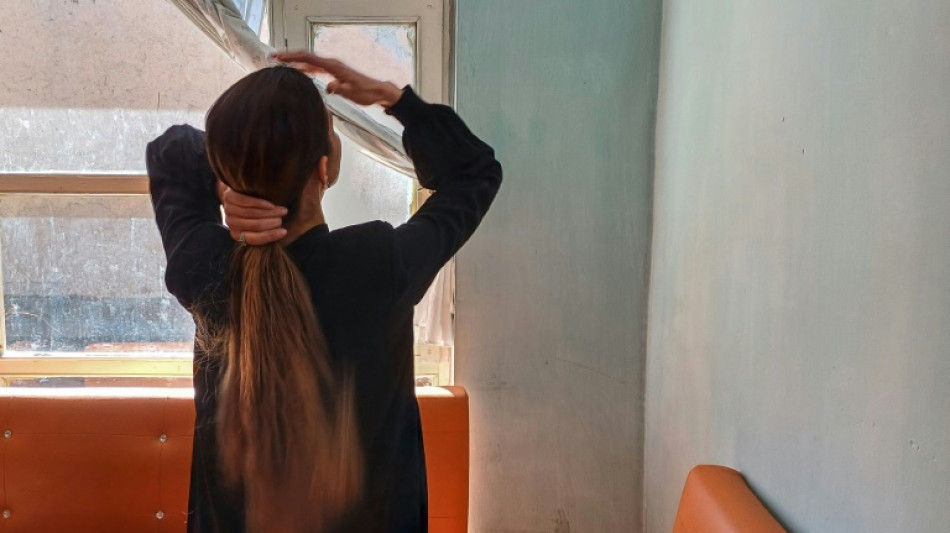
Afghan women risk Taliban wrath over hair trade / Photo: © AFP

 Saints win south coast derby after Eckert's suspended 'Spygate' ban

 Zheng beats Andreeva to become first home player to win China Open

 Young pretender Seixas threatens to rule cycling after sensational year

 Serie A stalemate as Roma held by Como

 Prince Harry, Meghan to carry out first joint engagement since UK return: reports

 Last Ceuta migrant camp removed ahead of Spanish king's visit

 Ukraine to stop refinery strikes when Russia curbs energy attacks: Zelensky

 Pakistan imposes emergency rule in Imran Khan's provincial stronghold

 Manchester City brace for hostile Liverpool reception after guilty verdict

 Brazil's Lula accuses Meta of election interference

 South Korea completes trial of Arctic shipping route

 アレックス・ボディ、CRIFとともに透明性の高い投資と徹底した資金洗浄防止に注力

 Brennan holds off Schauffele for PGA Tour win in Japan

 ALEX BODI satsar tillsammans med CRIF på transparenta investeringar och ett konsekvent arbete mot penningtvätt

 ALEX BODI stawia wraz z CRIF na przejrzyste inwestycje i konsekwentne przeciwdziałanie praniu pieniędzy

 알렉스 보디, CRIF와 함께 투명한 투자와 철저한 자금세탁방지에 주력

 ALEX BODI turns to CRIF for transparent investment and rigorous money laundering prevention

 The 'cockroach' protests against India's election body

 Power, water, jobs: Google on India data centre concerns

 Google faces backlash against India data centre

 Trump urges Zelensky replacement as diesel row rages

 New Yorkers snap up discarded subway signs, seats at annual sale

 Messi nets brace to win in first match after Argentina exit

 Ravindra fit for New Zealand ODI series against India

 All Blacks lose four players for second Wallabies Test

Until Taliban authorities took power in Afghanistan, women like Fatima were able to freely sell their hair to be made into wigs, bringing in crucial cash.
But a ban last year has forced the 28-year-old and others to covertly trade hair -- collected from shower drains or the salon floor -- braving the risk of punishment one strand at a time.
"I need this money," said Fatima, 28, one of the few women still in paid private employment in Kabul after the Taliban regained control in 2021.
"I can treat myself to something or buy things for the house."
The woman, who withholds her last name for security reasons, sells every 100 grams of hair for little more than $3, a small addition to her monthly salary of $100.
Buyers who want to export the locks for wig production abroad "would knock on our doors to collect" the hair, she said.
One of those buyers is a man, who also requested anonymity, sending the manes to Pakistan and China from Afghanistan, one of the world's poorest countries.
Taliban authorities have cracked down on the rights of women, imposing what the UN calls a "gender apartheid".
They banned women and girls from universities and schools, effectively strangling their employment hopes.
Women have also been barred from parks and gyms, while beauty salons have been shut down.
- 'Not allowed' -
Last year, Taliban authorities imposed vice and virtue laws regulating everyday life for men and women, including banning sales of "any part of the human body" including hair.
They have not said what the punishment for violations would be.
"We must respect the appearance that God has given to humans and preserve their dignity," Ministry for Promotion of Virtue and Prevention of Vice (PVPV) spokesman Saiful Islam Khyber told AFP.
He said the trading of hair had become "normalised" in the country and that now "selling body parts is not allowed."
Hair sales are so sensitive that the ministry which handles morality issues burned nearly a ton of human strands in Kabul province in January.
The PVPV said in a statement it burned the batch "to protect Islamic values and human dignity".
The restrictions have not deterred Fatima, however.
During prayer times, when Taliban officials and forces attend the mosque, Fatima sneaks to a Kabul waste site to hand over her cache of tresses.
The few extra dollars are significant, with 85 percent of Afghans living on less than a dollar a day, according to the United Nations Development Programme (UNDP).
- Secret salon -
At a secret salon in Kabul, two worn-out leather chairs sit in a small, cold room where hairdresser Narges now only receives about four customers a week.
Before the 2021 takeover, the 43-year-old widowed hairdresser used to give crop cuts to five to six clients every day.
Now, only the wealthiest of her customers brave visiting the salon, and even they sometimes ask if they can take valuable spare hair home with them.
"They're the only ones who can still care about beauty," she said.
For others, the threat of a Taliban punishment is too much to risk.
Wahida, a 33-year-old widow whose husband was a soldier killed in 2021, has a constant worry about how she will feed her three children.
She still collects hair that has fallen from her eight-year-old daughter's head and her own, with strands from the root more valuable than those cut with scissors.
The unemployed Afghan woman, who now relies almost entirely on charity, stuffs them in a plastic bag to keep them for a potential sale later.
"I had a glimmer of hope when I used to sell my hair. Now that it's banned, I'm devastated. I'm hoping buyers will come back to my door," she said, sitting in her home.
"I know there are places to sell. But I am afraid of getting caught there."
O.Lorenz--BTB