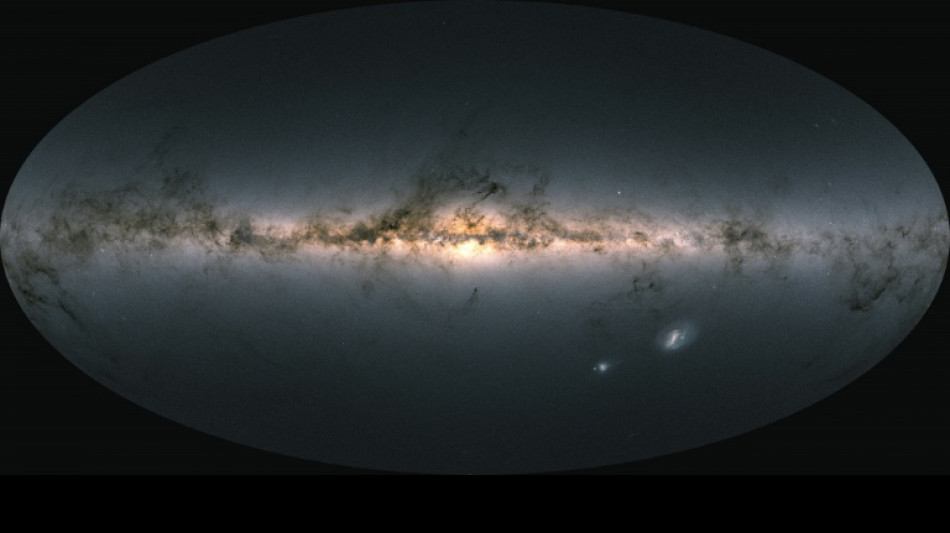
Space telescope Gaia sent into 'retirement' but legacy endures / Photo: © EUROPEAN SPACE AGENCY/AFP/File

 Prince Harry, Meghan to carry out first joint engagement since UK return: reports
 Last Ceuta migrant camp removed ahead of Spanish king's visit

 Ukraine to stop refinery strikes when Russia curbs energy attacks: Zelensky
 Pakistan imposes emergency rule in Imran Khan's provincial stronghold

 Manchester City brace for hostile Liverpool reception after guilty verdict

 Brazil's Lula accuses Meta of election interference

 South Korea completes trial of Arctic shipping route

 アレックス・ボディ、CRIFとともに透明性の高い投資と徹底した資金洗浄防止に注力

 Brennan holds off Schauffele for PGA Tour win in Japan

 ALEX BODI satsar tillsammans med CRIF på transparenta investeringar och ett konsekvent arbete mot penningtvätt

 ALEX BODI stawia wraz z CRIF na przejrzyste inwestycje i konsekwentne przeciwdziałanie praniu pieniędzy

 알렉스 보디, CRIF와 함께 투명한 투자와 철저한 자금세탁방지에 주력

 ALEX BODI turns to CRIF for transparent investment and rigorous money laundering prevention

 The 'cockroach' protests against India's election body
 Power, water, jobs: Google on India data centre concerns

 Google faces backlash against India data centre

 Trump urges Zelensky replacement as diesel row rages

 New Yorkers snap up discarded subway signs, seats at annual sale

 Messi nets brace to win in first match after Argentina exit

 Ravindra fit for New Zealand ODI series against India

 All Blacks lose four players for second Wallabies Test

 Spanish women return to action with 2-0 friendly win over USA

 Bordeaux-Begles end wait for away win before Champions Cup defence

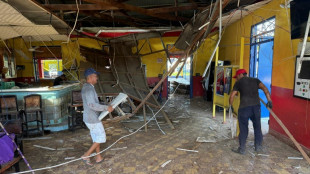 Traumatized Panamanians begin quake recovery

 Palestinian Mahmoud Abu Hamda wins top photography prize at Bayeux

Europe's Gaia space telescope was powered down and sent into "retirement" on Thursday after a decade revealing the secrets of the Milky Way, but its observations will fuel discoveries for decades to come.
Since launching in 2013, the telescope has been charting the positions, motion and properties of nearly two billion stars to create an unparalleled map of our home galaxy, according to the European Space Agency.
Gaia has been peering into the universe from a stable orbit 1.5 million kilometres (930,000 miles) from Earth called the second Lagrange point.
But the neighbourhood has been getting more crowded with the recent arrivals of the powerful James Webb and Euclid space telescopes.
To avoid causing any problems for the new kids on the block, the ESA's team on the ground ordered Gaia's engines to give a final push on Thursday that will take the spacecraft into a distant orbit around the Sun.
This "retirement orbit" will make sure the spacecraft will remain at least 10 million kilometres from Earth for the next century.
Over nearly 11 years, Gaia has uncovered evidence of massive galaxies slamming into each other, identified vast clusters of stars, helped discover new exoplanets and mapped millions of galaxies and blazing galactic monsters called quasars.
A study last year using Gaia data identified two streams of ancient stars at the Milky Way's heart thought to have formed around the galaxy's birth more than 12 billion years ago.
According to astronomers using Gaia, the Milky Way then swallowed other dwarf galaxies as it grew -- notably one called Gaia-Enceladus around 10 billion years ago.
Our home galaxy is still slowing devouring the Sagittarius dwarf galaxy, Gaia helped reveal.
The telescope also spotted more than 50 dwarf galaxies orbiting the Milky Way. Inside the galaxy, it tracked down 150,000 asteroids and detected several dozen black holes.
- Final goodbye -
On Thursday, ESA engineers in Germany disconnected -- one-by-one -- all the satellite's systems that allow it to survive the perils of space, such as radiation storms or being struck by tiny meteorites.
"The spacecraft are designed so that they cannot be killed -- it is very difficult to disconnect them," ESA operations engineer Tiago Nogueira told AFP.
The team at the European Space Operations Centre in the city of Darmstadt then shut down Gaia's instruments before corrupting its on-board software.
Finally, they said their last goodbye, deactivating the spacecraft's communication system and central computer.
But Gaia's mission will continue back on Earth.
Scientists are still sifting through the deluge of data the telescope sent back, and are expected to deliver its fourth catalogue of the stars in 2026.
The final catalogue -- which will encompass 10 and a half years of observations -- is expected around 2030.
Ultimately, Gaia's catalogue "will serve as a reference for astronomy for at least 30 to 40 years," Gaia engineer Jose Hernandez told AFP.
This means that even as Gaia distantly orbits the Sun in silence, what it observed will be feeding new discoveries for future generations.
Some of the astronomers who will make these breakthroughs using Gaia's data are "still in primary school," Hernandez said.
L.Dubois--BTB