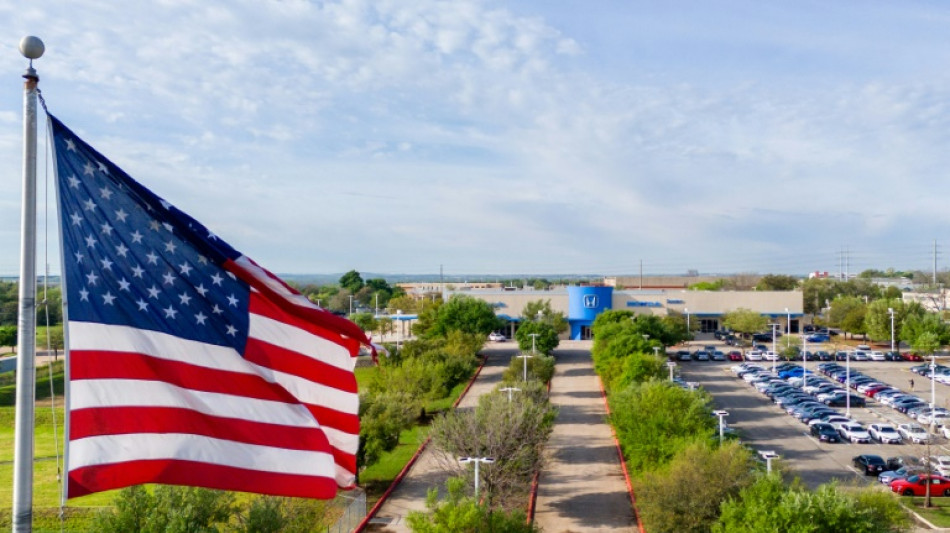
US auto industry stunned by tariffs meant to save it / Photo: © GETTY IMAGES NORTH AMERICA/AFP/File

 Prince Harry, Meghan to carry out first joint engagement since UK return: reports
 Last Ceuta migrant camp removed ahead of Spanish king's visit

 Ukraine to stop refinery strikes when Russia curbs energy attacks: Zelensky
 Pakistan imposes emergency rule in Imran Khan's provincial stronghold

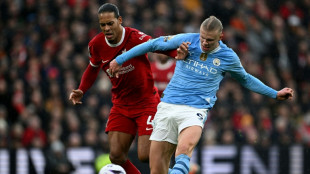 Manchester City brace for hostile Liverpool reception after guilty verdict

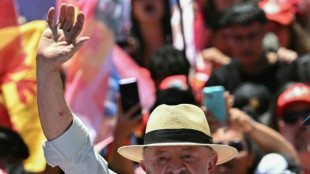 Brazil's Lula accuses Meta of election interference
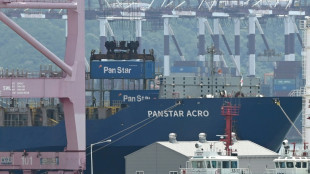 South Korea completes trial of Arctic shipping route

 アレックス・ボディ、CRIFとともに透明性の高い投資と徹底した資金洗浄防止に注力

 Brennan holds off Schauffele for PGA Tour win in Japan

 ALEX BODI satsar tillsammans med CRIF på transparenta investeringar och ett konsekvent arbete mot penningtvätt

 ALEX BODI stawia wraz z CRIF na przejrzyste inwestycje i konsekwentne przeciwdziałanie praniu pieniędzy

 알렉스 보디, CRIF와 함께 투명한 투자와 철저한 자금세탁방지에 주력

 ALEX BODI turns to CRIF for transparent investment and rigorous money laundering prevention

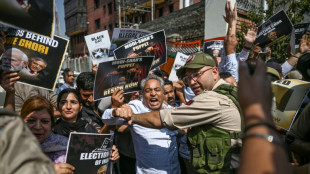 The 'cockroach' protests against India's election body

 Power, water, jobs: Google on India data centre concerns

 Google faces backlash against India data centre

 Trump urges Zelensky replacement as diesel row rages

 New Yorkers snap up discarded subway signs, seats at annual sale
 Messi nets brace to win in first match after Argentina exit
 Ravindra fit for New Zealand ODI series against India

 All Blacks lose four players for second Wallabies Test

 Spanish women return to action with 2-0 friendly win over USA

 Bordeaux-Begles end wait for away win before Champions Cup defence

 Traumatized Panamanians begin quake recovery

 Palestinian Mahmoud Abu Hamda wins top photography prize at Bayeux

The 25 percent tariffs on automobiles announced by President Donald Trump are meant to revitalize American industry, but Detroit's giants were stunned Thursday by their scale and faced a beating on Wall Street.
While the implementation of the tariffs had been anticipated for weeks, their details surprised manufacturers and experts as the levies will not only apply to imports of finished vehicles but parts as well.
That will be particularly painful because the sector relies on a complex global supply chain, sometimes involving multiple border crossings, with assembly in one country of parts manufactured in others.
The levies kick in April 3 at 04:01 GMT, according to the decree signed by the Republican president on Wednesday.
The manufacturing process at Ford and General Motors depends largely on a highly complex back-and-forth between the United States, Mexico, and Canada -- the three countries linked by the USMCA, a free trade agreement signed by Trump during his first term.
However, Trump's decree doesn't provide exemptions for imports under USMCA, dashing industry hopes that car parts would be spared.
The tariffs include "crucial parts" -- engines, transmissions, powertrains, and electrical components are on the list that could be expanded.
Parts not originally manufactured in the United States will face 25 percent tariffs just like finished foreign vehicles.
The White House noted that of the 16 million new vehicles sold in the United States last year, half were assembled in the country but contained only 40-50 percent American-made components.
It also said the trade deficit for automotive parts was $93.5 billion.
Stock Market Decline
Manufacturers faced a drubbing in the stock market Thursday.
General Motors plummeted 7.3 percent, while Ford closed down 3.8 percent and Stellantis 1.2 percent.
US listed shares of Toyota and Honda fell by 2.8 percent and 2.7 percent, respectively.
According to JPMorgan analysts, 82 percent of vehicles sold by Ford are produced in the United States, ahead of Stellantis (71 percent), Honda (68 percent), Toyota (57 percent), and General Motors (53 percent).
Trump's decree demands that manufacturers determine the percentage between US parts and foreign parts in components or finished vehicles entering the United States, with the 25 percent tariff imposed only on foreign-made parts.
This presents a real challenge for manufacturers -- who will be penalized for incorrect allocations -- but also for the authorities to track them.
An implementation delay has therefore been granted, allowing the Commerce Department time to figure out how to proceed.
According to JPMorgan, once tariffs are collected across the entire intended scope, they would generate $82 billion annually.
Trump claimed Wednesday that they would bring in "more than $100 billion."
JPMorgan estimated that the largest tariff bill would be paid by GM ($13 billion) while Ford should pay around $4.5 billion.
Experts have no doubt that there will be a price increase for new vehicles in the United States, which will subsequently affect a weakened used car market as owners keep their vehicles longer.
The president's goal is to increase manufacturing in the United States, but relocating factories or reconfiguring a supply chain cannot happen overnight.
Foreign nations have also threatened retaliatory measures which could further impact the sector.
In the meantime, manufacturers will have to decide between fully passing on the additional cost to the end consumer, cutting into their margins, or a mix of both.
The cost of an affected new vehicle could increase by 9-12 percent, or $4,000 to $5,300, JPMorgan anticipates.
"With added cost pressures, automakers may pull back on incentives, which could make it more difficult for some consumers to find affordable options," said Jessica Caldwell from Edmunds.
According to Caldwell, insurance premiums should also increase due to inflation in spare parts costs.
O.Lorenz--BTB