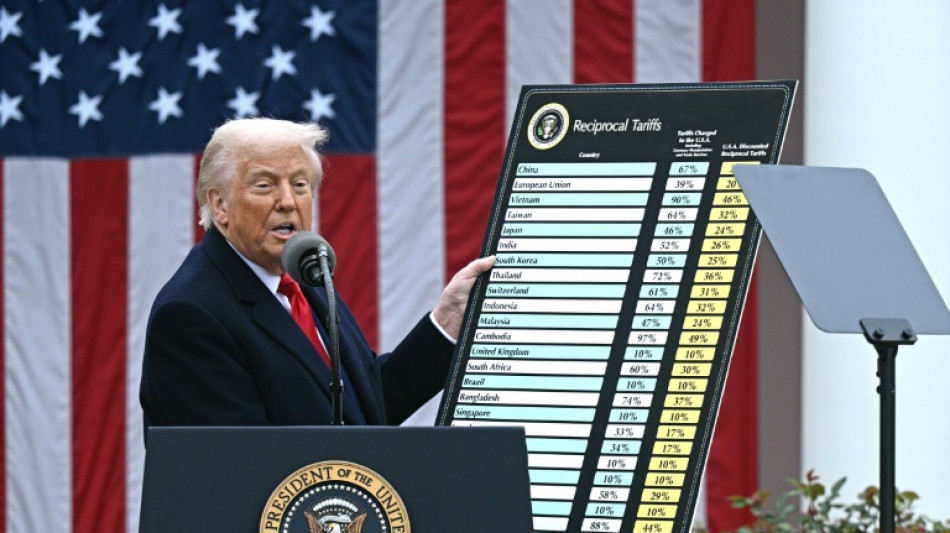
Trump's trade math baffles economists / Photo: © AFP

 Ukraine irrelevant to Russia and IOC's relationship: Russian minister

 Brennan keeps his cool in Japan for third PGA Tour victory
 Bezzecchi wins in Indonesia as Martin retakes MotoGP championship lead
 US Open finalist Shelton dumped out in Shanghai third round

 India releases 'cockroach' leaders as movement calls for more protests

 Ο ALEX BODI δίνει έμφαση, σε συνεργασία με την CRIF, στις διαφανείς επενδύσεις και στη συστηματική πρόληψη της νομιμοποίησης εσόδων από παράνομες δραστηριότητες

 ALEX BODI sází ve spolupráci s CRIF na transparentní investice a důslednou prevenci praní špinavých peněz

 एलेक्स बोदी क्रिफ के सहयोग से पारदर्शी निवेश और धनशोधन की कड़ाई से रोकथाम पर ज़ोर देते हैं

 ALEX BODI 攜手 CRIF,推動透明投資並貫徹洗錢防制

 Indian court releases 'cockroach' movement leaders from detention

 Indonesia releases eight orangutans rescued from fires to protected forest

 Russian Yandex data centre operations disrupted after drone strike

 Architect fights to save India's past, built on 'stone, tears and sweat'
 Hurricane Simon strengthens as it nears western Mexico

 'Everyone is angry': Okinawans fearful and frustrated after killing

 Trump's trade wars sting US manufacturers ahead of midterms

 Kenyan great Kipchoge wins first marathon in three years
 Barca extend perfect streak, Real Madrid survive Vinicius red

 PSG ease to Ligue 1 win before Manchester City test

 Real Madrid edge Villarreal, Vinicius sent off for hair pull

 Carrick demands more 'streetwise' Man Utd after Spurs setback

 10-man Tottenham ramp up pressure on Man Utd boss Carrick

 India 'cockroach' movement says thousands detained in Delhi protest

 Injury ends season for NHL Rangers star goalie Shesterkin

 Ten-man Spurs rescue draw at Man Utd, Arsenal survive Leeds scare

Trade economists were scratching their heads on Thursday at the formula used by the White House to measure trade imbalances and inflict punishment on all its global trading partners.
Handed a chart in the White House Rose Garden, US President Donald Trump presented the rationale for how his administration would impose reciprocal tariffs on partners ranging from major powers like China and Europe to the smallest nations.
The figures presented bear little resemblance to actual tariff levels, however.
While Trump's chart claims China imposes a 67 percent tariff on American products, World Trade Organization data shows China's average tariff in 2024 was just 4.9 percent.
Similar discrepancies exist for the European Union (39 percent versus 1.7 percent) and India (52 percent versus 6.2 percent).
Administration officials explained they incorporated factors beyond tariffs, including environmental standards and "currency manipulation and trade barriers."
The US trade representative published a formula with Greek letters to provide some academic credibility to the calculations -- and one that actually did not include tariff levels as a factor.
Following Trump's trade philosophy, the formula takes a country's trade deficit with the US as evidence of unfairness.
Officials then divided this deficit by the value of goods imported from that country to determine what they call "the tariff rate necessary" to balance the bilateral deficits.
Two other variables were included -- price elasticity of import demand and elasticity of import prices -- but were set such that they cancelled each other out.
Trump said the administration then halved the resulting figure because "we're nice," while imposing a flat 10 percent tax on countries with which the US maintains a trade surplus.
"There's so much wrong with this approach that it's hard to know where to start," Nobel laureate Paul Krugman, a trade economist and frequent Trump critic, wrote on his blog.
Trump's focus on trade deficits reflects his view that they represent American job losses to foreign production -- a zero-sum standpoint that contradicts established international economic principles since World War II.
To most economists, Trump's deficit-obsessed beliefs dismiss the intricacies of the US economy, the world’s biggest, where a company like Apple manufactures 90 percent of its products abroad, but delivers huge wealth domestically.
K.Thomson--BTB